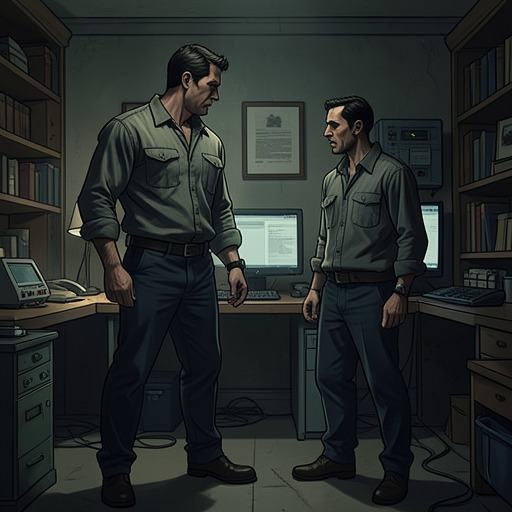
Drax frames McKendrick for Hannah's murder
The North WaterDrax frames McKendrick for Hannah's murder by turning an invented eyewitness account into evidence against a vulnerable shipmate. The episode is not simply a mistaken identification: Drax exploits McKendrick’s reputation and Captain Brownlee’s desire for a manageable suspect, while Patrick Sumner tests the accusation against physical evidence. The resulting conflict exposes how easily suspicion can harden into apparent certainty when the person accused is already discredited.
The accusation takes shape
After Cavendish insists that McKendrick is the murderer, Drax listens to the discussion and recognizes that the case lacks a witness who can place the carpenter with Hannah. He volunteers that he has seen the two together. When Sumner asks when, Drax initially offers an evasive explanation for why he had not mentioned it earlier. He then accompanies the others to Brownlee’s cabin, where the captain has McKendrick brought up in irons and orders Drax to repeat his account in front of him.
Drax’s testimony is specific enough to sound like an observed fact: he claims he saw McKendrick touching Hannah’s body and attempting to embrace him beside the deckhouse. The location and purported conduct give the accusation a concrete shape, but the specificity comes from Drax, not independent corroboration. In the earlier discussion, Drax himself judges McKendrick too timid to kill someone. The contrast between that assessment and his later testimony makes the accusation’s function plain: it supplies the witness the case needs, not a reliable explanation of the murder.
Reputation and convenient certainty
Cavendish has already treated McKendrick’s sexual reputation as proof of guilt. He says that men will testify to the carpenter’s alleged misconduct and argues that this is enough to establish his culpability. When Sumner points out the absence of convincing proof, Cavendish again substitutes reputation for evidence. His certainty rests not on a demonstrated connection to Hannah’s death but on the assumption that a stigmatized man is inherently suspect.
Brownlee does not simply accept every detail without question: he warns McKendrick that lying will bring severe consequences, and Sumner examines him for signs of a struggle. Yet Brownlee also has a practical reason to keep him in custody. He hopes Sumner is wrong because releasing McKendrick would leave the ship without an easy replacement suspect and bring further trouble. The inquiry therefore takes place under pressure to preserve an existing conclusion. McKendrick’s reputation makes him seem plausible to the officers, while the captain’s convenience makes that plausibility useful.
Sumner tests the story against the body
Sumner’s challenge turns on details that the accusation cannot explain away. He recalls the paired marks on Hannah’s neck and asks how McKendrick could have made them with his injured hand. McKendrick’s left thumb is damaged beyond repair. When Sumner sets the hand injury beside the pattern of the marks, McKendrick begins to recognize the force of the contradiction: if he lacks two functioning thumbs, the particular marks cannot have been made by him as alleged.
The evidence is not merely a question of whether McKendrick had an opportunity to approach Hannah. Sumner connects an observable physical limitation to the form of the injuries, making the distinction between a suspicious reputation and a viable account of the killing. He also points to the records in his sketchbook, whose diagrams preserve details of Hannah’s injuries. Brownlee dismisses those drawings as inconclusive and gives greater weight to the claim that McKendrick was seen with Hannah and to the carpenter’s reputation. Sumner answers that the damaged thumb makes it physically impossible for McKendrick to have committed the crime in the manner indicated by the marks.
Institutional resistance and later meaning
Brownlee maintains his authority as captain and keeps McKendrick confined, leaving the question unresolved aboard ship despite Sumner’s argument. He proposes that Sumner can present his opinion to a magistrate after they return to England. Sumner warns that this delay may allow the actual killer to leave the ship and disappear. The disagreement is therefore consequential: the dispute concerns not only which explanation fits the evidence, but whether evidence will be acted upon in time.
Later, in the timber yard, Sumner describes a larger plot in which Cavendish sank the Volunteer and Drax and Sumner were the only men who might have known or guessed what happened. He says the intended sequence was for Drax to shoot him and for Stevens to shoot Drax, leaving matters apparently settled, but that the plan misfired. Baxter calls Sumner’s reasoning sharp while denying that it is correct, then stresses that two men lie dead and that Sumner killed one of them. This later exchange does not make Baxter’s denial a confession; it does show how the earlier framing belongs to a wider pattern of calculated deception and managed appearances. In the case against McKendrick, Drax’s false testimony supplies an appearance of certainty, while Sumner’s attention to the damaged thumb reveals how fragile that certainty is.