Flesh and soul
The North WaterFlesh and soul is a recurring philosophical tension in Patrick Sumner’s story: whether consciousness and moral meaning transcend the body, or arise within the vulnerable, material life that ends in pain and death. Sumner’s memories of dissection and war make the body seem brutally legible but spiritually empty; Otto’s faith in an immortal essence offers a contrary vision. Their exchanges do not settle the dispute. Instead, the experience of nearly drowning, the persistence of memory, and the limits of speech keep the question attached to bodily life rather than resolving it as doctrine.
The body as matter
Sumner’s reflections begin with the dissection hall in Belfast, where he watched Slattery cut into a cadaver and joke that he had not yet found its immortal soul or reasoning faculties. The remembered scene turns an abstract question into a physical procedure: the body is opened, its organs handled, and its contents exposed, but no visible spirit appears. Sumner recalls jars of sectioned brains floating without thought or desire. To him, flesh seems redundant and helpless, while the leap from bone to spirit remains impossible to explain. The memory gives his skepticism a concrete basis: it is not simply an argument against belief, but a vision of material remains that seem to contain no trace of the person who once thought and wanted.
Yet this outlook does not make the body or the material world meaningless to Sumner. Walking through Hull after taking opium, he finds ordinary sights and sounds charged with sudden force: damp bricks glow in moonlight, boots strike stone, voices and cartwheels mingle with gulls. He values this temporary beauty, describing the world’s sensory clamor as unusually vivid. The contrast matters. A body may appear, under dissection, to be only meat; embodied perception can also make the world intensely present. The scene leaves spiritual transcendence unproved while showing how sensation itself can give material existence an extraordinary, if temporary, richness.
Memory under threat
The physical stakes of the question sharpen during the voyage north. Feverish and weak in his cabin, Sumner sleeps and wakes beneath bear hides and blankets while the Volunteer moves through fog and drizzle, its hull sheathed in ice. His opiated mind drifts through dreamlike scenes, but repeatedly returns to the overwhelmed field hospital he knew in the past. There he worked through the morning, probing, sawing, and suturing among mangled bodies, blood, heat, flies, and the cries of the wounded and dying. He had told himself that duty required him to keep working, because labor was all that remained possible. The remembered scene joins the body’s vulnerability to the practical demands imposed on those who must treat it: neither spiritual explanation nor abstract reflection stops the work of injury and care.
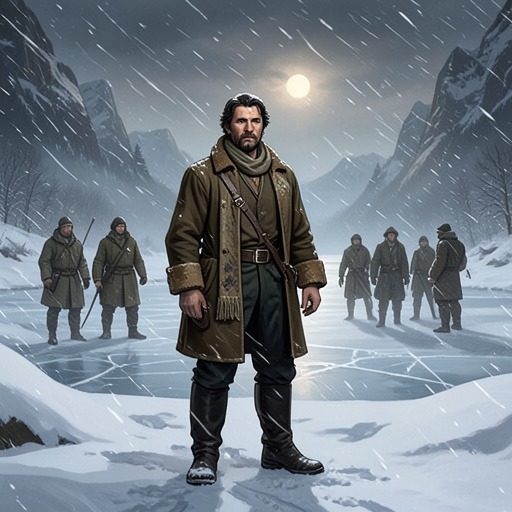
After Sumner has been missing on the ice for several hours, Otto interprets the episode through spiritual belief. He suggests that Sumner’s soul may have left his body for a higher realm, where the dead gather before the saved and damned are separated. Sumner cannot recall such a journey. His memory of the experience is instead pain and fear followed by a dark, unpleasant nullity. Otto imagines that Sumner might have encountered his dead parents; Sumner shakes his head rather than claiming a vision or reunion. The discrepancy is decisive: Otto supplies an account of transcendence, but Sumner’s own experience offers no confirming memory.
Otto’s spiritual account
Otto’s faith is not presented as a casual comfort detached from argument. He tells Sumner that the dead would appear as they had in life, except that their bodies would be made of light rather than flesh. In his account, light is their immortal essence, and the fall of the flesh allows truth to shine through. The formulation preserves bodily likeness while transforming bodily substance: the dead remain recognizable, but what they are made of changes. Sumner challenges the premise by asking how a body could be made from light, pressing Otto to explain the relation between an image and a material reality.
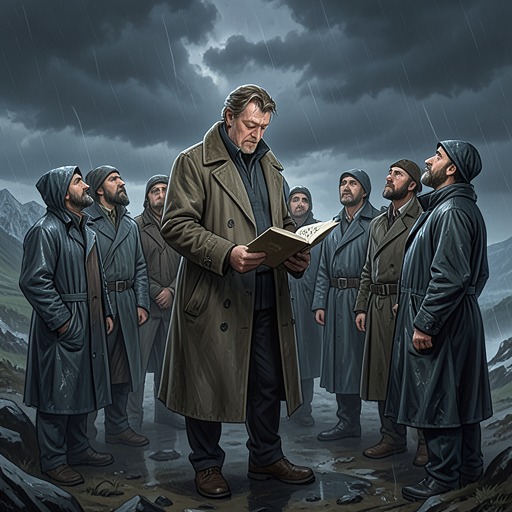
Otto answers that the visible world is not the whole truth. Dreams and visions, he argues, are as real as matter, and thought must come from God. Sumner offers a more worldly account: thoughts come from experience, from what people have heard, seen, read, and been told. Otto rejects this as a theory that would leave life stagnant, condemned to face backward. Their disagreement is therefore also about whether human consciousness can make something genuinely new. For Otto, spiritual origins make growth possible; for Sumner, the contents of thought remain connected to lived experience. When Sumner looks toward the ice and open water, the debate is set against a landscape whose immensity does not itself decide between their explanations.
Survival, change, and the limits of words
Sumner’s own body after the ordeal seems to him nearly erased and remade. Once conscious again, he spent a week in his bunk, barely moving or speaking. He describes himself as like a diagram or sketch that could be rubbed away and begun again, while pain and emptiness seemed to mold and stretch his soul. The image carries an apparent possibility of transformation, but he refuses to treat survival as proof of spiritual renewal. He tells Otto that he did not die in the water and that, if he had died, he would be new somehow; instead, he feels nothing new about himself. Bodily suffering has altered the terms of the question without giving him the rebirth he imagines death might have brought.
The dispute reaches beyond metaphysics into ethics and language. Sumner offers the propositions that sin is remembering and good is the absence of evil. Otto counters that such beliefs would make the world chaotic, and locates confusion instead in human vanity and misunderstanding. When Sumner asks why a child would be killed, Otto says that the most important questions cannot be answered with words, which he likens to toys that adults ought to put aside. Sumner resists: words are all people have, and abandoning them would make them no better than beasts. Otto’s response is that Sumner must find explanations on his own.
This exchange leaves flesh and soul unresolved in a productive way. Otto interprets suffering through an order beyond the visible body; Sumner distrusts a promised afterlife he cannot remember and insists on the human need to speak about what cannot be made intelligible. But his skepticism is not a simple dismissal of experience, just as Otto’s belief is not a demonstrated fact. The body supplies the evidence each man handles differently: for Sumner, dissection, injury, and survival resist claims of spiritual renewal; for Otto, the limits of visible matter leave room for an immortal essence. Their conflict makes the question of the soul inseparable from memory, pain, moral bewilderment, and the effort to give those experiences words.