Freedom, Nothingness, and Action
The North WaterFreedom, Nothingness, and Action emerge as competing ways Patrick Sumner tries to understand his condition: he briefly welcomes freedom as release from past defeats, doubts its meaning when it seems indistinguishable from mere existence, and turns back toward action and survival. The passage makes these ideas unstable rather than presenting them as a settled doctrine; Sumner’s changing judgments are bound to his body and to the immediate effects of drink and a drug.
Freedom as an Unsettled Condition
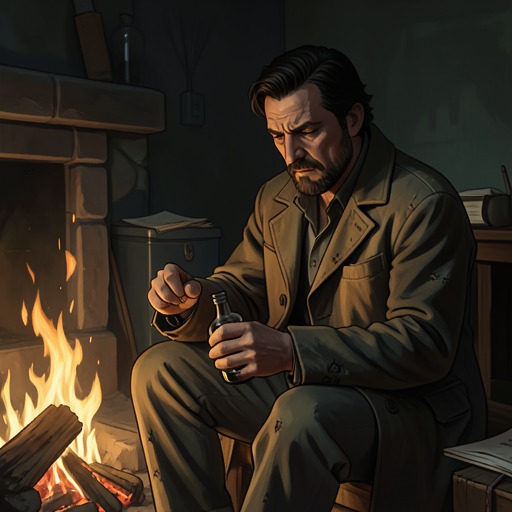
In a tavern side room, Sumner considers the accumulation of loss and disappointment that has brought him there: betrayal, humiliation, poverty, disgrace, the deaths of his parents from typhus and of William Harper from drink, and chances and plans that came to nothing. Yet he remains alive, warm, and breathing. From that fact he briefly reasons that having nothing left may mean being free to become anything. The passage therefore makes freedom feel less like a secured achievement than a possible interpretation of having been stripped of former prospects.
That relief does not last. Sumner recognizes that the freedom he has imagined may be only the condition of a vagrant or a beast, without meaningful distinction between himself and the wooden table or empty glass before him. The comparison drains freedom of its reassuring force: if it names mere absence of constraint, it cannot by itself establish what a person is free for. The thought turns from liberation toward nothingness, leaving Sumner uncertain whether his state is possibility or emptiness.
Words Against Events
Sumner’s reasoning repeatedly tests whether language can hold the experiences it names. He considers words such as freedom too fragile to withstand scrutiny, and concludes that abstractions dissolve into vapor and fog. Against them he returns to the conviction that only actions and events count, a thought he recognizes as recurring in his mind. The insistence is not a confident philosophical resolution: it arises as he catches himself trying to think his way out of lived difficulty.
The passage sharpens this contrast by having Sumner warn himself that life cannot be puzzled out or talked into submission. It must instead be lived through and survived as best a person can manage. Action here means neither a grand project nor proof of a stable identity; it is the practical alternative to allowing abstract words to substitute for experience. His outlook remains conflicted, since the idea itself is articulated through the very thinking he distrusts.
The Body's Counterargument
The scene makes Sumner’s philosophical shifts inseparable from physical circumstance. He has mixed the contents of a chemist’s bottle into rum and waits for the drug to take effect. As he feels relief and then renewed ease, he attributes the change to the body—to blood and chemistry—rather than to the mind. His account of freedom and action is thus presented alongside an altered bodily state, not as detached speculation.
That change also modifies his view of other people. In the warmth of the drug’s effect, he judges Brownlee and Jacob Baxter to be dutiful men who believe in action, consequence, capture, and reward. The judgment follows a bodily swing toward feeling better about himself and the world; it does not settle the earlier doubts about freedom or establish that their outlook is correct. By ending with Sumner raising his empty glass to call the landlord, the scene returns from philosophical uncertainty to a small, concrete action.