Hastings disappears and sinks
The North WaterThe disappearance and presumed sinking of the Hastings turns a dangerous night on the Arctic ice into a crisis of isolation for the whaling party. After a storm and a moving iceberg disrupt the floe, the ship vanishes; a search later finds a capsized whaleboat and scattered wreckage, but no people. The loss of the vessel and its crew leaves the survivors without their anticipated rescue and with wintering in the north as a possible alternative.
Background and Circumstances
The Hastings is part of a whaling enterprise already shaped by commercial pressure and environmental risk. Before the loss, the ships have sailed north through poor weather, hunted seals, and continued into waters where ice conditions could constrain their movements. The industry itself is becoming harder to sustain: Arthur Brownlee recalls that earlier voyages could return with large quantities of whalebone, whereas modern whaling requires costly steam power, specialized weapons, and luck, and may still yield little. These pressures form the commercial setting for a voyage in which both the animals and the ice are consequential forces.
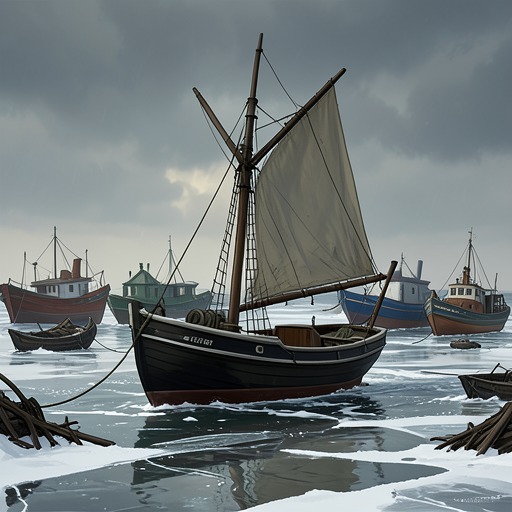
By the time the crew is waiting near Pond’s Bay, the season and position make outside assistance uncertain. The ships have been delayed by foul weather and unusually dense sea ice. Brownlee is eager to proceed, while captains from several vessels pass the time together as they wait for conditions to change. The Hastings is therefore not merely a nearby ship: it is a potential source of support within a fleet operating in a difficult, increasingly remote environment.
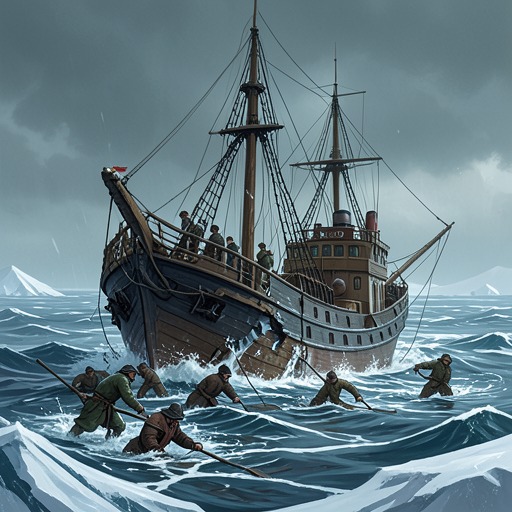
The danger becomes immediate when the wind changes and the drift ice begins moving toward the men. Cavendish orders an ice dock cut to protect the ship. The men use saws and coordinated teams to divide the thick floe into sections, but the surrounding pack continues to press forward. The practical work of cutting a refuge buys no certainty. During the storm, an iceberg grinds against the floe, the ice jolts, and a tent catches fire after a stove overturns. The men endure the immediate emergency, but the event leaves their camp and the nearby ships exposed to the same shifting ice.
The Hastings Disappears
By morning, the storm has abated. The party examines what remains of the burned tent, salvages usable items, and repacks the whaleboats. They raise the one surviving tent and wait for Black, Jones-the-whale, and the others to return from the Hastings. When fog lifts, Cavendish looks east through a telescope for the returning party and its boats. Instead, the view is empty. Otto then reports that the Hastings is gone.
Cavendish initially offers a reassuring explanation: the ship may have ventured into the pack during the storm to avoid the bergs and should return once it finds the floe edge. He urges patience and argues that Campbell knows where the stranded men are. Patrick Sumner questions the account, asking why a ship would leave its moorings in a storm rather than remain where it was. Otto answers that a captain might have to move to save a ship from an approaching iceberg. The exchange leaves the disappearance unresolved: the men have neither seen the Hastings sink nor established where it went.
The uncertainty is sharpened by the scale of the danger. Patrick Sumner recognizes that the missing ship may have been sunk, although Cavendish rejects that conclusion and insists it is still somewhere in the sound. Otto proposes a search by whaleboat, reasoning that the strong wind could have carried the Hastings far east or left it damaged and unable to steer. Cavendish agrees to go out, but his confidence that they will find it soon is not supported by any sighting. The missing vessel becomes both a physical absence and a dispute over what the survivors can reasonably infer from the storm.
Wreckage and Consequences
The next afternoon, the search produces material evidence rather than a rescue. The men find a capsized whaleboat, followed by a broken trail of empty blubber casks and shattered timbers extending for about half a mile. They move slowly through the area, collecting pieces, examining them, and then dropping them back into the water. No one from the Hastings appears. Cavendish, previously inclined to joke and reassure the men, is now silent and visibly affected by the catastrophe.
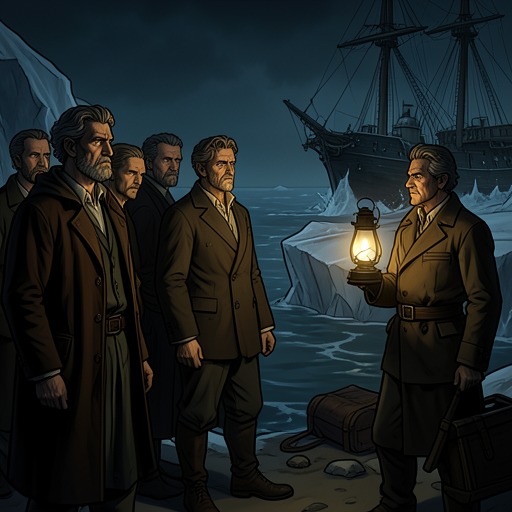
The wreckage changes the survivors’ assessment of their situation. Patrick Sumner concludes that their best hope of rescue is gone. Some of the men weep; others pray. Otto consults the charts and takes a sextant reading, identifying that they are past Cape Hay and can reach Pond’s Bay before night. He proposes that another ship may be found there. Cavendish acknowledges the remaining possibility that they will have to winter in the region, a prospect he presents as something that has been done before rather than as a secure plan.
The evidence supports the conclusion that the Hastings was destroyed and that its crew perished, but the scene does not show the ship’s final moments or establish exactly how it was lost. The storm and iceberg provide an immediate context for its disappearance, and the wreckage confirms that a serious maritime disaster has occurred; the survivors’ understanding remains an inference made in the absence of bodies or a direct account. That gap matters: the ship’s disappearance first invites hope that it has simply moved out of sight, then forces the men to reckon with the likelihood that it will never return.
Narrative Significance
The episode converts the Arctic setting from a hazard that can be managed through labor into a force that can erase a ship and sever a rescue plan. The ice dock, the boats, the telescope, the charts, and the sextant are practical tools, but none can restore contact with the Hastings. The men’s methods shift accordingly: they move from waiting and explanation to searching, then from search to navigation toward a possible refuge.
The disaster also exposes the limits of command under extreme conditions. Cavendish first attempts to control the meaning of the disappearance by treating it as temporary, while Otto’s cautious proposal and Sumner’s question keep the possibility of loss in view. Once wreckage is found, reassurance gives way to practical decisions about where to go and whether wintering is unavoidable. The Hastings’s presumed sinking is therefore not only a maritime loss; it is the turning point that removes the party’s expected support and makes its survival depend on what can still be reached.