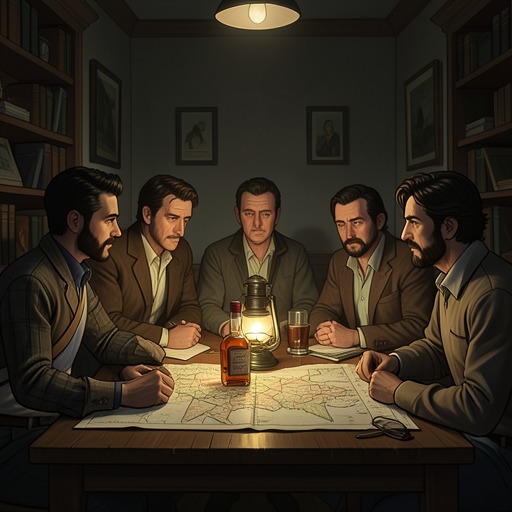
Joseph Hannah's murder and concealment in a ballast cask
The North WaterJoseph Hannah’s murder and concealment in a ballast cask expose the danger of a shipboard community that recognizes signs of harm but fails to protect the person at its center. Before Hannah is found dead, Patrick Sumner reports that his examination revealed he had been assaulted. The boy does not identify anyone responsible, and the captain accepts that silence as a reason to take no further action. His eventual discovery in a barrel transforms an unresolved report into a murder investigation aboard the Volunteer.
Background and Warning
The circumstances leading to the murder are established during the ship’s sealing voyage. After days of difficult weather north from Lerwick, the crew reaches the seal pack and begins hunting. Henry Drax works alone across the ice, killing seals while the other men gather the skins. The voyage is organized around labor and expected returns: Arthur Brownlee counts the skins, estimates their value, and presses the hunt forward as competition from other whaling ships closes in. In this setting, Hannah’s vulnerability is noticed but does not become the crew’s priority.
When Sumner tells Brownlee that an examination of Hannah disclosed an assault, Brownlee briefly stiffens and asks how it occurred. Hannah gives no account. Later, when the captain asks him directly who was responsible, he remains silent. His silence leaves the circumstances unclear, but it does not erase Sumner’s concern: Sumner insists that Hannah has been grievously assaulted and that the responsible man is aboard the ship.
Brownlee nevertheless treats the absence of an accusation as a limit on what can be done. He says that if Hannah will not identify an attacker and maintains that no assault occurred, the matter cannot be pursued further. Sumner proposes seeking witnesses, but Cavendish responds with a snort. The exchange ends without an inquiry that establishes what happened or safeguards Hannah. The captain’s authority, the surgeon’s warning, and the boy’s inability or unwillingness to speak do not combine into protection; instead, the case is left unresolved.
Discovery and Examination
The unresolved concern becomes a murder investigation when a cooper, examining a damaged ballast cask, finds Hannah’s body inside. The discovery links the ship’s ordinary work and storage spaces to the crime: the barrel had held ballast water, and the body had remained concealed there until the cooper looked inside. Hannah is carried to the mess cabin and laid on a table for Sumner to examine, while the assembled crew watches in silence. Sumner recognizes that his medical training cannot undo what has happened; in this moment he can only inspect the evidence and establish what it shows.
The examination identifies strangulation, and Sumner records further signs of severe violence, including fractures and missing teeth. These findings make clear that Hannah’s death was not an unexplained disappearance or an accident, but a killing preceded by assault. Brownlee responds with anger and promises that the guilty man will be taken to England in chains and hanged. His declaration marks a sharp change from the earlier decision to let the matter drop, but it comes only after Hannah has been found dead; the crew’s attention now turns to identifying the killer and accounting for how the crime went unnoticed.
Responsibility and the Limits of Proof
Sumner can place his last sighting of Hannah on the day before the first flensing, but that detail does not establish when or where the boy was killed. The interval matters: Hannah had first come to the officers’ attention as a possible victim, then remained unaccounted for until his body was found. The examination supplies evidence of violence, but not the identity of the person responsible. At the mess-cabin table, Cavendish looks away and whispers to Drax; the narration gives no content for the exchange, so it registers as an unanswered gesture rather than proof of either man’s involvement.
Brownlee’s response is shaped by more than the crime itself. He regards a child’s murder as unprecedented aboard a whaling ship and fears the damage it will do to his final voyage and reputation. Inwardly, he assigns responsibility to Baxter, whose choice of crew and larger scheme, he believes, set the disaster in motion; this is Brownlee’s judgment, not evidence identifying Hannah’s killer. The gap between what the captain suspects, what the medical examination establishes, and what the crew can prove leaves the investigation under pressure from competing forms of responsibility: personal guilt, command, and the legal promise of punishment.
Neglected Warning and Retrospective Meaning
After Joseph Hannah and his companions fail to come to Sumner’s cabin as requested, Sumner considers looking for them in the forecastle but decides the matter can wait until morning. His concern is already curdling into impatience: he privately regards the boy as a hopeless case and entertains explanations that diminish the force of what he had observed. He then returns to The Iliad and reaches for the key to the medicine chest. This hesitation does not establish what happened to Hannah or who was responsible, but it complicates the image of Sumner as the lone advocate who had done all that could be done. He recognizes signs of harm, yet does not pursue the boy when an opportunity to follow up presents itself.
In retrospect, the murder’s concealment in a ballast cask gives physical form to the distance between noticing danger and acting on it. The warning had entered the ship’s official conversation, but Hannah remained without an identified protector; only the discovery of his body makes the crew’s neglected concern impossible to set aside. The event’s significance lies not in a proven account of every step leading to his death—the evidence presented here does not supply one—but in the stark reversal from an unresolved report to a public demand for punishment. Brownlee’s promise comes after the loss, when the ship must confront both the killing and the failure to notice it in time.