Joseph Hannah's tooth
The North WaterJoseph Hannah's tooth turns a disputed murder investigation into a confrontation with physical evidence. A child's tooth broken at the root is found embedded in Henry Drax's arm; its presence connects Drax to a case in which suspicion has been directed at Samuel McKendrick. The tooth does not, by itself, narrate how it came to be there, but its discovery sharply challenges the account Drax has helped establish and gives Patrick Sumner a concrete basis for accusing him.
Identity and Physical Appearance
The object is identified first by its appearance and then by its connection to the dead boy. During treatment of Drax, Sumner dislodges a small object from a wound. He recognizes it immediately as a child's tooth, pale and broken at the root, and shows it to Arthur Brownlee. Later, Sumner refers to it explicitly as Joseph Hannah's tooth and identifies the arm in which it had been embedded as Drax's right arm. These details make the tooth more than an unidentified fragment: it is a specific object recovered from Drax's body and associated by the investigators with Hannah.
The discovery is consequential partly because of the object's scale. The tooth is small, but it cannot be dismissed as an abstract suspicion or as an argument about character. It has a physical location, a recognizable form, and a direct connection to the inquiry's central victim. Sumner's recognition turns a minor object emerging during medical care into evidence that demands an explanation from Drax.
Discovery and Drax's Response
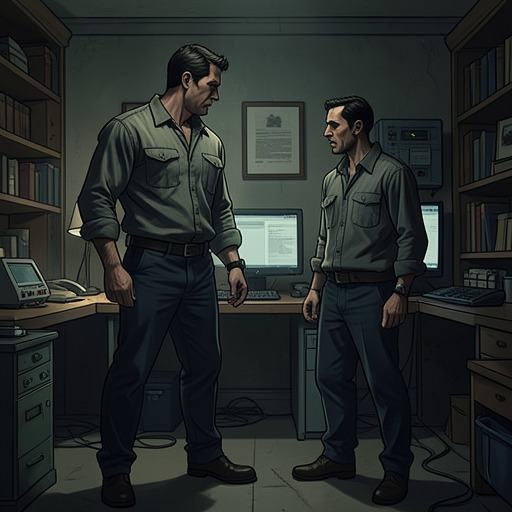
Drax reacts as soon as Sumner displays the tooth. He pulls his arm away and denies that the tooth is his, even after Sumner points out that it was found in his arm. Brownlee is present as the exchange unfolds; he moves to the cabin door to call for the first mate while the three men watch one another carefully. The scene changes the balance between them: until then, the object has been concealed within Drax's body, but once recovered and recognized it becomes visible to the men investigating Hannah's death.
Drax's denial does not explain the tooth's presence. In a later exchange, Sumner again asks about the right arm and identifies it as the one in which Hannah's tooth had been embedded. Drax dismisses the question, describing the wound as minor and himself as a quick healer, but still says that he cannot explain how the tooth got there. The recurrence matters: the tooth is not only a sudden revelation in one cabin scene; it remains a fact that Sumner can return to and that Drax cannot account for.
Evidence and the Accusation Against McKendrick
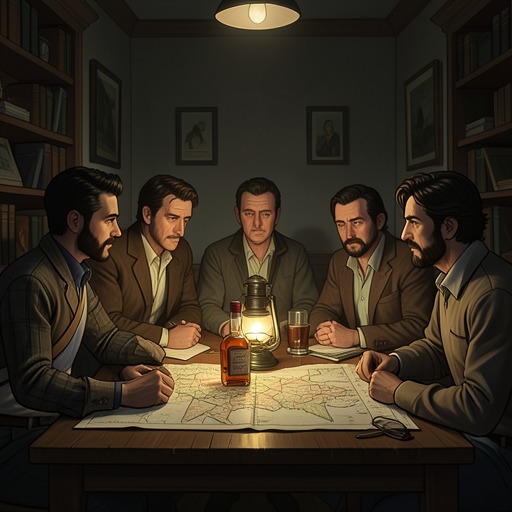
The tooth emerges against a background of accusation already shaped by prejudice and uneven credibility. Cavendish presents McKendrick as a plausible suspect by invoking his reputation and alleging that he had been seen behaving improperly toward Hannah's body. Brownlee has McKendrick brought up in irons and is reluctant to release him, in part because he sees him as a convincing culprit and has no easy substitute suspect. Drax reinforces the case by reporting that he saw McKendrick with the dead boy, a statement Brownlee has him repeat in front of the prisoner.
Sumner challenges that accusation with physical findings. He points to the pattern of marks on Hannah's neck and to the damage to McKendrick's left thumb, arguing that McKendrick could not have committed the crime. Brownlee remains unconvinced and treats the case against the carpenter as stronger than Sumner's interpretation. In this setting, the tooth changes the evidentiary problem: suspicion can no longer rest only on who seems plausible or whose account is accepted. An object associated with Hannah has been recovered from Drax himself, the man whose testimony helped direct the inquiry toward McKendrick.
Investigative and Narrative Significance
Sumner identifies the tooth as evidence sufficient to see Drax hanged. That declaration states its immediate force within the confrontation, not a confirmed legal outcome: the available account does not establish a trial or sentence. What the scene does establish is a reversal in the investigation. McKendrick's guilt has been treated as convenient and increasingly settled, while the tooth supplies a material fact that turns attention toward Drax and makes his denial part of the case against him.
The object's narrative function is therefore both evidentiary and structural. The investigation has depended on contested testimony, reputations, and Brownlee's judgment about which suspect can occupy the role of culprit. The tooth interrupts that arrangement. Its significance does not depend on Drax confessing; indeed, he denies ownership and later claims he cannot explain its presence. Instead, the object makes the gap between his statements and the physical circumstances impossible to ignore. A small recovered object becomes the hinge between a persuasive accusation against McKendrick and the exposure of Drax as the person the investigation must confront.