Money, Profit, and the Commodification of Life
The North WaterMoney, Profit, and the Commodification of Life is a governing theme in the novel, linking the decline of whaling to the conversion of animals, ships, labor, and human survival into assets. Its force lies in the contrast between the older violence of harvesting whales and the newer financial schemes that treat a shipwreck as a source of profit. The change in business does not end exploitation; it rearranges what can be valued, who bears the risk, and whose life is treated as expendable.
Industry, Energy, and Declining Resources
When Arthur Brownlee insists that he is a whaling man, Baxter accepts his identity but sets it against a changed economy. Thirty years earlier, Baxter recalls, a boat and harpoon could make a fortune; now successful hunting requires expensive steam power, harpoon guns, and luck, while a ship may return without a catch. He describes their earlier years as highly profitable, but insists that petroleum and coal gas have displaced whale oil. Brownlee rejects petroleum as a passing fashion and holds to the possibility of filling the ship’s hold. Their disagreement is more than a personal dispute: Brownlee’s pride in a trade and its skills confronts Baxter’s assessment of markets and investment.
The novel gives that economic change a material and ecological dimension. The crew sail north from Lerwick through difficult weather, prepare for sealing, and load their boats with skins. Brownlee estimates the value of the catch in oil and market prices; the seals are both living animals and units in a commercial calculation. Later, Brownlee expects more whales in the North Water, while acknowledging that whales have moved farther north from waters where they were once plentiful. Their movement toward more dangerous ice makes the chase riskier for ships and crews. The industry’s response is not to abandon the hunt, but to imagine more powerful steamships capable of pursuing whales farther into perilous waters. Technological progress thus promises access to dwindling resources while extending the danger imposed on workers and animals.
Insurance and the Financial Plot
The economic argument becomes a conspiracy when Baxter shows Brownlee papers setting out twelve thousand pounds divided three ways. He urges Brownlee to keep that sum in mind, contrasting it with what the ship could earn from killing whales. His explanation that money finds its own routes casts financial pressure as something difficult to control, but the papers make the pressure concrete: the parties are considering a return far beyond ordinary whaling proceeds.
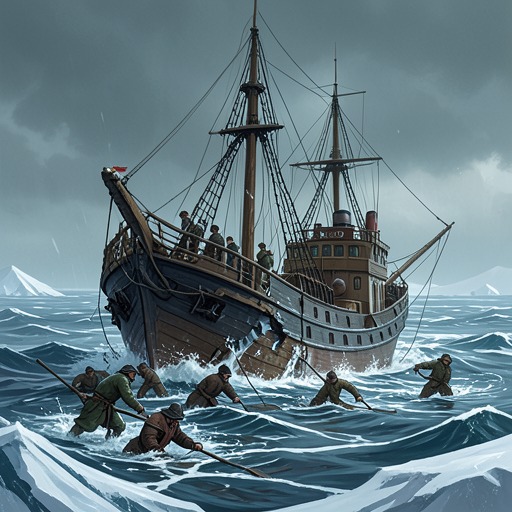
The arrangement depends on the Volunteer being lost in a way that appears credible. After the sealing success and during the passage north, the crew’s optimism and Brownlee’s hopes of catching whales coexist with a plan involving the Hastings and Campbell. The ships are not to meet or communicate until the moment is judged right, in part because the Volunteer is disproportionately insured and underwriters may suspect conspiracy. Campbell later warns Brownlee that the whales are secondary to finding a suitable opportunity to sink the ship without drawing suspicion. The ice and the timing matter not only as hazards of navigation but as elements that could make an intentional loss appear natural.
Cavendish’s later remark that the Volunteer could be sunk at another time, though that would look less convincing after the crew have built an ice dock, exposes the scheme’s dependence on appearances. The intended financial gain requires a plausible account of disaster. When Patrick Sumner confronts Baxter afterward, he proposes that Cavendish sank the Volunteer and that a sequence of deaths was meant to leave the remaining knowledge contained. Baxter denies Sumner’s account, then turns the conversation toward the two dead men and Sumner’s own responsibility for one of them. The exchange shows how financial plotting and control of the story of a loss can converge: the scheme misfires, but responsibility remains something to argue over and exploit.
Animals, Cargo, and the Price of Life
The novel repeatedly places animal life beside market value. After a polar bear is killed, Henry Drax identifies a possible buyer for its cub and estimates its worth alive. Brownlee permits the cub to be kept in a cask, with a grille to be fitted, and says that any money it fetches will go to the dead oarsman’s family. The decision combines a stated provision for the bereaved with the capture and confinement of the cub as a saleable object. Compassion and commerce are not cleanly separated; the proposed compensation itself depends on assigning the animal a price.
Whaling makes the conversion still more systematic. After a whale is killed, Brownlee measures its length and estimates the oil and whalebone it will yield, calculating a market value close to nine hundred pounds if prices hold. The carcass is processed for blubber, baleen, jaws, tail, and fins; what remains is allowed to sink or be taken by sharks. The operation turns a large animal into distinct products and an anticipated sum. The crew’s extra ration of rum after the work also links commercial success to the immediate conditions of shipboard life: a profitable catch produces a small, tangible reward for those who have processed it.
Labor and Human Vulnerability
The same accounting logic governs work aboard ship, though people are not simply paid according to the value they create. After the first whales are processed, Patrick Sumner is assigned to carry heavy blocks of blubber from the foredeck and pitch them down to the men in the hold. The work is dirty, exhausting, and physically demanding; he slips and nearly falls into the hold before Otto saves him. Sumner experiences satisfaction in having completed the task, and sleeps without laudanum that night. His episode makes labor both bodily and economic: the ship’s valuable cargo moves through the exertion and risk of individual workers, including a surgeon who has been put to manual work.
The treatment of the dead also reveals how money is used to manage loss. Following the bear hunt, Brownlee connects the proposed sale of the cub to payment for the dead oarsman’s family. Earlier, Baxter presses Brownlee to remember the sum awaiting the conspirators rather than define their voyage by pride or by the fish. In both cases, human consequences are measured through monetary arrangements, although the scale and purpose differ. The text does not equate compensation with conspiracy; it shows instead how readily lives and losses enter calculations made by those in command.
Wages, Employment, and the Limits of Rescue
When Sumner returns to Hull, Baxter greets him as someone presumed drowned or frozen and offers food, lodging, and a possible introduction to a surgeon in London. He also acknowledges that the whaling trade is dying and that Hull offers little future for a man of Sumner’s abilities. The offer sounds like assistance, but it is framed through employability and the transfer of a worker to a more promising labor market. Sumner insists that he has come for his wages before leaving. Their exchange places a concrete claim to earned money beside Baxter’s broader promises of accommodation and work.
Across these episodes, money can provide wages, compensation, employment, and rewards, but it also helps authorize dangerous labor and conceal deliberate loss. The transition from whale oil to petroleum changes the trade’s prospects without removing the violence on which its profits depend. Animals become products, ships become insured risks, and people become workers, dependents, suspects, or liabilities. The theme’s central tension is that monetary value may sustain life in one circumstance while making another life or loss seem acceptable in the pursuit of gain.