Opium Dependence and Withdrawal
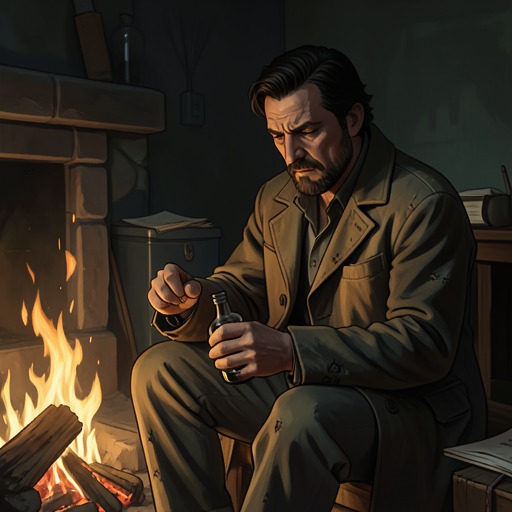
The North WaterOpium Dependence and Withdrawal is a persistent bodily condition in Patrick Sumner’s story, not merely a detail of his medical practice. Laudanum helps him sleep and recover, but when his supply is separated from him during the crisis on the ice, the loss becomes an ordeal in its own right. The narrative connects dependence to disrupted sleep, physical distress, impaired endurance, and Sumner’s urgent attention to the drug even amid other dangers. Its symptoms gradually lessen, but the later discovery that no laudanum remains makes clear that relief has not meant resolution.
Dependence Before the Supply Is Lost
Sumner’s reliance is evident before he is stranded without the medicine. Even with laudanum, he cannot sleep for more than an hour or two at a time. His disturbed rest is also bound up with Joseph Hannah’s death: Sumner is troubled by the memory of Hannah’s body and by the image of McKendrick under arrest, and cannot settle into the certainty of McKendrick’s guilt that seems to comfort the others. The passage does not reduce his sleeplessness to withdrawal; it presents grief and unresolved suspicion alongside a dependence that the drug does not simply overcome.
Laudanum nevertheless serves a practical purpose in Sumner’s routine. After assisting with the strenuous work of cutting an ice dock, he feels weak and unwell, eats, takes a dose, and settles in his cabin. He falls asleep readily, though the collisions of the moving ice repeatedly wake him. The contrast is telling: the drug can ease his passage into sleep, but it cannot insulate him from the ship’s precarious surroundings or silence the sounds that recall artillery from his earlier life. His use is woven into ordinary efforts to rest and function, even as external danger keeps interrupting that rest.
Separation from the Medicine
The immediate withdrawal crisis begins when the crew is driven from the Volunteer and must take shelter on the ice. Sumner realizes that the medicine chest containing his opium has gone aboard the Hastings, apparently packed with his sea chest by mistake among the supplies carried by the first party. He recognizes that he failed to check his necessities and blames Jones-the-whale for not being more careful about the boat’s load. The loss is therefore not presented as a deliberate decision to stop taking the drug: it results from the disorder of evacuation and the separation of supplies from their owner.
At first Sumner tells himself that one night without opium will be manageable. That calculation depends on the storm ending quickly. As the men shelter in a tent, the weather worsens and the possibility of another night on the ice makes him anticipate becoming sick. He cannot sleep, and his thoughts turn toward the absent medicine even while the men face exposure and the loss of shelter. He tries to distract himself with memories of Belfast—drinking whiskey at Kennedy’s, rowing on the Lagan, and spending time in the dissecting rooms with Sweeney and Mulcaire—but achieves only a restless, incomplete doze. The remembered places and routines offer imagined distance from the present, not actual relief.
Withdrawal Amid the Camp’s Collapse
The danger around Sumner intensifies as the storm damages the camp. A moving iceberg strikes the floe, the tent catches fire, and the crew takes refuge in the remaining whaleboats. Packed inside without light, Sumner lies among the others, unable to sleep. He feels increasingly agitated by the unmet need for opium, while the men around him speak bitterly about the leadership and their desire to get home alive. His withdrawal is thus experienced within a collective emergency: the same night that deprives him of his usual medicine also deprives the crew of secure shelter and makes the uncertainty of their survival immediate.
The next day brings further hardship. Snow continues, and Sumner is unable to sleep despite his exhaustion; he also experiences aches and difficulty urinating. His distress is rendered as a cluster of bodily and mental disruptions rather than as an abstract diagnosis. The novel places those symptoms alongside the weather, poor provisions, and the crew’s uncertain prospects, without suggesting that dependence is the only cause of his weakness or that his suffering is separate from the conditions imposed on everyone else.
Partial Easing and Changed Attention
After the night when he sees the bear, Sumner’s symptoms gradually diminish. He still has headaches and night sweats, but nausea becomes less frequent and his digestion improves. The account gives no indication that he has regained access to opium; the change is instead described as a gradual reduction in symptoms over time. The bear encounter marks the point from which this improvement is noted, but the narrative does not establish that seeing the animal causes the symptoms to ease.
As Sumner becomes less dominated by his own physical condition, he can pay closer attention to the other men. He sees that the lack of shipboard work has left them pale and listless, and worries that inactivity will deepen their decline during the winter. He proposes dividing the crew into watches, with hunting and walking to keep them active. The men resist until Cavendish threatens to reduce their rations. Sumner’s concern for the camp’s bodily survival emerges as his own symptoms recede: the narrative moves from the demands of his private need toward his recognition of a shared need for movement and endurance. The improvement is relative, however. Weather soon prevents regular hunting and exercise, provisions remain scarce, and cold forces the men to burn their remaining fuel supplies.
Dependence Beyond the Ice Crisis
Sumner’s later search for medicine shows that laudanum remains a pressing concern after the immediate period of deprivation. When he examines a medicine chest, he empties it and turns it upside down to ensure that it contains nothing else. He asks for laudanum, repeats the demand, and is told by the priest that the last bottle has already been used. Sumner closes his eyes briefly, then resumes eating. The exchange is brief, but its sequence matters: he searches carefully, presses for a direct answer, and receives confirmation that there is no supply left.
Taken together, these episodes distinguish temporary improvement from freedom from dependence. Sumner’s symptoms lessen while he is stranded, yet he later seeks laudanum again and confronts its absence. The narrative does not supply a medical resolution or portray withdrawal as a single, neatly bounded episode. Instead, it follows the dependence through interrupted sleep, a mistaken separation from his medicine, symptoms endured amid Arctic exposure, and a renewed search for the drug. Laudanum remains both an aid to rest and a measure of how much Sumner’s body can demand from him, even when the dangers around him appear more urgent.