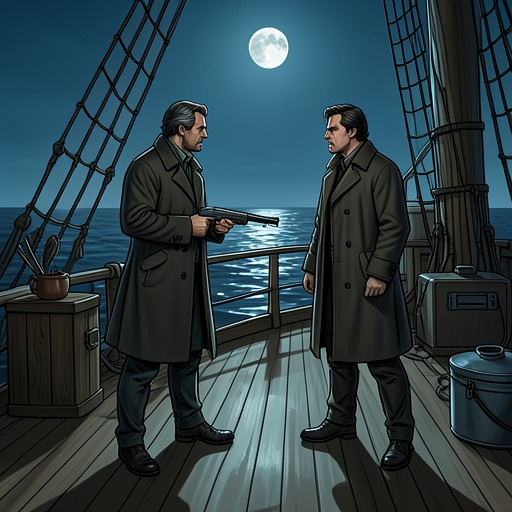
Patrick Sumner—Jacob Baxter
The North WaterPatrick Sumner and Jacob Baxter are joined by the commercial venture of the Volunteer, but their relationship turns on a deeper imbalance: Baxter treats people as instruments of business, while Sumner ultimately refuses to accept Baxter’s account of what happened or the bargain he offers. Baxter’s help with employment becomes inseparable from an attempt to arrange Sumner’s death, and their final meeting reverses the employer’s control without resolving the danger between them.
Employment and Commercial Context
Baxter’s connection to Sumner is established through the whaling enterprise and the wages Sumner claims after returning alive. By the time they meet again, Sumner has survived the northern voyage and comes to Baxter for payment, not reconciliation. Baxter responds with forced-seeming hospitality, insisting that Sumner stay for a drink rather than leave at once. Beneath his genial manner, Sumner senses wariness at the sight of a man Baxter had assumed was lost.
Baxter also presents himself as a possible source of work. When Sumner says he needs employment and has a letter, Baxter reads the priest’s recommendation and offers to write to James Gregory, a surgeon in London. He proposes arranging a bed for Sumner at the Pilgrim’s Arms while they wait for a reply, and says London offers a better prospect than Hull. The offer is concrete, but it sits within a relationship already marked by Baxter’s power to direct Sumner’s movements and prospects.
That power belongs to a larger commercial order. In conversation with Arthur Brownlee, Baxter argues that the old profits of whaling have passed: the whales have been heavily depleted, petroleum and coal gas have displaced whale oil, and the industry requires costly machinery while promising uncertain returns. He frames money as a force that cannot be controlled by personal preference. The papers he brings to Brownlee set out a proposed division of twelve thousand pounds among three people, a sum he emphasizes is beyond what they could expect from whaling. This is evidence of Baxter’s willingness to redirect the venture toward a more profitable scheme, though it does not itself establish that Sumner knew of the arrangement.
The Plan Against Sumner
Baxter’s most consequential use of Sumner comes after he decides that Henry Drax has become too dangerous to keep in his plans. Baxter explains that Drax returned a month earlier and that he initially believed he could make use of him. Sumner’s letter from Lerwick then helped convince Baxter that he had bound himself to a threat he could not control. Baxter says he needed to lure Drax away and catch him by surprise, and chose Sumner as bait.
The instructions Baxter gives Stevens reveal how deliberately he stages the encounter. At midnight, Stevens is to summon Sumner from his room at the Pilgrim’s Arms with a false message about urgent news concerning the Volunteer. Because Sumner does not know the town or Baxter’s house, Stevens is to lead him toward the river and into the old timber yard. There, Drax is to shoot Sumner; Stevens is then to shoot Drax, place a revolver in Sumner’s hand, take valuables from both men, and disappear. Stevens offers to shoot Sumner himself, but Baxter insists that Drax must do it first. The plan depends on a manufactured appearance of events as well as on the deaths themselves.
Competing Accounts of the Plot
When Sumner challenges Baxter, he rejects the idea that he was merely a lure. He suspects that Baxter wanted him dead because he and Drax might have known or guessed that Cavendish had sunk the Volunteer. In Sumner’s reconstruction, Drax would kill him, Stevens would kill Drax, and the resulting scene would leave the suspected secret buried with its witnesses. The plan has misfired: Drax is dead, but Sumner is alive and has returned to confront the man behind the arrangement.
Baxter does not simply confirm Sumner’s accusation. He admits that using Sumner as bait was wrong and describes his purpose as removing Drax before Drax could destroy him and his interests. He portrays Drax as uncontrollable and says that force was necessary, while presenting his own decision as a hurried response to danger. His explanation acknowledges the trap but leaves a distinction between what he says he intended—Drax’s death—and Sumner’s belief that Sumner was also meant to die. That unresolved difference keeps the confrontation grounded in competing interests rather than turning Baxter’s account into a complete confession.
The Final Bargain and Reversal
Baxter tries to make the situation serve him once more. He points out that two men lie dead in the timber yard, one killed by Sumner, and warns that an inquiry into Sumner’s past in India could cause trouble for both of them. He offers fifty guineas and the chance to put the matter behind him, arguing that Sumner has done him a service by killing Drax. The offer turns a violent scheme into a proposed business settlement: Baxter would pay, and Sumner would leave without looking back.
Sumner does not accept the bargain as a final settlement. He asks for the rest of the money in Baxter’s safe, making clear that the offered payment is not enough. He then orders Baxter to fill a leather satchel, checks the safe, and restrains and gags him before directing him toward the stables. The shift is stark: Baxter, who had arranged for others to guide Sumner into a trap, is now compelled to guide Sumner himself. The supplied account ends during this reversal, with Sumner controlling the immediate encounter but the longer consequences still unstated.
Significance of the Relationship
Their conflict links personal betrayal to the business logic surrounding the Volunteer. Baxter’s talk of declining whale profits, the proposed division of a large sum, and his insistence that appearances matter in arranging the ship’s sinking all place commercial calculation beside physical danger. Sumner’s return disrupts the clean outcome Baxter sought: a supposedly dead witness reappears, understands the trap as more than an isolated attempt to eliminate Drax, and demands more than the payment offered to buy his silence.
The relationship therefore changes from dependence on Baxter’s employment and assistance into mutual exposure. Baxter can threaten Sumner with investigation and implicate him in the timber-yard deaths; Sumner can connect Baxter to the suspected destruction of the Volunteer and has already killed Drax. Neither man fully controls what the other can reveal. Their final exchange ends not in trust or settlement, but in a temporary reversal of power whose outcome remains open.