Seals hunted for their pelts
The North WaterSeals hunted for their pelts are the Volunteer’s first major Arctic quarry, and their capture turns the uncertain voyage into a brief, measurable commercial success. The hunt gives Arthur Brownlee a chance to test his crew and expand the catch, while exposing the labor and risks hidden behind his calculations of skins, oil, and market value.
Commercial Setting and Preparation
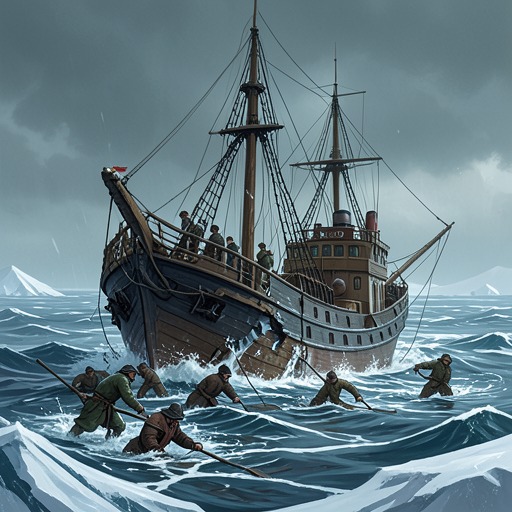
After sailing north from Lerwick through fog, sleet, and two gales, the crew reaches sea ice near Jan Mayen Island. They sight the main pack two days later, and at dawn the next day lower the boats. Before the hunt, the men receive rifles, gunpowder, and percussion caps; they mold bullets and sharpen knives. The sequence makes the work appear organized and purposeful, but the boats must operate across shifting ice, and each catch depends on finding and reaching groups of animals.
The first day produces a substantial load. Henry Drax works alone across the ice, killing and skinning animals while moving from group to group. The five whaleboats return laden with skins. Arthur Brownlee counts the haul and estimates that four hundred skins could yield nine tons of oil, with each ton potentially selling for about forty pounds. The arithmetic gives the hunt a value beyond its visible cargo: skins become an estimate of future oil and revenue, subject to market prices and luck.
The catch is also part of a contest. The pack is beginning to divide and scatter, and Dutch, Norwegian, Scottish, and English whaling ships are spread along the floe edge, competing for portions of the same resource. Brownlee believes the pack is unusually large and the ice still navigable. From the crow’s nest, he assesses where to hunt next and concludes that a larger catch is within reach. He decides to send out a sixth boat, extending the work beyond the original five.
The Sixth Boat
At four in the morning the boats are lowered again. Patrick Sumner is assigned to the sixth with Cavendish, the steward, the cabin boy, and several men regarded as persistent malingerers. In eighteen degrees of frost, they row southeast for half an hour before spotting a dark patch of animals. Cavendish leads the party across the ice; once within range, the men spread out and shoot. They kill three adults and six young, while the rest escape.
The group separates to continue the hunt. The cabin boy remains to skin the dead animals, while Patrick Sumner walks east. He shoots two more and attempts to prepare and tie their skins together. By noon he has killed six more and is about a mile from the boat, pulling roughly a hundred pounds of skins over loose ice. The rope and the distance make the catch a physical burden as well as a measure of success. Fatigued, he keeps moving toward the boat, thinking of the warmth of his cabin and the laudanum he takes each evening. The passage places the commercial output alongside the bodily cost of obtaining it: the skins must be carried back by the people who have hunted them.
Labor, Command, and Value
The hunt’s organization reflects Brownlee’s authority over both the target and the workforce. He signals the first group of men back, counts their skins, surveys the remaining pack, and then expands the operation by ordering a sixth boat out. His decisions are guided by estimates of tonnage and possible earnings, but also by the season’s changing conditions and the presence of competing ships. The animals are encountered as moving groups on ice; to the captain, they are also a cargo whose value depends on how many the crew can secure before the opportunity passes.
The labor is divided among killing, skinning, hauling, and returning the catch to the ship. Henry Drax performs the first day’s work alone, while on the sixth-boat hunt Cavendish directs the party and the cabin boy stays behind to process the dead animals. Patrick Sumner both hunts and prepares skins before carrying them back. These tasks are distinct, but dependent: a successful shot does not become a stored cargo until the animal has been processed and its skin brought aboard. Brownlee’s decision to put additional men into the field increases the potential return by also placing more of the crew in the cold and on the ice.
Narrative Significance
The hunt establishes an early pattern in which Arctic life is described through the tension between economic ambition and material limits. The crew’s first load encourages confidence, and Brownlee imagines a much larger catch, but the pack is already dispersing and other ships are taking part in the same competition. Success is real yet provisional: the figures are estimates, the market price is uncertain, and the available animals cannot simply be treated as an inexhaustible supply.
The seals also mark a transition in the voyage’s work. After this successful hunt, morale rises, and Brownlee reads the crew’s optimism as a sign that the season may go well. Later, as the Volunteer crosses into the North Water, the crew begins hunting whales instead. The contrast places the seal catch within a broader whaling economy already under pressure: Brownlee and Jacob Baxter discuss the declining prospects of traditional whaling and the replacement of whale oil by petroleum and coal gas. Against that background, the carefully counted skins are not merely an opening victory. They show how the ship tries to make a profitable season from available Arctic wildlife even as the industry and its markets are changing.