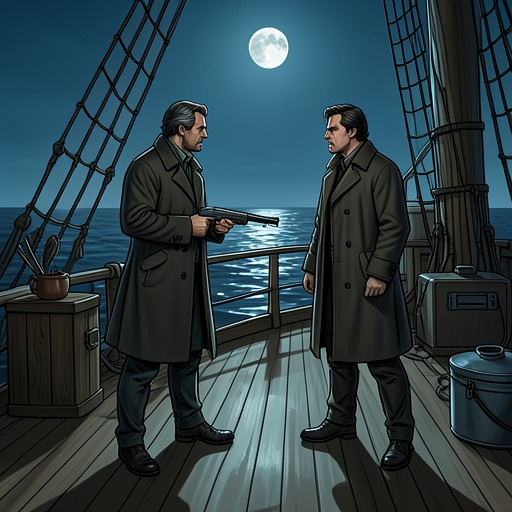
Shootout at the Hull timber yard
The North WaterThe Shootout at the Hull timber yard is the violent breakdown of Jacob Baxter’s plan to dispose of both Patrick Sumner and Henry Drax while making their deaths appear to be a mutual killing. Baxter arranges the meeting as a trap, but Drax fires at the wrong man: Stevens dies, Sumner survives, and ultimately kills Drax himself. The intended crime scene, designed to erase the planner from the story, instead becomes the site where Baxter’s scheme fails and Sumner escapes with Drax’s revolver.
Baxter’s Plan
Baxter sets the plot in motion after descending to the first-floor landing, where he summons Stevens from the hallway into the study and closes the door. Stevens has been reading the Hull and East Riding Intelligencer, his bowler on his knees. Baxter first checks that he has the revolver and bullets previously supplied to him, asks to inspect the weapon, and returns it. The exchange establishes that the killing is not an impulsive quarrel: Baxter is verifying the means before assigning Stevens a specific role.
At midnight, Stevens is to go to Sumner’s room at the Pilgrim’s Arms and claim that Baxter needs to see him urgently about important news concerning the Volunteer. Because Sumner does not know the town or Baxter’s house, Stevens can guide him towards the river, along Trippett and past the foundry, to the old timber yard. Baxter instructs him to get Sumner inside even if the explanation of a shortcut is not believed. Drax is to wait there and shoot Sumner; then Stevens is to shoot Drax. Baxter insists that he needs this order of events, although Stevens offers to shoot Sumner himself.
The planned aftermath is as deliberate as the invitation. Stevens is to put the revolver into Sumner’s hand, empty the pockets of both dead men, and leave. Baxter anticipates that a dock constable will hear the shots and find two bodies, each holding the weapon that killed the other. With no witnesses or other signs, he expects the police to treat the deaths as an unresolved mutual killing. He describes the result as freedom from Drax’s threats and demands. The scheme depends on a staged account of the deaths being more persuasive than the actual chain of responsibility.
The Trap Misfires
Drax waits at the yard with brandy and his own revolver. Before the meeting, he drops the bullets while opening the cylinder and loses one; he counts the remaining ammunition as sufficient to kill Sumner. His private intention is more direct than Baxter’s arrangement: he expects to shoot Sumner as soon as the men enter, without warning or conversation. This difference matters. Baxter’s plan requires Drax to perform one assigned killing and then become the second victim, while Drax treats the encounter as an opportunity to act on his own terms.
Clouds obscure the moon, and the yard’s shadows merge as Drax waits near the gate. On hearing voices, he stands, cocks the revolver, and aims at the two figures entering side by side. He fires at the man on the left. When he approaches the fallen figure with a light, he discovers that he has killed Stevens, not Sumner. The central reversal is an error of identification produced by the darkness, but it also destroys the carefully ordered sequence Baxter had prepared: the person meant to lure Sumner has become Drax’s unintended first victim.
Drax understands that Sumner must still be somewhere within the walled yard, since he has not gone back through the gate. He calls for the surgeon and briefly offers to lay down his weapon for a fight without guns, but receives no answer. He then takes up the revolver again and searches towards a cabin at the far end of the yard. Its half-open door and broken, shutterless windows make it a possible hiding place. Drax knows that the shot may have drawn attention and that delay could bring discovery, yet he still has not located Sumner.
Sumner’s Counterattack and Escape
Sumner is inside the cabin, holding a rusted saw blade and waiting. When Drax crosses the threshold, Sumner strikes him with it and kills him. The attack is sudden and unplanned in the sense that Sumner acts without pausing to deliberate; afterward, he is horrified by what he has done. He takes Drax’s revolver and hurries across the yard. The outcome reverses the intended roles in Baxter’s design: Drax, meant to kill Sumner and then be killed by Stevens, is killed by Sumner after mistakenly shooting Stevens.
Sumner leaves the yard and walks back towards town at a steady pace, without looking behind him. He enters a pub, orders a fourpenny ale and then another, and waits for his hands to stop trembling. He cannot manage to light his pipe and puts it away beside Drax’s revolver. The weapon is a concrete remnant of the failed plot: Sumner has it, rather than Stevens placing a revolver in his hand as Baxter had ordered. Sumner then asks the barman for a railway timetable, turning from the immediate danger in the yard towards a means of leaving town.
Consequences and Significance
The event exposes the vulnerability of Baxter’s plan to the very conditions it attempts to control. Its success requires each participant to follow a precise sequence: Stevens must bring Sumner to the yard, Drax must shoot the intended target, Stevens must kill Drax, and the scene must support a false account of reciprocal violence. In the darkness, Drax’s shot kills Stevens instead, and Sumner’s survival leaves no possibility of the planned second killing. Baxter’s instructions about the revolver, the position of the shot, and the removal of the men’s possessions cannot compensate for the failed identification at the gate.
The shootout also brings the three men’s differing purposes into collision. Baxter intends to escape Drax’s threats by arranging a crime that appears to resolve itself; Drax intends to kill Sumner without waiting on Baxter’s elaborate staging; and Sumner, cornered inside the cabin, acts to survive. The aftermath does not show Baxter’s intended disappearance of responsibility. Instead, Stevens and Drax are dead, Sumner has taken Drax’s gun, and Sumner is seeking a railway timetable. The yard’s planned fiction of two men killing each other is replaced by a chain of events Baxter could not direct.