Sled dogs
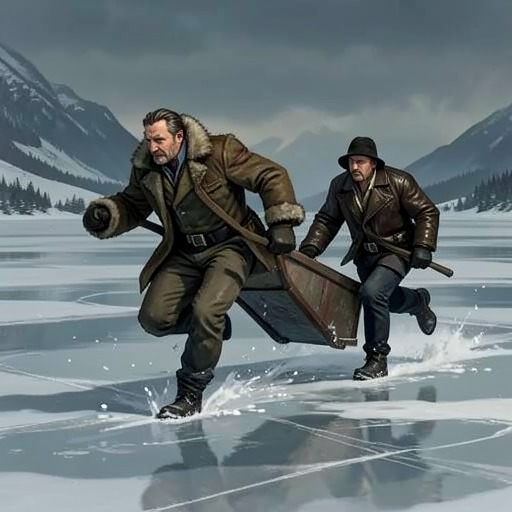
The North WaterSled dogs are the essential working animals of the Yaks in the Arctic scenes: they draw the sledge, accompany the hunters, and help them search the ice for seals. Their arrival first breaks the winter camp’s isolation through sound; later, their harnesses make Henry Drax’s escape possible. The dogs are not individually named or described at length, but their repeated presence makes them a practical measure of how survival depends on animal labor in the frozen landscape.
Arrival at the Winter Camp
The dogs announce the Yaks before the sledge can be seen. Their hectic barking reaches Patrick Sumner and the other men inside their tent, where Sumner initially takes the sound for a dream of dogs from home. As the camp wakes, two Yaks approach across the sea ice with their brindled dogs spread out in front of the sledge. The barking continues as the visitors arrive, making the animals the first unmistakable sign of contact with the outside world.
At the camp, the dogs form part of the Yaks’ working and trading party. The men have brought food on the sledge, and they negotiate with Cavendish for supplies, exchanging a frozen seal for knives and whale line. While the meat is prepared for the hungry sailors, the Yaks tether and feed their dogs outside. The scene places the animals within the same practical economy as the sledge and provisions: they are cared for, but their work is also indispensable to travel and hunting.
Work, Care, and Arctic Survival
The dogs’ work is most visible through the sledge, which carries the hunters and their equipment over the ice. The Yaks return to seal hunting after the first exchange, and their dogs remain part of the camp’s daily routine. At night, the men tether them to stakes made of whalebone driven into the gravel and feed them the remains of rancid walrus meat. This detail shows care in the conditions available, while also locating the dogs within a harsh system of subsistence in which food and fuel are tightly connected to successful hunting.
The text does not assign the dogs individual personalities or give them names. Instead, their presence is conveyed through coordinated labor and ordinary sounds: barking as the sledge approaches, the group’s movement with the hunters, and their care at the camp. That limited characterization keeps attention on the shared practical dependence between people and animals. The dogs make movement across the ice possible, while the hunters’ catches sustain both the human group and the animals that serve it.
Searching the Ice for Seals
On a later expedition, Sumner rides on the sledge with the Yaks along the coastline. When they stop, they unharness one dog and let it investigate the snow for a seal’s breathing hole. The dog circles and barks; Merok catches it by the mane and draws it away while Urgang approaches the opening with his spear. The episode gives the dog a specific part in the hunt: it searches a featureless stretch of ice for signs that a seal is below.
The dog does not make the kill, which depends on Urgang’s patience and skill with the spear and line. Its contribution is nevertheless integral to the sequence. The hunt begins with the dog’s search and alert behavior, then passes to the hunters’ actions once the breathing hole has been located. Afterward, the party returns across the ice with the large seal in tow. The dogs thus appear not as background decoration but as working participants in a method of hunting shaped by close observation and cooperation.
Drax’s Escape and the Dogs’ Narrative Role
The dogs’ practical value becomes consequential during Drax’s flight from the winter camp. After killing the two Yaks, he takes their deerskin traces, wakes the dogs one by one, and harnesses them. He also takes clothing and equipment from the snow house before returning outside to the sledge. The dogs’ established role as draft animals now serves an abrupt new purpose: Drax uses the same means of transport that had supported the hunters’ daily work to leave the camp.
This reversal connects the dogs’ ordinary labor to the novel’s larger pattern of human dependence on animals and Arctic resources. Their work enables the Yaks to travel and hunt, and their continued care is part of the camp’s routine; in Drax’s hands, their harnessing becomes part of a violent escape. The dogs are not presented as knowing participants in his decision. Rather, the narrative shows how a practical relationship with animals can be redirected by the actions of the people who control the sledge and its traces.
Across these scenes, Sled dogs are defined by their place in a working community: they signal the Yaks’ arrival, pull the sledge, help search for seals, and require food and tethering. Their recurring presence gives the Arctic setting a material structure, where movement and survival depend on more than human effort alone. The contrast between their routine service and their use in Drax’s escape gives that role its sharpest narrative consequence.