Sumner operates on the missionary's abdominal abscess
The North WaterSumner operates on the missionary's abdominal abscess in a remote cabin, where the priest's worsening illness leaves him little time and few medical resources. The operation brings Sumner's practical surgical knowledge into direct contact with the limits of what he can know or control: he intervenes decisively, yet expects the priest may not survive. The priest is alive the next morning, and a later letter confirms that Sumner's actions are regarded as having saved his life.
Diagnosis and Decision
The immediate crisis follows a night of escalating pain. Anna, who has been reading Saint Paul's letters to the Corinthians at the bedside, asks Sumner privately whether the priest is going to die. Sumner explains that an internal rupture has left the priest's abdomen filling with poison, but tells Anna plainly that he cannot save him by the means currently available. Her confidence that he will do so does not change his assessment. When she presses him for a reason behind the illness, he offers no consoling explanation; she returns to prayer while he remains focused on the condition itself.
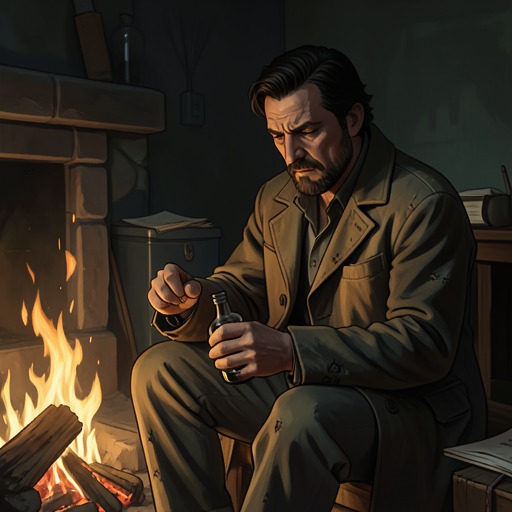
The priest then deteriorates further. He suffers violent shivering, becomes cold and clammy, and has a faint, irregular pulse. When he cannot keep down the brandy Anna offers, Sumner leaves the cabin briefly. The surrounding sea ice appears empty beneath visible stars at noon, and the stillness gives his momentary retreat the scale of an encounter with isolation and possible death. He goes back inside rather than allowing that pause to become an escape from the immediate task.
Sumner finds Anna applying another poultice and prepares to operate. He identifies the cecum as abscessed or possibly ulcerated, while acknowledging that the precise distinction will not alter what he must do. Opium, which might otherwise help, is unavailable. He concludes that an incision is the best remaining way to release the diseased matter. The decision is urgent but not presented as certainty: before proceeding, he briefly considers whether the condition might instead be a hernia or tumor, then rejects those alternatives on the basis of his examination and reasoning.
Preparation and Operation
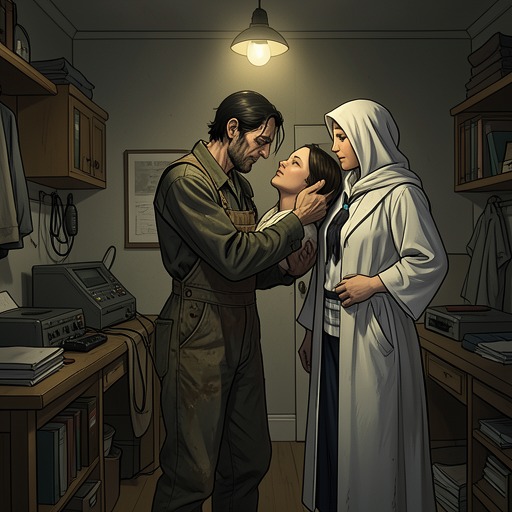
The cabin's limited equipment shapes the procedure. Sumner takes ether, lint, and a lancet from the medicine chest, sharpens the instrument, clears the table, and wipes it down. He examines the priest and explains the proposed incision. When the priest asks how Sumner knows what to do, Sumner identifies himself as a surgeon. The brief exchange makes professional skill, rather than religious reassurance, the basis on which the operation proceeds; even so, Sumner tells the priest that success will require considerable luck.
Sumner brings the priest's brother in from the igloo and assigns the two helpers specific tasks. He uses ether to render the priest unconscious. Anna is told to watch for signs that the priest is waking and to administer more ether if necessary; her brother is given a bucket and towel and told to remain alert beside Sumner. The division of labor turns a small group with no established surgical facility into a working team. Anna's prayer is interrupted when Sumner needs her attention to the practical demands of the operation.
After checking the abdomen again, Sumner makes the incision and works through the tissue to reach the abdominal cavity. A large amount of infected material drains from the opening. The unexpected quantity startles those present: Anna cries out, her brother drops the bucket, and Sumner briefly recoils before resuming the work. He tells the brother to clean the table and dispose of the soiled rags in the stove. Together, the three turn the priest onto his side to aid drainage; Anna reapplies the ether when he begins to stir, while Sumner presses around the incision and the brother clears away the discharge. They continue until the flow stops.
Immediate Aftermath and Survival
The priest is carried back to bed, covered, and given a dressing. Sumner washes his hands, opens the window, and gathers the medicines that may ease the priest's pain. He explains to Anna how and when to use them, then leaves the cabin to smoke. His assessment remains guarded: he doubts the priest will live more than a day and fears that damage to the gut could lead to further leakage and death. The operation has relieved the immediate pressure, but Sumner does not mistake that intervention for a cure or a guarantee.
By morning, however, the priest is still breathing and appears no worse than before. Sumner removes and replaces the dressing, inspects the wound, and attends to the seepage. The survival of the night is a limited but significant reversal of his expectation, not proof that the danger has passed. When the priest asks what Sumner found inside him, Sumner gives a restrained answer. His attention remains on the patient's condition rather than on claiming a successful outcome.
Consequences and Significance
The episode establishes the difference between Sumner's medical competence and his power over the outcome. He diagnoses the abscess, makes a reasoned decision under uncertainty, organizes the available help, and performs a difficult operation with improvised resources. At the same time, the unavailable opium, the severity of the illness, and the possibility of further internal damage leave survival beyond his control. His work is neither a miracle attributed to faith nor a triumph he can confidently claim; it is an intervention carried out under conditions in which skill and luck coexist.
The operation also recurs later as evidence of Sumner's past. When Baxter reads a letter stating that Sumner saved the missionary's life, Sumner acknowledges what he did but attributes much of the result to luck. That later reference confirms the consequence that the cabin scene could not yet establish. In retrospect, the operation stands as a concrete instance of Sumner's identity as a surgeon: he may be uncertain about the patient's future, but when faced with an urgent need, he assesses, prepares, and acts.