The Decline of the Nineteenth-Century Whaling Industry
The North WaterThe Decline of the Nineteenth-Century Whaling Industry is the economic and environmental pressure behind the voyage of the Volunteer: whaling still promises wealth, but the conditions that once made it attainable have changed. Through the competing judgments of Brownlee and Baxter, the work of the crew, and increasingly poor catches in the Arctic, the novel shows an industry pressing on even as its old expectations falter. The decline is not presented as a simple end to whaling. It appears instead as a widening gap between commercial ambition and what the sea, the technology, and the season will allow.
Changing Economics and Technology
Baxter describes the scale of change by contrasting the present with the remembered voyage of the Aurora in 1828. Thirty years earlier, he recalls, a boat and harpoon could be enough to make a fortune; the Aurora returned by June with whalebone piled high on its gunwales. He does not pretend that the earlier work was easy, but argues that it was possible on terms that no longer apply. A modern operation requires a two-hundred-horsepower steam engine, harpoon guns, and luck, and may still return without a catch. The comparison makes technological investment a condition of entry into a trade whose success has become less dependable, not a guarantee of profit.
Baxter's judgment is also tied to an immediate business scheme. He presents Brownlee with papers and stresses that twelve thousand pounds divided three ways would exceed what Brownlee could expect to earn from killing Whales. Brownlee does not readily accept that conclusion: he insists that he will fill the hold and maintains his identity as a whaling man. Baxter, by contrast, says the trade is finished and wants to settle up and buy a modest manufactory. His claim that money finds another route when one is blocked gives the industry's decline a practical force: capital can abandon whaling even while the men, ships, and risks remain at sea.
Catch, Labor, and Commercial Promise
The voyage nevertheless begins with evidence that extraction can still pay. Sailing north from Lerwick, the Volunteer passes through fog, sleet, and gales before reaching sea ice near Jan Mayen Island. The crew prepares rifles and knives, then lowers its boats when the main seal pack appears. Drax works methodically across the ice, killing and skinning Seals hunted for their pelts; the five boats return laden with skins. Brownlee estimates that four hundred skins will yield nine tons of oil, worth about forty pounds per ton if the market holds. The catch encourages him to press on, though other Dutch, Norwegian, Scottish, and English ships are competing along the same floe edge. A strong season remains imaginable, but its returns depend on the size and location of the pack, the market, and competition.
The first whale caught in the North Water deepens that promise. Black strikes it, and Otto's boat closes in to harpoon it again before the other boats join the attack. Once the animal is secured alongside, Brownlee estimates a yield of ten tons of oil and at least half a ton of whalebone, worth close to nine hundred pounds at market if prices hold. The crew spends four hours flensing it; the carcass is stripped, the blubber stowed, and the deck cleaned. Brownlee rewards the sailors with an extra ration of rum. The episode displays the trade as a coordinated production process, from the harpooners' work at sea to the cutting, hauling, and storage that turn a kill into cargo.
The labor does not stop with the specialist crews. After two more Whales are killed and flensed the following day, Sumner is assigned a pick haak and leather apron. He carries blocks of blubber, each weighing at least twenty pounds, from the foredeck and pitches them down to the men storing them below. The work is dirty and physically demanding; he slips repeatedly and is saved from falling into the hold by Otto. Its consequence is both bodily exhaustion and an unusual satisfaction in completing a task through physical effort. For the ship, this labor is part of converting a catch into a commercial product; for Sumner, it briefly provides a kind of restorative work apart from his medical role.
Scarcity, Season, and Risk
The early catch does not settle the question of the industry's future. After the Volunteer reaches Pond’s Bay, sightings are scarce. On the few occasions when boats are lowered, the Whales disappear beneath the ice before the crew can strike them. Brownlee wonders whether Baxter may be right and whether too many Whales have been killed, though he resists believing that such a vast ocean could be emptied quickly. He also considers another possibility: if the animals remain, they may be learning to evade the hunters. The novel leaves his uncertainty intact, placing commercial disappointment beside a possible ecological explanation without treating either as proven.
Seasonal conditions compound the problem. Bad weather and fog halt fishing, and unusually dense ice delays the fleet at the entrance to Pond’s Bay. When the season advances, Black and Otto argue that most Whales have moved farther south and that continuing north increases the danger of becoming trapped in the ice. Cavendish disregards their advice and takes the Volunteer north with the Hastings. They see Whales but fail to catch them. Later, amid a season in which the fleet is not filling its ships, Cavendish complains that any crew with the ability to fish would still be out at sea. His insistence converts the economic pressure into a test of competence and resolve, even as the voyage grows more dangerous.
Industry and the Insurance Scheme
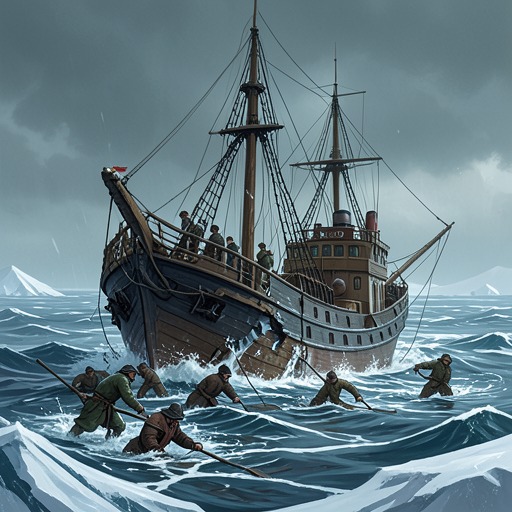
The declining returns also make the Volunteer's commercial purpose inseparable from the plan to sink her. Campbell warns Brownlee that the Whales are only a small part of the business and that there may not be many good chances to sink the ship in a way that will appear convincing to underwriters. The appearance of an ordinary loss matters because an unusually heavily insured vessel already invites scrutiny. Brownlee hopes there is enough ice to make the operation manageable; later, Cavendish observes that if the Volunteer does not sink now, he can sink her later. The ship's purpose is thus divided: it is sent north to fish, but its insured loss is also treated as a possible source of profit.
That plan ties the trade's weakening prospects to a further transfer of risk. Poor catches and uncertain markets do not lead the owners to abandon the voyage cleanly; instead, the prospect of insurance money gives them reason to make the loss of the ship appear natural. Meanwhile, the crew remains exposed to the dangers of the same ice that might provide cover. When drift ice begins moving toward the ship in Lancaster Sound, the men labor to cut an ice dock for protection. The machinery of commerce, the physical work of the sailors, and the threat of Arctic conditions meet in one place: the hoped-for profit survives, but increasingly through a scheme that treats both ship and crew as expendable.