The Decline of the Whaling Industry
The North WaterThe Decline of the Whaling Industry is the economic and environmental pressure shaping the voyage of the Volunteer. In Brownlee’s account, a trade that once made modestly equipped ships rich now demands costly machinery and brings no assurance of a catch. Whales are said to have moved farther north, while petroleum, coal gas, and paraffin displace whale oil in the market. The hunt continues, but its prospects are increasingly entangled with risk, labor, and a changing energy economy.
A Trade Changed by Time and Technology
Brownlee and Jacob Baxter describe the industry as having passed its most profitable period. Baxter recalls twenty-five years of strong returns and contrasts them with an earlier era, when a small boat and a harpoon could be enough to make a fortune. He evokes the Aurora returning in June 1828 with its gunwales piled high with whalebone. By the time of the conversation, he argues, a successful whaler needs a two-hundred-horsepower steam engine, harpoon guns, and luck—and may still return without a catch. His comparison makes decline more than a matter of nostalgia: the capital required to pursue whales has risen even as the likelihood of a profitable voyage appears to have fallen.
Brownlee resists Baxter’s conclusion. He maintains that the whales remain available to a captain who knows where to look and a crew capable of meeting the demands of the work. Their disagreement is not over whether the old economics have changed, but over whether skill and persistence can still overcome that change. Baxter treats the transition as an opening onto a different business; Brownlee continues to stake his authority and hopes on filling the hold.
The Hunt Moves North
The voyage gives the changing geography of whaling a practical form. The Volunteer sails north from Lerwick through fog, sleet, and gales before reaching the ice near Jan Mayen Island. The crew first works the seal pack, a successful hunt that gives the men confidence and brings in a measurable return: Brownlee estimates that four hundred skins will yield nine tons of oil, with each ton worth about forty pounds if market prices hold. This is seal oil, not whale oil, and the distinction matters. The early success shows that the ship can still earn from Arctic hunting, but it does not answer whether the larger, more uncertain whale fishery can sustain the voyage.
Brownlee later tells Patrick Sumner that the North Water is now the place to find whales. He contrasts it with waters that had been productive twenty years earlier and says the animals have moved north, away from the harpoon. In his explanation, they are safest where the ice is thickest and following them is most perilous for the ships. This is a captain’s assessment rather than an independent account of whale populations, but the novel links it to the expedition’s actual route: the whalers must push toward colder, more hazardous waters in pursuit of a resource that has become harder to reach.
Work, Catch, and Risk
The North Water produces a first whale for the Volunteer near the end of June. Black strikes it, and the boats converge as the wounded animal surfaces again. Otto’s boat approaches; other harpooners, including Brownlee, Drax, and Black, join the hunt. The scene demonstrates that the trade still depends on coordinated boat work and skilled crew, even with the technological change Baxter describes. The eventual catch is valuable: Brownlee estimates ten tons of oil and at least half a ton of whalebone, worth close to nine hundred pounds at market if prices remain firm.
The value is realized through labor aboard ship. Otto and Black climb onto the whale to remove blubber and baleen, while the crew stows the blubber below. The following day, Patrick Sumner is assigned to carry blocks weighing twenty pounds or more from the foredeck and pass them down into the hold. He slips, is nearly lost into the hold, and is saved by Otto. The work leaves him bruised and aching, but he also experiences the satisfaction of completing a demanding physical task and sleeps without laudanum that night. The catch thus registers both as revenue and as bodily effort, with danger embedded in the process of turning an animal into saleable material.
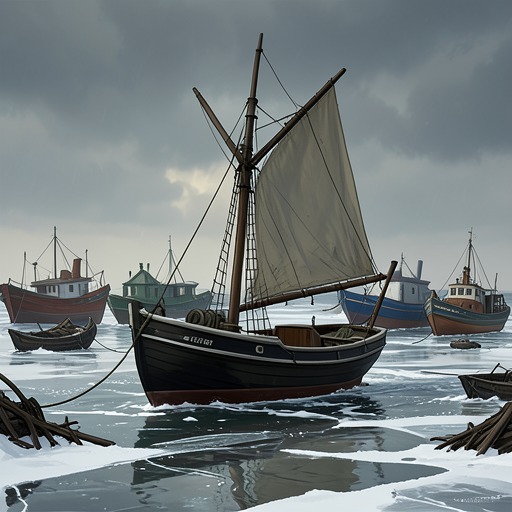
The trade’s dependence on conditions beyond the crew’s control appears again near Pond’s Bay. Foul weather obscures potential prey, and unusually dense sea ice delays the ships despite Brownlee’s eagerness to proceed. When drift ice begins moving toward the vessels, the men cut an ice dock from a six-foot floe, using long saws and teams of workers. The episode places the hunt within a physical environment that can stop fishing or threaten the ships themselves; pursuing whales farther north does not simply extend the old business but increases its exposure to difficult conditions.
Energy Transition and Commercial Aftermath
Baxter identifies the market change directly: consumers no longer want whale oil, he says, because petroleum and coal gas have taken its place. His claim that petroleum will endure is challenged by Brownlee, who calls it a passing fashion and insists that whales remain worth pursuing. The novel later presents the transition in more concrete terms through a report about Baxter. A Hull barman says that, after two of Baxter’s ships went down in Baffin Bay, the underwriters paid him; he also reports that Baxter gave some money to the drowned sailors’ families but retained a substantial sum. The same account says Baxter has moved into coal oil and paraffin. These details reach the reader as local testimony, not as a full accounting of Baxter’s finances, but they show how the old trade’s hazards and the replacement fuels converge in his business fortunes.
Baxter’s view of the future also reaches the workers whose livelihoods depend on the fleet. When Sumner returns alive and asks for his wages, Baxter describes whaling as a trade in decline and presents London, rather than Hull, as the place where a young surgeon might find work. The change in fuel markets therefore carries consequences beyond the sale of oil: it narrows the apparent future of the ships and the people attached to them. Yet the catches, the rigging, the flensing, and the perilous movement through ice continue. The industry’s decline is not a clean ending but an uneven transition, in which the old work persists while capital and commerce turn toward other sources of energy.