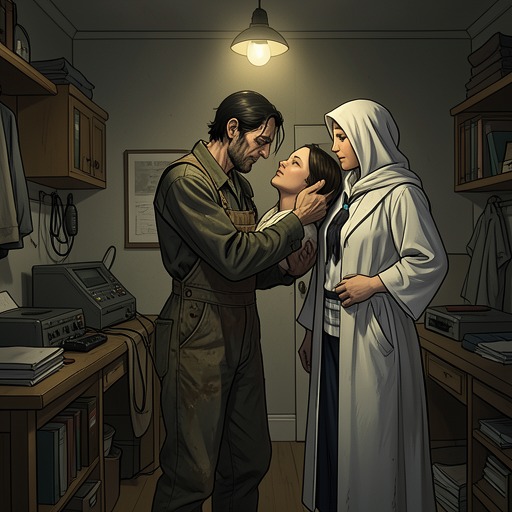
The Missionary’s Abdominal Abscess
The North WaterThe Missionary’s Abdominal Abscess is a rapidly worsening illness that brings Patrick Sumner’s medical training into direct confrontation with the limits of what he can treat in an isolated Arctic setting. Initially mistaken for a digestive complaint, the condition develops into a suspected abscess near the priest’s cecum. Sumner ultimately opens the abdomen to drain it, an intervention that relieves the immediate pressure but does not resolve his fear that the priest may still die.
Initial Symptoms and Misjudgment
The crisis begins after the priest has suffered constipation and taken purgatives. During the night, he develops severe diarrhea. Anna, who has been sleeping on the floor, helps him clean himself, empties the pot, gives him water, and covers him with blankets. Sumner observes but does not assist. He regards the priest as robust for his age and attributes the constipation to the familiar shortcomings of an Arctic diet lacking plants, vegetables, and fruit. Because the purgatives have taken effect, he expects the priest to return to normal.
The next morning, the priest feels improved enough to eat breakfast sitting upright and ask Anna to bring his books and papers. Sumner meanwhile says farewell to Urgang and Merok, who have spent the night in an igloo. Their departure leaves him with the priest and Anna as the illness enters a more dangerous phase. At lunch the priest eats hardtack and bouillon, then vomits. He becomes pale, develops more severe lower-abdominal pain, and can barely urinate. Sumner examines his pulse and tongue and presses on his abdomen. The skin is tense, but he finds no sign of a hernia; pressure above the ilium produces a sudden, severe response from the priest.
Recognition of the Abscess
Anna asks Sumner privately whether the priest is going to die. Sumner identifies an abscess inside the right side of the abdomen, just above the groin, and explains that an internal part has ruptured and the belly is filling with poison. He tells her he can do nothing and considers the situation impossible. The diagnosis changes his earlier assumption that the illness is a temporary consequence of diet and constipation: the priest’s pain and inability to keep food or drink down now point to a serious internal condition.
The priest’s state worsens over the following hours. He develops violent shivering, cold and clammy skin, a faint and irregular pulse, and a brown streak on his tongue. He vomits brandy when Anna tries to give it to him. Sumner steps outside, unable for a time to remain in the cabin amid the illness and the priest’s complaints. In the Arctic stillness, with stars visible at noon, he experiences the landscape as a place emptied of life. He then returns to the cabin and commits to acting rather than leaving the priest without an attempt at treatment.
Decision to Operate
Sumner identifies the priest’s cecum as abscessed, while allowing that it may instead be ulcerated. He judges the distinction less important than draining the diseased matter. The medicine chest contains no opium, which he considers useful, so he decides to make an incision. The decision is made under severe constraints: the patient is critically ill, the setting is remote, and the available treatment is limited to the medicines and instruments Sumner has brought with him. The procedure is not presented as a certain cure; it is the intervention he believes offers the best available chance of relief.
Before operating, Sumner asks Anna to bring her brother in from the igloo. He uses ether to anesthetize the priest, has Anna maintain it if the patient begins to revive, and assigns the brother to assist with a bucket and towel. Sumner clears the table, prepares a lancet, and positions an extra candle to see by. Although he briefly questions whether he has mistaken the condition for a hernia or tumor, he reasons through the diagnosis and proceeds. His work combines clinical judgment with practical adaptation: Anna and her brother become necessary assistants because no larger medical team is available.
Drainage and Immediate Aftermath
Sumner makes an incision in the abdomen and opens the cavity. The abscess drains a substantial quantity of infected fluid. Anna reacts in horror, and her brother drops the bucket; Sumner regains control of the procedure and directs them to clean the table and dispose of soiled cloths. Working together, they turn the priest onto his side to aid drainage while Anna keeps the ether in place. Sumner presses around the wound to expel what remains, and the flow eventually stops.
They return the priest to bed, cover him, and dress the wound. Sumner washes his hands, opens the window, and explains how Anna should administer the few medicines that might ease or moderate the pain. Despite having completed the operation, he expects the priest may not survive more than a day. He fears that the severity of the abscess has caused a perforation in the gut and that further leakage would be fatal. He then leaves the cabin to smoke, with no assurance that the intervention has changed the likely outcome.
The next morning, the priest is still breathing and appears no worse than before. Sumner removes and replaces the dressing, inspecting the wound as he works. This survival through the night gives the procedure an immediate, limited success, but it does not establish that the priest has recovered. When the priest asks what Sumner found inside him, Sumner answers that it was nothing good. The scene ends with the patient alive and the prognosis unresolved.
Significance
The abscess episode marks a change in Sumner’s response to suffering. At first he watches Anna care for the priest and treats the symptoms as an ordinary consequence of the Arctic diet. When those symptoms intensify into unmistakable danger, his initial declaration that nothing can be done gives way to a decision to operate. The change is not a sudden confidence in a cure: Sumner acts while openly recognizing the possibility that the priest will die.
The episode also defines the practical character of Sumner’s medical role. Earlier, aboard ship, he has been assigned strenuous work carrying blocks of blubber, slipping on the greasy deck and being saved from a fall by Otto. Here, his work is surgical rather than manual labor, but it likewise demands physical competence under difficult conditions. In the cabin, he must diagnose, prepare the instruments, direct improvised assistance, and care for the wound without the resources of a hospital. The abscess therefore exposes both the reach and the limits of his skill: he can intervene decisively, yet the patient’s survival remains uncertain.