The Will to Survive and Survival
The North WaterThe will to survive in The North Water is neither a secure moral principle nor a promise that effort will be rewarded. It appears first as an insistent bodily demand, then as practical labor under danger, and finally as the fact of remaining alive despite forces that make survival seem unlikely. Patrick Sumner’s fall through Arctic ice and rescue by Black form its most concentrated episode, but the novel extends the theme through Arthur Brownlee’s memories, the crew’s work, and Sumner’s continued life after the voyage.
The Body’s Demand
An early scene presents survival at its most elemental. A man in a tavern checks the clock shortly after noon and reckons that he has sixteen hours to do what his body requires. The ache within him is persistent, sometimes quiet and sometimes insistent; its imagined silence would mean that he was dead. Survival here has no heroic language. It is measured by a body that continues to make demands and by the effort to meet them. The man’s confrontation with the barman and a Shetlander adds defiance to that bodily urgency, but does not resolve it: the immediate need remains.
Patrick Sumner gives the theme a more reflective dimension. In a tavern, after his history of betrayal, humiliation, poverty, disgrace, and bereavement, he takes laudanum mixed with rum and tries to understand what remains to him. He considers whether being alive, warm, and breathing might mean that he is free, despite having lost so much and become a surgeon on a whaling ship. The thought briefly consoles him, then collapses under scrutiny: if freedom means only being unbound, an empty glass and a wooden table would be free too. He returns instead to the conviction that action and events matter more than abstract formulations, and that life must be lived through and survived. The passage makes survival at once stubbornly material and resistant to easy philosophical consolation.
Exposure, Effort, and Rescue
The northward voyage subjects that conviction to physical test. After days of fog, sleet, wind, and seasickness, the crew reaches ice near Jan Mayen Island and prepares for sealing. Henry Drax works alone across the ice, killing seals and stripping their skins; the five boats return laden. Arthur Brownlee counts the catch in commercial terms: four hundred skins might yield nine tons of oil, with each ton worth about forty pounds if the market holds. The hunt makes survival and profit inseparable from hard, dangerous work, while the competing ships and dispersing seal pack place a limit on the opportunity. The men’s effort keeps the enterprise going, but the returns remain uncertain.
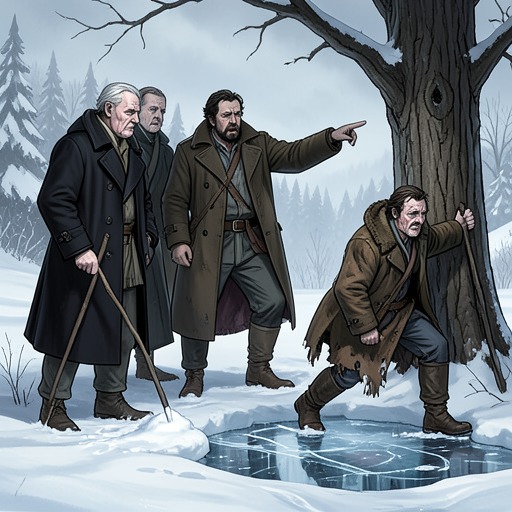
Sumner’s own labor on the ice becomes a more immediate ordeal. His injured leg complicates a crossing between floes. As he attempts to jump a narrow gap, his foot slips and he falls into the water. He reaches for the ice but cannot pull himself out; the floes shift, the cold weakens him, and the rope attached to the sealskins will not bear his weight. Cavendish is within sight, but Sumner receives no help from him. The episode strips survival down to a choice between continued exertion and surrender to the conditions around him. Sumner repeatedly tries to regain the ice and stays afloat, but the scene does not make self-reliance sufficient: he remains in peril until someone else finds him.
Black discovers Sumner wedged between the floes, secures a rope around his chest, and hauls him onto the ice. Sumner is unresponsive at first. Black strikes his face to rouse him, then helps him sit and offers bouillon, which Sumner can barely take. Black judges that Sumner has been in the water for three hours and should not have survived. Sumner’s face bears frostbite, and he cannot recall the fall or the cold; he remembers only the snow-filled sky. His first request is for laudanum. The rescue therefore does not turn survival into a clean triumph: it restores a life still marked by exposure, dependence, and the habits Sumner carried with him.
Survival as Work and Interdependence
The novel repeatedly places survival inside collective labor. On the first whale hunt in the North Water, Black strikes the whale, and Otto’s boat moves close enough for Otto to harpoon it. The whale resists before the surrounding boats join the attack. Afterward, Brownlee estimates that its carcass will yield ten tons of oil and at least half a ton of whalebone, worth nearly nine hundred pounds at market. Otto and Black work on the carcass for hours; the crew stows the blubber, cleans the deck, and receives an extra ration of rum. The sequence links a dangerous hunt, coordinated skill, and the commercial value expected to sustain the voyage. Brownlee’s confidence that the catch may make them rich sits beside the physical effort on which that prospect depends.
Sumner is drawn into this labor when he is assigned to carry blocks of blubber from the foredeck to the hold. The work is dirty and exhausting, and he slips repeatedly, nearly falling into the hold before Otto saves him. Yet at the end of the day Sumner feels satisfaction in having completed a task that tested his body. He sleeps without laudanum for once and eats breakfast despite his stiffness. This small change is important: for a brief interval, physical exertion and the completion of necessary work offer an alternative to the drugged escape on which he relies. The moment does not cure his dependence, but it shows that survival can involve renewed participation as well as endurance.
The crew’s preparation for moving ice makes the same interdependence visible on a larger scale. When the wind changes and drift ice begins to approach, Cavendish orders the men to cut an ice dock for the ship’s protection. They mark out the dimensions, divide into teams, and operate long saws through ice six feet thick. The work is coordinated and exhausting; the threat continues to advance while they cut. The passage presents survival not as a solitary virtue but as a task organized through commands, shared skill, and collective exertion, without guaranteeing what the effort will achieve.
The Limits of Endurance
Brownlee’s dream after the loss of the Percival turns survival into a stark fantasy of necessity. In the dream, the ship has gone down so quickly that its provisions are beyond the crew’s reach, and the men face death in darkness. Brownlee imagines them sharing the blood of a dead crewman as a source of warmth and sustenance. He tells himself that there is no longer room for ordinary judgments of sin, only the struggle between life and death. The dream does not establish that the imagined acts occurred; it reveals how catastrophe has reorganized Brownlee’s understanding of what a person might do to live. Survival appears as a limit case in which familiar moral language falters before immediate need.
Brownlee’s own history also complicates the idea of endurance. After the Percival, the surviving men do not return to sea, but Brownlee does. He regards himself as the only one stubborn, or foolish, enough to continue. His persistence helps bring him back to whaling, yet his final voyage aboard the Volunteer is tied to a scheme involving the heavily insured ship and the Hastings. He can regard his continued life as evidence of tenacity without making that persistence morally admirable. The novel distinguishes the capacity to go on from the wisdom or justice of what a person chooses to do with that capacity.
The economic setting presses against endurance as well. Brownlee remembers a time when a captain with a boat and harpoon could make a fortune, but Baxter argues that the old conditions have passed: petroleum and coal gas have displaced whale oil, while modern hunting demands greater investment and luck. Brownlee insists that whales remain and can still be found with the right captain and crew. Later, he expects more whales in the North Water, where they have moved toward ice that makes pursuit perilous. Survival here includes the precarious continuation of an industry, but the same pursuit of profit exposes men and animals to danger. The work may sustain the voyage while the changing market and depleted opportunities threaten its future.
Survival Beyond the Ice
Sumner’s life after the fall is not confined to the rescue itself. During the Siege of Delhi, he is wounded while escaping a street fight, binds his leg, and tells himself to remain alert if he is to live. He expects British troops to advance and hopes that staying alive will allow them to find him and take him home. The scene echoes the ice ordeal: pain and fear narrow his attention to immediate actions, while survival depends partly on his own decisions and partly on forces beyond his control. Later, after returning from the Arctic, Sumner appears in Hull alive despite having been presumed drowned or frozen with the other lost men. He asks Baxter only for his wages before leaving. That return confirms survival as an outcome, not a resolution: Sumner is alive, but the novel does not equate being alive with being restored or secure.