Volunteer
The North WaterThe Volunteer is the whaling ship at the center of the novel’s Arctic voyage: a workplace, a vehicle for commercial ambition, and ultimately the object of a deliberate scuttling. Its passage from Lerwick toward the northern hunting grounds first binds Patrick Sumner to the routines and risks of whaling, then exposes how financial schemes can turn the ship itself from shelter into a liability. The vessel’s destruction is not simply an encounter with hostile ice; it is also the material consequence of a plot involving Jacob Baxter and Cavendish.
A working ship and its commercial setting
Patrick Sumner joins the Volunteer as its surgeon, expecting to leave the next morning and offering a note of hand. He imagines that his duties will be limited: occasional purgatives and the certification of deaths, with time left for drawing, writing, and reading Homer. The ship’s actual work will soon make that imagined leisure seem remote. The voyage is organized around catching and processing animals, and the surgeon becomes part of that production rather than an observer set apart from it.
The industry behind the voyage is already changing. Jacob Baxter explains to Arthur Brownlee that earlier voyages could return quickly with large quantities of whalebone, but that dwindling prospects now demand powerful steam engines, harpoon guns, and luck, without assuring a profitable catch. He argues that the industry’s successful years have exhausted the opportunity that once made it lucrative, while petroleum and coal gas have displaced whale oil. The Volunteer therefore sails within a business facing both ecological pressure and a shift in energy markets: the voyage still pursues whales, but its commercial rationale is increasingly uncertain.
The financial stakes are made tangible when Baxter brings papers to Brownlee and points to twelve thousand pounds divided among three people, a sum he presents as far beyond what Brownlee could expect to earn from whaling. Baxter describes money as a force that follows its own course, regardless of what its participants prefer. Later, Campbell warns that the whales are only a small part of the larger scheme and that any sinking must appear convincing to underwriters. Together, these conversations place the Volunteer within a proposed insurance arrangement in which the appearance of an accident matters alongside the ship’s cargo and catch.
Voyage, hunting, and labor
The Volunteer enters Lerwick harbor on April 1, 1859, among other whaling ships. Brownlee goes ashore to meet his local shipping agent and select Shetland crew members, while Sumner distributes tobacco and treats a deckhand, Thomas Anderson, for a painful stricture. The ship’s life is thus established through both recruitment and ordinary service: the crew is assembled for the hunt, while the surgeon attends to the ailments that accompany shipboard work.
North of Lerwick, fog, sleet, and bitter winds leave Sumner seasick and unable to read or write. After two gales, the weather moderates on the eleventh day, and the ship reaches scattered sea ice with Jan Mayen Island visible in the distance. The crew receives rifles and ammunition and prepares for sealing. On the ice, Henry Drax works alone, killing seals and removing their skins; by the end of the labor, the five whaleboats carry heavy loads. The hunt is presented as coordinated production, but also as demanding physical work that leaves the ice marked by the processing of the catch.
After three weeks from Jan Mayen Island to Cape Farewell, the crew remains occupied with whale lines, boat falls, lances, and harpoons. The successful sealing has raised morale, and Brownlee senses renewed confidence in the season. By the last week of June, the ship has crossed into the North Water. Black strikes the first whale near dawn, and Sumner watches from the crow’s nest as the animal descends with the harpoon still embedded and later resurfaces, bleeding, closer to the ship.
The handling of the whale makes the ship both hunting platform and processing site. Its right fin is secured to the larboard gunwale, and ropes, a block, and the windlass bring its body partly out of the water. Brownlee measures it with a knotted line and estimates a yield of ten tons of oil and more than half a ton of whalebone, worth nearly nine hundred pounds if prices hold. The next day, Sumner is assigned to carry blocks of blubber from the foredeck to the hold, where they are stored in the flens-gut. Each weighs at least twenty pounds. The task leaves him bruised and aching, but gives him a rare satisfaction in physical effort; for once, he sleeps without laudanum. The ship’s economic purpose is therefore registered not only in Brownlee’s valuation but in the labor imposed on the crew, including the surgeon.
Command, ice, and deliberate destruction
The Volunteer’s command changes after Cavendish is badly injured. Though he has broken his nose and lost several front teeth, he resumes his duties after a short recovery and tells the crew that he is taking command while Brownlee recovers. He also assures them that Henry Drax is chained in the hold and will play no further part in the voyage. The ship remains an organized workplace, but authority has shifted to a man whose later actions make that order unstable.
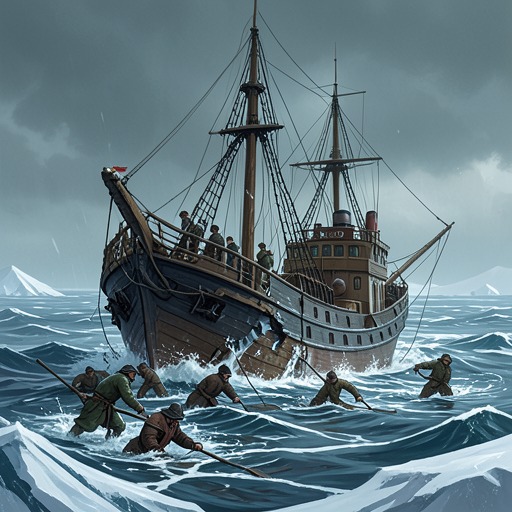
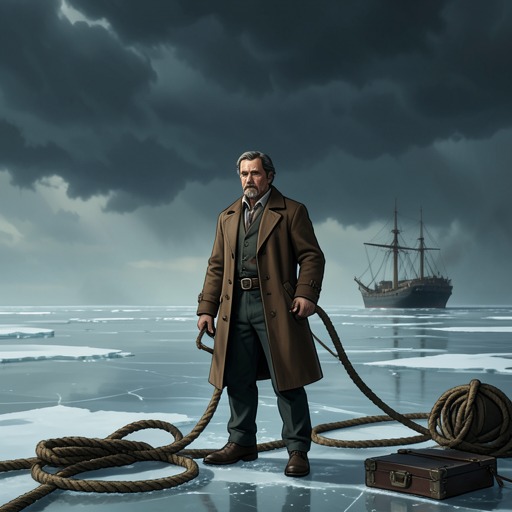
When the drift ice begins moving toward the vessel, Cavendish orders the men to cut an ice dock for protection. They bring up saws, gunpowder, ropes, and poles; Black marks out the dimensions, and the crew divides into teams to make the first long cuts. This collective work is an attempt to manage the danger through practical skill and coordinated labor. Yet the Volunteer’s exposure to ice is not the whole explanation for its fate. Cavendish has already indicated that he can sink the ship later, and, in the forehold, he takes an ax and repeatedly strikes its damp timbers. The blows break through the doubled planking and initiate the ship’s flooding.
Within two hours, the Volunteer pitches forward until its bowsprit lies against the ice and its foremast has snapped. Cavendish sends Black and a team back aboard to salvage booms, spars, and rigging and to cut down the remaining masts before they break away. With the masts gone and only the stern showing above the surrounding ice, the once-protective vessel appears radically diminished. Sumner’s recognition of its fragility follows from this transformation: the ship is made of wood, nails, and rope, not an invulnerable barrier between its crew and the Arctic.
Loss and narrative significance
The scuttling turns a financial conspiracy into a physical emergency. Sumner later describes the sinking as something Cavendish carried out at Baxter’s direction, and says that he and Drax were the only people who might have known or guessed what had happened. In his account of the failed plan, Drax shoots him and Stevens shoots Drax, but events do not resolve into the neat sequence intended. This retrospective explanation connects the ship’s destruction to the attempted management of witnesses as well as to the pursuit of insurance money.
After the voyage, Sumner says he does not want to be known as the only man who survived the Volunteer. He wishes he had never been aboard or seen what occurred there, and distinguishes between events that were accidental and those that were not. The ship’s significance consequently exceeds its function as transport or whaling equipment. It carries the crew into a dangerous environment, organizes their work, and becomes the instrument through which commercial calculation produces catastrophe. Its destruction also leaves Sumner with a burdened identity: survival is not presented as uncomplicated escape, but as a continuing connection to the ship and to the deaths and concealed wrongdoing associated with it.