Volunteer crew's first whale hunt
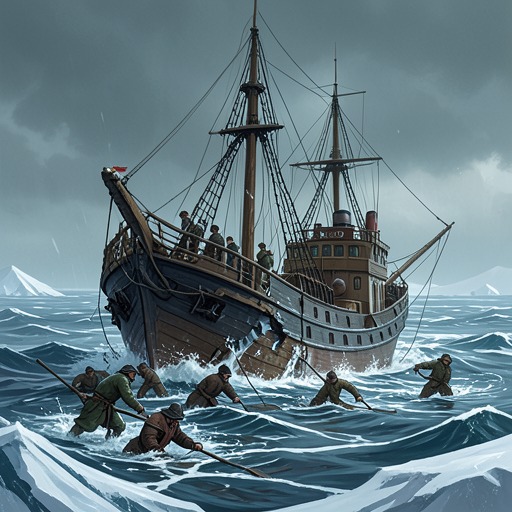
The North WaterThe Volunteer crew’s first whale hunt in the North Water is both a commercial milestone and a test of coordinated labor. Black strikes the first whale; Otto and the other boat crews join the pursuit, and Henry Drax delivers the final lance thrust. The kill brings the men a valuable cargo and a shared moment of triumph, while exposing the physical work and risks on which the declining whaling trade depends.
Industry and Preparation
The hunt takes place against a worsening commercial outlook. Arthur Brownlee remembers an earlier era when a boat and harpoon could make a fortune, but says modern success demands expensive steam power, harpoon guns, and luck. Jacob Baxter argues that the market has changed: whale oil has lost ground to petroleum and coal gas. Brownlee remains convinced that whales can still be found and that a capable captain and crew can fill the hold. The disagreement gives the hunt a larger economic stake: it is an attempt to make the old business work in a market and a sea that have changed.
The crew’s route north is arduous. They sail from Lerwick through fog, sleet, and gales, with Patrick Sumner too seasick to read or write. After eleven days, the weather settles and they reach sea ice near Jan Mayen Island. The men prepare for sealing with rifles, ammunition, and sharpened knives; two days after sighting the seal pack, they lower the boats. Henry Drax works alone across the ice, killing seals and removing their skins. Brownlee counts the catch and estimates that four hundred skins could yield nine tons of oil. This successful opening raises morale, but the pack is dispersing and competing ships are also working along the floe edge.
After three weeks from Jan Mayen Island to Cape Farewell, the crew maintains its equipment and continues north. Brownlee senses optimism following the sealing success. He expects more whales in the North Water, where, he observes, whales have moved as hunting pressure has increased farther south. The crew enters the North Water in the last week of June. By then the men have been preparing lines, lances, and harpoons, and the whale hunt begins near dawn the following day.
The First Kill
Black strikes the first whale. Woken by the shouting and running on deck, Sumner follows the hunt from the crow’s nest. Through a spyglass he watches the whale dive and surface again, with Black’s harpoon still attached. Otto’s boat is closest when the whale rises. Otto stands in the bow and throws a second harpoon, which strikes deep. The whale’s violent movement tosses the boat and throws its oarsmen from their seats.
When the whale surfaces again, the other boats have gathered around it. Cavendish, Black, and Drax join the pursuit, and two more harpoons are driven into its flank. The harpooners then use their lances as the animal continues to resist. Drax presses his lance in search of the vital organs; the whale finally dies, and the men cheer. Brownlee waves his hat from the quarterdeck, while the crew on deck celebrates. Watching from above, Sumner feels a brief sense of shared achievement and of belonging to a joint undertaking.
The crew secures the whale to Cavendish’s boat and tows it back to the ship, singing as they row. On deck, the whale is measured and raised partly out of the water. Brownlee estimates that it will yield ten tons of oil and at least half a ton of whalebone, worth close to nine hundred pounds if market prices hold. The estimate makes the physical danger legible in commercial terms: a single kill is measured in cargo, market value, and the prospect of profit.
Processing and Consequences
After resting, Otto and Black put on crampons and climb onto the whale to cut out its blubber and remove the baleen, jaws, tail, and fins. The flensing takes four hours. The crew stows the blubber in the flens-gut, cleans the deck, and puts away its tools. Brownlee orders an extra ration of rum for each sailor; cheers follow, and a fiddle and dancing provide a release after the work. The operation does not end with the kill: towing, securing, cutting, storing, and cleaning are all necessary parts of turning the whale into saleable material.
The next day, two more whales are killed and flensed. Sumner, otherwise unoccupied, is assigned a pick haak and a long leather apron. He carries blocks of blubber, each weighing at least twenty pounds, from the foredeck and pitches them down to the men in the hold. The work is dirty and exhausting; he slips several times and nearly falls into the hold before Otto saves him. Though bruised and aching afterward, Sumner feels satisfaction in the physical task and sleeps without laudanum for once. Cavendish jokes that the surgeon may yet become a whale man. His work briefly shifts him from observer of the hunt to participant in the labor that follows it.
Significance
The first hunt joins the spectacle of the chase to the less celebrated work of processing its result. The boats depend on coordinated action, while the whale becomes a sequence of tasks and products: oil, blubber, and whalebone, each tied to Brownlee’s hopes for a profitable voyage. Yet the success does not resolve the trade’s underlying uncertainty. Brownlee’s estimate is conditional on prices holding, and his earlier account of technological expense and diminishing prospects remains in force. The crew’s triumph is real, but so is its dependence on a hazardous, increasingly difficult pursuit.
For Sumner, the hunt briefly offers a sense of collective purpose that contrasts with his isolation in the cabin and his troubled attention to Joseph Hannah. The singing tow and the crew’s shared celebration draw him toward the ship’s common endeavor; the next day’s hauling gives that feeling a bodily form. The episode therefore marks both a commercial success for the Volunteer and a short-lived change in Sumner’s relation to its working crew.