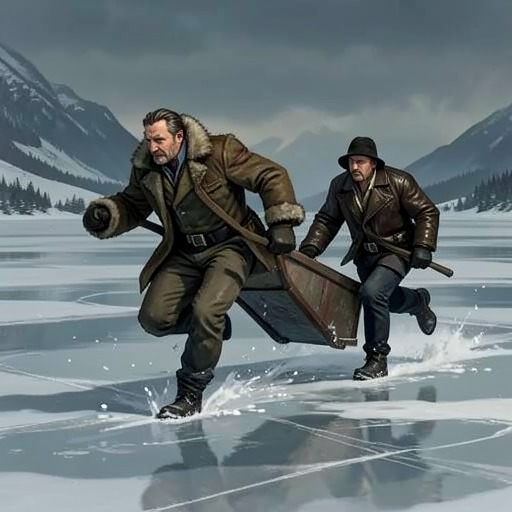
Volunteer is damaged by ice and abandoned
The North WaterThe Volunteer is damaged and abandoned in Lancaster Sound after a moving ice pack fractures the ice dock built to shelter her. The evacuation is both a practical struggle for survival and a turning point in the concealed plan to sink the heavily insured ship: the ice creates a real emergency, while Cavendish acknowledges that he can still sink the vessel later if the accident does not do so. The episode makes the boundary between maritime disaster and deliberate fraud difficult to separate.
Commercial Scheme and Maritime Context
The crisis follows a voyage in which commercial pressure shapes decisions at every stage. Before sailing, Baxter presents Brownlee with papers describing £12,000 to be divided three ways, a sum he stresses is far beyond what Brownlee could expect to earn from whaling. Brownlee agrees to proceed but warns that Campbell must be present when needed. Baxter describes money as a force that cannot be controlled, while Brownlee recognizes the consequences of allowing the scheme to determine their course.
The voyage nevertheless begins with productive hunting. After the crew reaches the sealing grounds near Jan Mayen Island, the five whaleboats return with 400 skins; Brownlee estimates they could yield nine tons of oil. Later, as the Volunteer crosses into the North Water, Black strikes the crew’s first whale. Brownlee calculates that its blubber and whalebone could bring close to £900. These catches demonstrate the ordinary commercial work the ship is equipped to perform, but the plot’s concealed financial objective increasingly overshadows its earnings from hunting.
The wider arrangement depends on appearances as well as money. The Volunteer is disproportionately insured, a circumstance that makes underwriters alert to possible conspiracy. Campbell warns that the ship must be sunk in a way that does not invite their scrutiny and argues that the whales are secondary to the opportunity to make the vessel’s loss look credible. The later ice emergency supplies precisely the kind of plausible external cause that could obscure deliberate action, even though the damage itself is real.
The Ice Dock and Its Failure
When the wind shifts suddenly from south to north, the loose pack drifting through the sound begins advancing toward the ship. Cavendish orders the crew to cut an ice dock out of the land floe. The work is organized as a demanding collective operation: men mark the dock’s dimensions, use long steel saws suspended from wooden tripods, and cut through ice six feet thick. Its sides are 200 feet long. After the crew divides the floe into large sections, Black places gunpowder in a cut; the blast breaks apart the blocks, which the men drag clear with grappling hooks.
The crew then warps the Volunteer into the cleared space, secures her with ice anchors, and returns aboard exhausted. Sumner has helped with the cutting and is weak after the labor. He takes laudanum and falls asleep, but the moving ice repeatedly wakes him. At first, the dock appears to provide the protection the men intended: it holds the ship between the land floe and the surrounding pack. The danger lies in the force gathering outside it. As the wind drives the pack onward, separate floes press together into an increasingly continuous field.
In the early hours, a corner of the dock fractures under that pressure. The broken section drives into the Volunteer’s sternpost, forcing the ship forward and sideways until her bows strike the opposite end of the dock. Squeezed between the moving pack and the land ice, the vessel lifts and strains. Sumner is thrown from sleep by the disturbance; his books and medicines fall from their shelves, and the lintel of his cabin door breaks. The scene turns a carefully engineered refuge into a trap: the same ice cut to protect the ship becomes part of the force constricting her.
Evacuation and the Decision to Abandon Ship
Cavendish orders an immediate evacuation. The crew lowers whaleboats onto the floe and carries provisions, fuel, rifles, ammunition, and other supplies away from the damaged vessel. Chests, bedding, and food casks are moved out, with the boats covered by tarpaulins and hauled to a safer distance. Sumner moves between ship and floe, carrying whatever the others direct him to take. He learns from Black and Otto that the ship may have been stove in at the bow or stern; only the upward pressure of the ice is keeping her from sinking outright.
Cavendish raises the ensign upside down as a distress signal. He also orders Drax released from the forehold, where he has been held in chains. Drax emerges with his wrists still manacled and questions the scale of the panic, arguing that the water in the hold is shallow and that the vessel is strongly built. His assessment does not resolve the emergency. The pressure of the ice has already displaced and damaged the ship, and the crew continues preparing to salvage equipment and leave.
The crisis also brings the commercial scheme into sharper view. Cavendish tells Drax that if the Volunteer does not sink in the present circumstances, he can sink her later. Drax objects not to the objective but to the appearance: after building an ice dock, a later sinking would not look as convincing. Their exchange reveals that the ship’s loss is not merely an unwanted possibility. At the same time, it does not make the ice damage fictitious; the pack has fractured the dock and placed the crew in genuine danger. The fraud relies on turning an authentic maritime peril into cover for a planned destruction.
Abandonment and Its Consequences
Within two hours, the Volunteer pitches so far forward that her bowsprit lies against the ice and her foremast breaks. Cavendish sends Black and a team back aboard to recover spars, booms, and rigging and to bring down the remaining masts before they break away. With most of her rig removed and only her stern visible above the piled ice, the ship has lost the shape and function that made her a means of travel. Sumner’s response registers the collapse of his confidence in the vessel as shelter: what had seemed capable of protecting him now appears fragile and exposed.
The Hastings, waiting four miles to the east, becomes the crew’s means of escape. Cavendish walks across the ice carrying a small knapsack with biscuits, tobacco, and rum, then returns with an offer of refuge from Captain Campbell. He organizes the transfer into three gangs of twelve and uses the whaleboats as sledges. Black and Jones-the-whale lead the first two groups away, while the third remains by the wreck until the others return. Abandoning the Volunteer is therefore not a single act but a staged removal of people and supplies across the ice, dependent on coordination and on the shelter offered by another ship.
The episode’s significance lies in its double account of loss. The crew confronts an immediate, physical threat and must leave a damaged vessel; simultaneously, the ship’s destruction has been discussed as a source of insurance money. Later, Sumner identifies the Volunteer’s sinking as deliberate and tells Baxter that the plan was for Drax to shoot him and Stevens to shoot Drax, leaving the matter apparently settled. That later accusation confirms how the earlier emergency fits into the larger scheme, while the ice dock’s failure and the evacuation show the real danger through which the scheme is carried out.