Whales
The North WaterWhales shape the novel’s Arctic voyage as living animals, elusive quarry, and a source of commercial value. Their apparent movement away from hunting grounds forces whalers to follow them north into increasingly difficult waters, while the work of capturing and processing them turns each encounter into a test of skill, endurance, and profit. The contrast between abundant expectations and poor later sightings makes Whales a measure of the industry’s confidence—and of its limits.
Whales and the Whaling Trade
Before the voyage, Patrick Sumner imagines the northern ice fields as a place of natural wonders, including great right Whales gathered beneath the ice. He plans to sketch them, paint landscapes, and keep a journal, expecting that his duties as a ship’s surgeon will leave him ample time. The prospect seems almost like a holiday after his experience in India. This expectation places Whales within a broad Arctic vision, but the commercial purpose of the expedition soon narrows that vision: they are also the animals on which the voyage’s success depends.
The trade is already under pressure. Jacob Baxter recalls an earlier period when a relatively modest whaling operation could return quickly with a profitable cargo, but argues that hunting has changed: steam power, harpoon guns, and luck are now necessary, and even those may not secure a catch. He also points to the replacement of whale oil by petroleum and coal gas. Arthur Brownlee rejects the idea that the industry is finished, insisting that Whales remain available to a capable captain and crew. Their disagreement sets commercial hope against the evidence of a changing market and increasingly difficult hunting.
Brownlee’s own theory of their distribution is optimistic. He believes that sailing farther north will lead to more sightings, and imagines that the world’s northernmost waters may contain an immense, ice-free refuge where right Whales remain plentiful. Patrick Sumner regards this as speculation rather than established knowledge. Brownlee’s confidence is nevertheless consistent with his determination to keep pursuing the animals: the possibility of a remote abundance allows him to interpret the northern route as an opportunity, even as the voyage encounters signs of scarcity and danger.
Hunting on the Northern Route
The expedition’s first work in the north is sealing, not whaling. After sailing from Lerwick through fog, sleet, and gales, the crew reaches the vicinity of Jan Mayen Island, prepares weapons, and begins hunting on the ice. The success of this operation lifts morale and encourages expectations for the season ahead. As the ships continue toward the North Water, Brownlee anticipates that the crew will find more Whales there. He explains their increasing distance from earlier hunting grounds by suggesting that they have moved north, away from the harpoon and toward ice that is more perilous for human pursuers.
The first whale hunt in the North Water begins near dawn in the last week of June, when Black strikes a whale. From the crow’s nest, Sumner watches the wounded animal submerge and surface again, and follows the boats as the crew gathers around it. Otto makes another harpoon strike; Black, Drax, and Cavendish are also among the men who join the hunt. The crew’s coordinated effort ends with the whale killed, and the men celebrate the result. For Sumner, watching from above, the success briefly creates a sense of shared purpose, a feeling that he belongs to a collective undertaking larger than himself.
The whale’s size makes that success legible in the ship’s accounts as well as in the crew’s excitement. Brownlee estimates that it will yield about ten tons of oil and at least half a ton of whalebone, together worth close to nine hundred pounds if market prices hold. After the animal is secured alongside the ship, Otto and Black lead the work of cutting away blubber and baleen. The processing takes four hours. Brownlee orders an extra ration of rum for each sailor, and music and dancing follow. The sequence links the animal’s capture to the ship’s labor, estimated cargo, and reward: the celebration rests on a productive kill.
Labor and Uneven Returns
The hunt does not end when the whale is brought alongside. On the following day, two more are killed and processed, and Sumner is assigned a physical share of the work. Wearing a leather apron and using a pick haak, he carries heavy blocks of blubber from the foredeck to the hold for storage. The task is exhausting, and he slips several times, but he finishes the day with a rare sense of satisfaction in work accomplished and a body tested. He sleeps without laudanum and eats well the next morning. The episode makes the whale’s commercial value inseparable from the strenuous labor needed to turn a catch into cargo, while giving Sumner a temporary place in the ship’s working community.
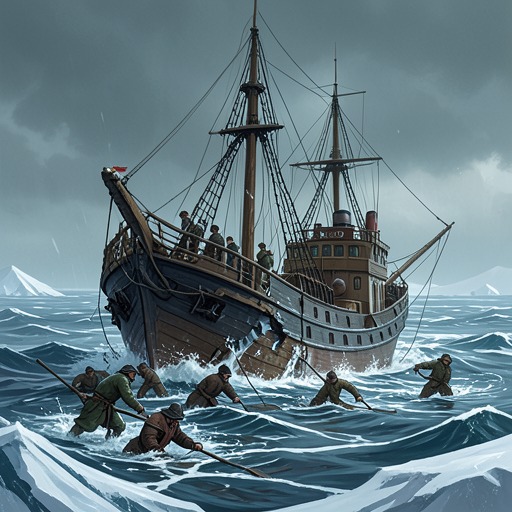
That early success does not represent the whole season. Near Pond’s Bay, foul weather first prevents hunting; after the weather clears, unusually dense ice delays the ships. When they can enter the bay, sightings are scarce, and the few attempts to lower boats end without a strike as the Whales disappear beneath the ice. After a week of failure, Brownlee begins to consider that too many may have been killed, although he struggles to accept that such a vast ocean could be depleted so quickly. The practical consequence is a change in course: he signals Campbell, leaves Pond’s Bay, and turns north in search of better prospects.
The Dead Whale and the Costs of Pursuit
Later, the crew finds a whale already dead and beginning to decay. Black and Cavendish judge that enough blubber remains to make processing worthwhile, so the animal is brought to the ship. The condition of the carcass changes the character of the work: the crew must contend with an unpleasant smell and visibly spoiled material, while Greenland sharks gather in the water around the remains. Even so, the men remove baleen from the upper jaw and store it, treating the find as a resource despite its condition. Once the work is finished, the remaining carcass is cut loose and drifts away among seabirds.
The episode sharpens the novel’s account of Whales as more than a simple measure of a successful hunt. Their remains enter a system that extracts value wherever possible, even from an animal already dead and deteriorating. Elsewhere, the empty boats and poor sightings undermine the assumption that a more northerly route will reliably provide abundance. The pursuit therefore joins ecological uncertainty to commercial pressure: the crew follows Whales toward more remote waters because the industry needs them, while the evidence of their disappearance and the risks of the ice make that confidence increasingly difficult to sustain.