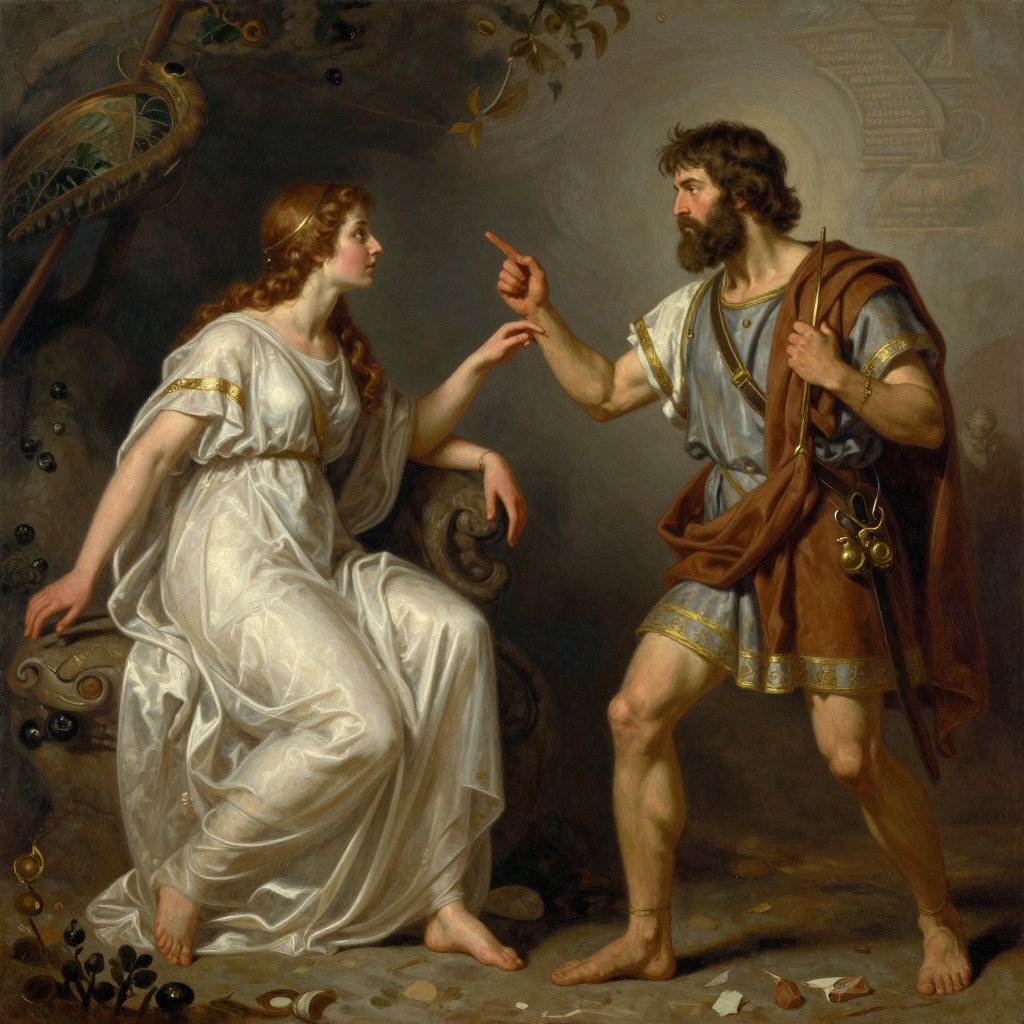
Clytemnestra
The OdysseyClytemnestra, daughter of Tyndareus and wife of Agamemnon, is the poem's central negative exemplar of female infidelity and murderous betrayal. Her story is repeatedly invoked throughout the Odyssey to contrast Penelope's unwavering loyalty and to warn Odysseus about the dangers of trusting even a wife, making her a crucial foil in the epic's moral architecture.
Identity and Background
Clytemnestra is introduced as the daughter of Tyndareus, a figure whose name carries the weight of a disastrous marriage. The poem consistently frames her as the antithesis of the faithful wife. In the underworld, Agamemnon's ghost bitterly contrasts her with Penelope, declaring that Clytemnestra's "abominable crime has brought disgrace on herself and all women who shall come after—even on the good ones." This judgment is echoed by the ghost of Agamemnon himself, who later tells Achilles that the fame of Penelope's virtue shall never die, while the song of Clytemnestra "shall be hateful among men, for she has brought disgrace on all womankind even on the good ones." Her very name becomes a byword for treachery.
The Narrative of Her Betrayal
The full story of Clytemnestra's betrayal is told by Nestor to Telemachus in Book III. Nestor explains that while the Achaeans were fighting at Troy, Aegisthus, "taking his ease quietly in the heart of Argos, cajoled Agamemnon's wife Clytemnestra with incessant flattery." Initially, Nestor reports, "she would have nothing to do with his wicked scheme, for she was of a good natural disposition." Her resistance was bolstered by a bard whom Agamemnon had left to guard her. However, Aegisthus carried this bard off to a desert island and left him to die, after which "she went willingly enough to the house of Aegisthus." This detail—the removal of the guardian bard—is crucial, as it suggests Clytemnestra's fall was not entirely her own doing but was precipitated by isolation and manipulation. The narrative thus offers a partial extenuation, a nuance typical of the poem's complex treatment of women.
The Murder and Its Aftermath
The murder itself is described in harrowing detail by Agamemnon's ghost to Odysseus in the underworld. Agamemnon recounts that Aegisthus and his "wicked wife" killed him between them. He was butchered "as though I were a fat beast in a slaughter house," while his comrades were slain around him. In his dying moments, Agamemnon heard Priam's daughter Cassandra scream as Clytemnestra killed her. He tried to raise his hands against his murderess, but "she slipped away from me; she would not even close my lips nor my eyes when I was dying." This final act of denial—refusing the proper rites to the dead—is presented as the ultimate proof of her shamelessness. The ghost of Agamemnon later reinforces this judgment in Hades, telling the ghost of Amphimedon that Clytemnestra's wickedness was the opposite of Penelope's virtue.
Thematic Significance: A Warning and a Foil
Clytemnestra's story serves as a constant, ominous warning for Odysseus. In the underworld, Agamemnon directly advises him: "Be sure, therefore, and not be too friendly even with your own wife. Tell her a part only, and keep your own counsel about the rest." He adds, "after all this there is no trusting women." This warning echoes throughout Odysseus's cautious return, explaining his initial reluctance to reveal himself even to Penelope. The contrast between Clytemnestra and Penelope is the poem's central moral lesson on marriage. Where Clytemnestra conspired with a lover to murder her returning husband, Penelope remained faithful for twenty years, weaving and unweaving a shroud to delay remarriage. The poem explicitly celebrates this contrast: Agamemnon's ghost declares that Penelope's "fame... of her virtue shall never die," while Clytemnestra's "song shall be hateful among men." Clytemnestra is thus not merely a character but a structural necessity, the dark mirror that makes Penelope's light shine brighter.