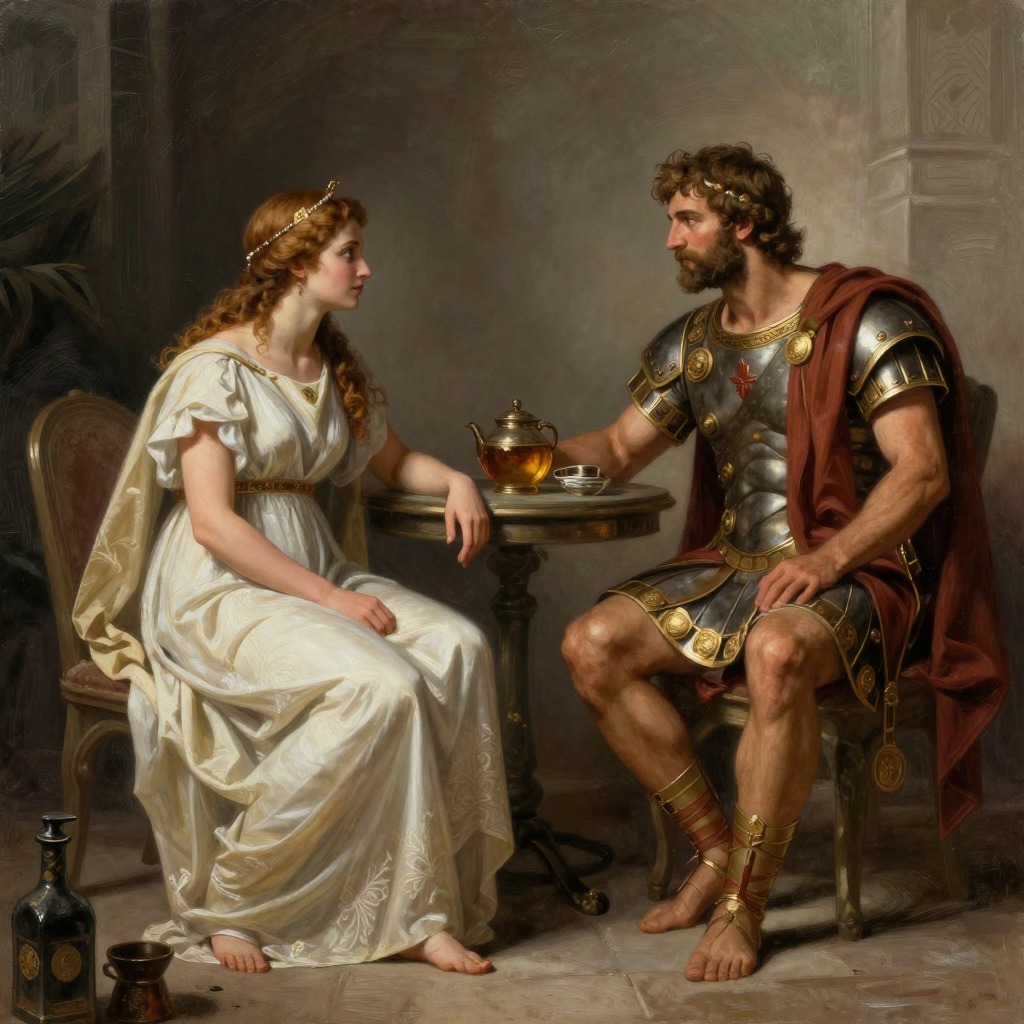
Helen
The OdysseyHelen, daughter of Zeus and wife of Menelaus, is the woman whose abduction by Paris sparked the Trojan War, and in the Odyssey she appears as a figure of profound ambiguity—at once the cause of immense suffering and a shrewd, remorseful survivor who actively shapes the narrative around her. She is not merely a passive prize or a distant memory; she enters the action of the poem in her own right, wielding her knowledge of drugs, her memory of Odysseus's wartime cunning, and her own sharp intelligence to influence the course of events. Her presence in the halls of Menelaus serves as a living reminder of the war's cost, a contrast to the faithful Penelope, and a source of crucial information about the hero whose return is the poem's central subject.
Identity and Background
Helen is introduced as the daughter of Zeus, a fact that sets her apart from mortal women and underscores her extraordinary beauty and fateful power. She is the wife of Menelaus, king of Lacedaemon, and the mother of Hermione, their only child together, for after Hermione's birth, the gods vouchsafed Helen no more children. Her abduction by Paris to Troy is the foundational event of the epic cycle, and she herself acknowledges the weight of this act, calling herself "my most shameless self" when she first sees Telemachus and reflects on the war fought on her account. The poet Samuel Butler, in his preface, advances the controversial theory that the Odyssey was written by a young woman who introduced herself into the work under the name of Nausicaa, and that the poem was drawn entirely from the place now called Trapani on the west coast of Sicily. This theory, while not universally accepted, frames Helen's character as one crafted by a female author with a particular interest in the perspectives and agency of women.
Role in the Telemachy
Helen's most significant appearance in the Odyssey occurs in Book IV, when Telemachus and Pisistratus visit the palace of Menelaus in Lacedaemon. She descends from her perfumed chamber, looking "as lovely as Diana herself," attended by her maids who bring her a silver work-box and a golden distaff. She immediately recognizes Telemachus by his resemblance to Odysseus, a moment that reveals her perceptiveness and her lingering connection to the past. When Menelaus confirms the likeness, Helen takes control of the conversation. She drugs the wine with nepenthe, an herb given to her by Polydamna of Egypt, which banishes all care and sorrow, ensuring that the evening's talk will not dissolve into tears. This act demonstrates her practical cunning and her desire to manage the emotional atmosphere of her household. She then tells a tale of Odysseus's secret mission into Troy, where he disguised himself as a beggar and she alone recognized him, washing and anointing him and swearing not to betray him. This story serves multiple purposes: it establishes Helen as a woman with secret knowledge and a capacity for loyalty, it provides Telemachus with a vivid account of his father's heroism, and it subtly rehabilitates her own reputation by showing her as an ally to the Greeks even while in Troy.
The Trojan War Narratives
Helen's account of Odysseus's spying mission is complemented by Menelaus's own story of the Trojan Horse, in which he describes how Helen, accompanied by Deiphobus, circled the wooden horse and called out to the Greek leaders, mimicking the voices of their wives. This episode casts Helen in a more ambiguous light: she is either testing the Greeks or actively trying to lure them to their doom. Menelaus recounts that Odysseus restrained Anticlus from answering, saving the entire ambush. Helen does not contradict this version, and the juxtaposition of her two stories—one of helping Odysseus, the other of nearly betraying him—creates a portrait of a woman whose loyalties are complex and whose actions are driven by circumstances beyond her control. She herself admits that her heart "was beginning to yearn after my home, and I was unhappy about the wrong that Venus had done me in taking me over there, away from my country, my girl, and my lawful wedded husband." This confession frames her as a victim of divine manipulation, a theme that resonates with the Odyssey's broader exploration of fate and human agency.
Thematic Significance and Contrast with Penelope
Helen functions as a foil to Penelope, the faithful wife who waits twenty years for Odysseus's return. Where Penelope weaves and unweaves a shroud to delay remarriage, Helen uses her weaving and her drugs to control the narrative of her own past. Where Penelope is defined by her loyalty and her cunning in preserving her husband's house, Helen is defined by her beauty and the destruction it caused. The ghost of Agamemnon in the underworld explicitly contrasts the two women, praising Penelope's "rare excellence of understanding" and declaring that her fame "shall never die," while condemning Clytemnestra and, by extension, Helen, for bringing "disgrace on all womankind even on the good ones." This judgment, delivered from beyond the grave, reinforces the poem's moral framework: the faithful wife is celebrated, the unfaithful one is condemned. Yet Helen's own narrative within the poem complicates this simple binary. She is not a villain but a survivor, a woman who has lived through the fall of a city and the death of countless men, and who now seeks to make peace with her past by telling her story on her own terms. Her presence in the Odyssey is a reminder that the war was not only a conflict of heroes but also a catastrophe for the women caught in its wake.