Helios
The OdysseyHelios, the sun-god also called Hyperion, occupies a unique position among the Olympians in the Odyssey: he is not a character who acts directly in the narrative but a cosmic power whose anger, once provoked, compels even Zeus to act. His cattle, kept on the Thrinacian island, are the instrument through which the poem tests the limits of mortal endurance and the cost of transgression. The prohibition against harming them, delivered first by the prophet Teiresias in the underworld and repeated by Circe, frames the final disaster of Odysseus's homeward voyage. Helios himself appears only once in the poem, in a scene of divine complaint, yet his threat to shine among the dead if he receives no recompense reveals the absolute seriousness of his domain: the sun's light is not to be taken for granted.
Nature and Domain
Helios is the sun personified, "who sees and gives ear to everything" . This omniscience makes him a natural witness and enforcer of justice. His cattle and sheep on Thrinacia are described as immortal in a peculiar sense: they do not breed nor diminish in number, and are tended by his daughters, Phaethusa and Lampetie . The herds are thus not ordinary livestock but extensions of the god's own substance, set apart from the mortal economy of slaughter and consumption. Circe warns Odysseus that if he harms them, destruction of ship and crew will follow, and even if he himself escapes, he will return late and in bad plight after losing all his men . The prohibition is absolute and the penalty explicit.
The Slaughter of the Cattle
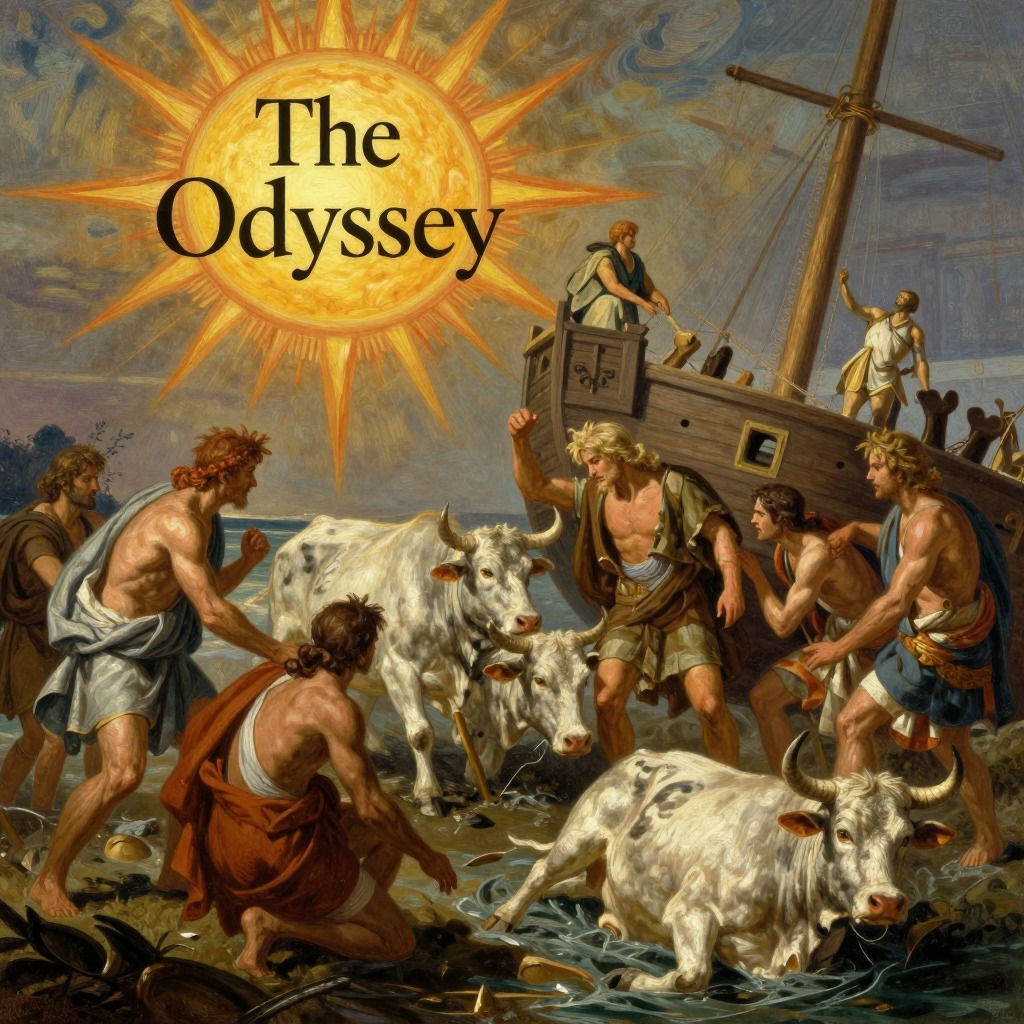
The crisis unfolds when Odysseus's men, stranded on Thrinacia by adverse winds and driven by starvation, ignore his warnings. While Odysseus prays apart, Eurylochus persuades the crew to kill the finest of Helios's cows, arguing that death by famine is worse than any divine punishment . They sacrifice the cattle using oak shoots instead of barley meal and water instead of wine, a perversion of proper ritual that underscores the desperation and impiety of the act. Immediately, supernatural signs appear: the hides crawl, the meat on the spits lows like living cattle . Lampetie reports the crime to her father, and Helios reacts with fury.
Helios's Complaint and Zeus's Response
Helios addresses the assembled gods with a threat that reveals the stakes: "Father Jove, and all you other gods who live in everlasting bliss, I must have vengeance on the crew of Ulysses' ship... If they do not square accounts with me about my cows, I will go down to Hades and shine there among the dead" . This is not mere hyperbole. The sun withdrawing his light would mean the end of the ordered world, a return to primordial darkness. Zeus immediately capitulates, promising to shatter Odysseus's ship with a thunderbolt as soon as it puts to sea . The ease with which Zeus agrees underscores Helios's unique power: unlike Poseidon, who must negotiate his grudges within the divine council, Helios's demand is granted without debate.
Consequences and Narrative Significance
The punishment is swift and total. Once the crew leaves Thrinacia, Zeus raises a storm, strikes the ship with lightning, and every man drowns (E00689-E00690). Odysseus alone survives, clinging to the wreckage. The episode thus serves as the culminating proof of Teiresias's prophecy and the final purification of Odysseus's company, leaving him solitary for his return to Ithaca. Helios himself never appears again in the poem, but his cattle remain a permanent symbol of the boundary between mortal need and divine prerogative. The episode also contrasts with the suitors' waste of Odysseus's own herds: where the suitors' gluttony is a social crime against xenia, the crew's hunger-driven transgression is a cosmic one, and its penalty is absolute annihilation. Helios, though nearly silent in the narrative, is thus one of the most decisive forces in the poem, a reminder that the natural order itself enforces limits that no cunning or endurance can evade.