Leiodes
The OdysseyLeiodes, son of Oenops, occupies a singular and deeply ambiguous position among the suitors who have overrun Odysseus's house. He is their sacrificial priest, the man who performs the ritual acts that ought to sanctify their feasting, yet he is also the only one among them who hates their evil deeds and feels indignation at their conduct. This contradiction—a priest serving a congregation whose behavior he abhors—defines his role in the poem and makes his eventual death one of the most morally unsettling moments in the slaughter of the suitors.
Identity and Role
Leiodes is introduced by name only when the contest of the bow begins. He sits in the corner near the mixing-bowl, a detail that associates him with the ritual side of the banquet rather than with the aggressive carousing of the other suitors. When Penelope brings out Odysseus's great bow and the twelve axes, Leiodes is the first to rise and attempt the stringing. He fails, his hands weak and unused to hard labor, and he immediately speaks a truth that the others refuse to acknowledge: "This bow shall take the life and soul out of many a chief among us, for it is better to die than to live after having missed the prize that we have so long striven for." His words are prophetic, though he does not fully grasp their meaning for himself. He puts the bow down and returns to his seat, and Antinous rebukes him for his defeatism, dismissing him as someone not born to be an archer.
Moral Position and Isolation
Leiodes stands apart from the other suitors not only in his physical weakness but in his moral sensibility. The poem explicitly states that he was "the only man who hated their evil deeds and was indignant with the others." This makes him a figure of conscience within a group defined by its collective lawlessness. Yet his conscience is entirely passive. He never acts on his disapproval, never leaves the house, never warns Penelope or Telemachus, and never refuses to perform his priestly duties for the suitors. He continues to serve as their sacrificing priest, which means he continues to pray on their behalf. This passive complicity, the poem suggests, is not innocence.
Death at Odysseus's Hands
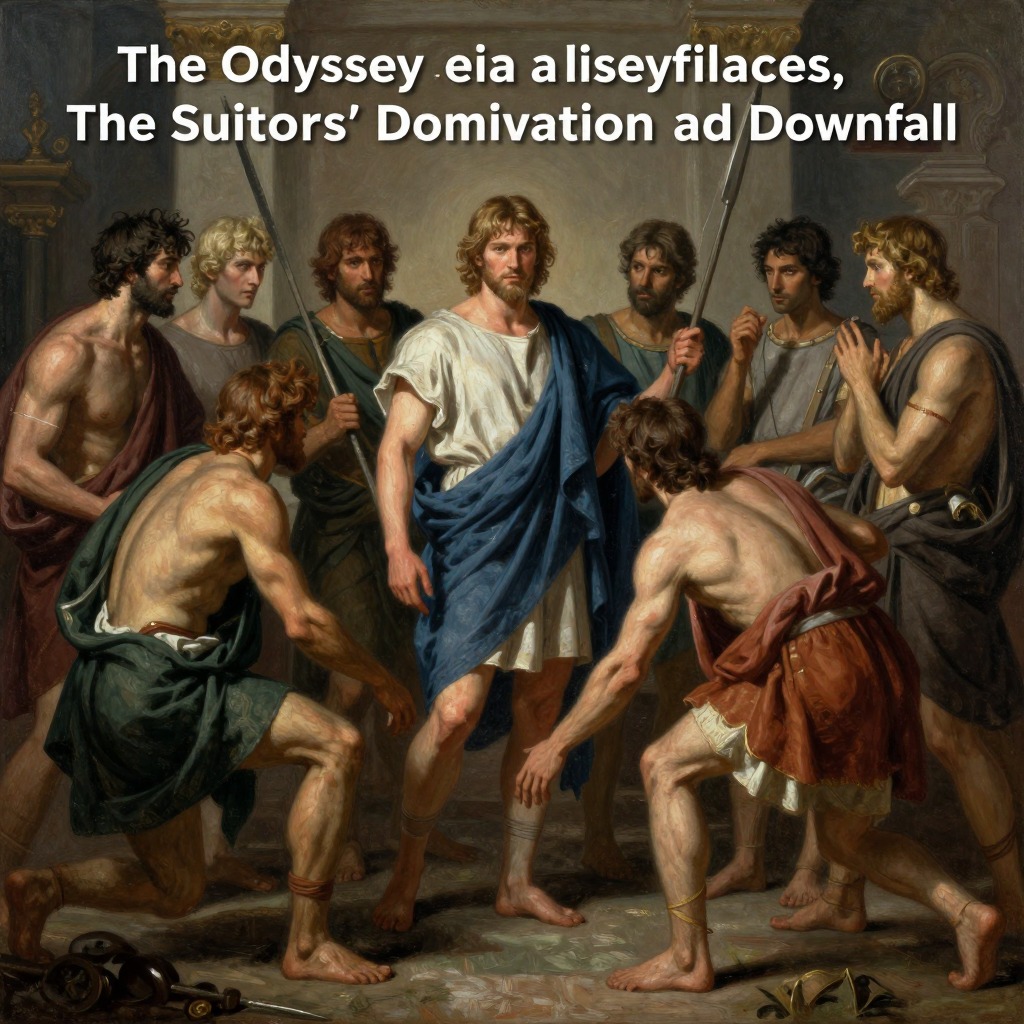
After the slaughter of the suitors is nearly complete, Leiodes catches Odysseus's knees and makes a desperate plea for mercy. He insists that he never wronged any of the women in the house, that he tried to stop the others, and that he is only their sacrificing priest—a functionary, not a perpetrator. He frames his death as undeserved: "If you kill me, I shall die without having done anything to deserve it, and shall have got no thanks for all the good that I did." Odysseus's reply is devastating and final. He looks sternly at Leiodes and says, "If you were their sacrificing priest, you must have prayed many a time that it might be long before I got home again, and that you might marry my wife and have children by her. Therefore you shall die." With these words, Odysseus picks up the sword that Agelaus had dropped and strikes Leiodes on the back of the neck, so that his head falls rolling in the dust while he is yet speaking.
Thematic Significance
Leiodes's death is the poem's most explicit rejection of the claim that passive disapproval or ritual service can absolve a person from responsibility for the community in which they participate. He did not kill anyone, he did not plot against Telemachus, he did not rape the maidservants, and he actively disliked the suitors' behavior. But he stayed. He performed the sacrifices that sanctified their feasts. He prayed—and the content of those prayers, Odysseus insists, must have included a wish for Odysseus's death and for Leiodes's own marriage to Penelope. The priest cannot separate himself from the prayers he offers. The poem thus draws a hard line: to serve the wicked, even as a reluctant functionary, is to share in their guilt. Leiodes's fate is a warning that moral neutrality, in a situation that demands moral action, is itself a form of participation in evil.