Penelope
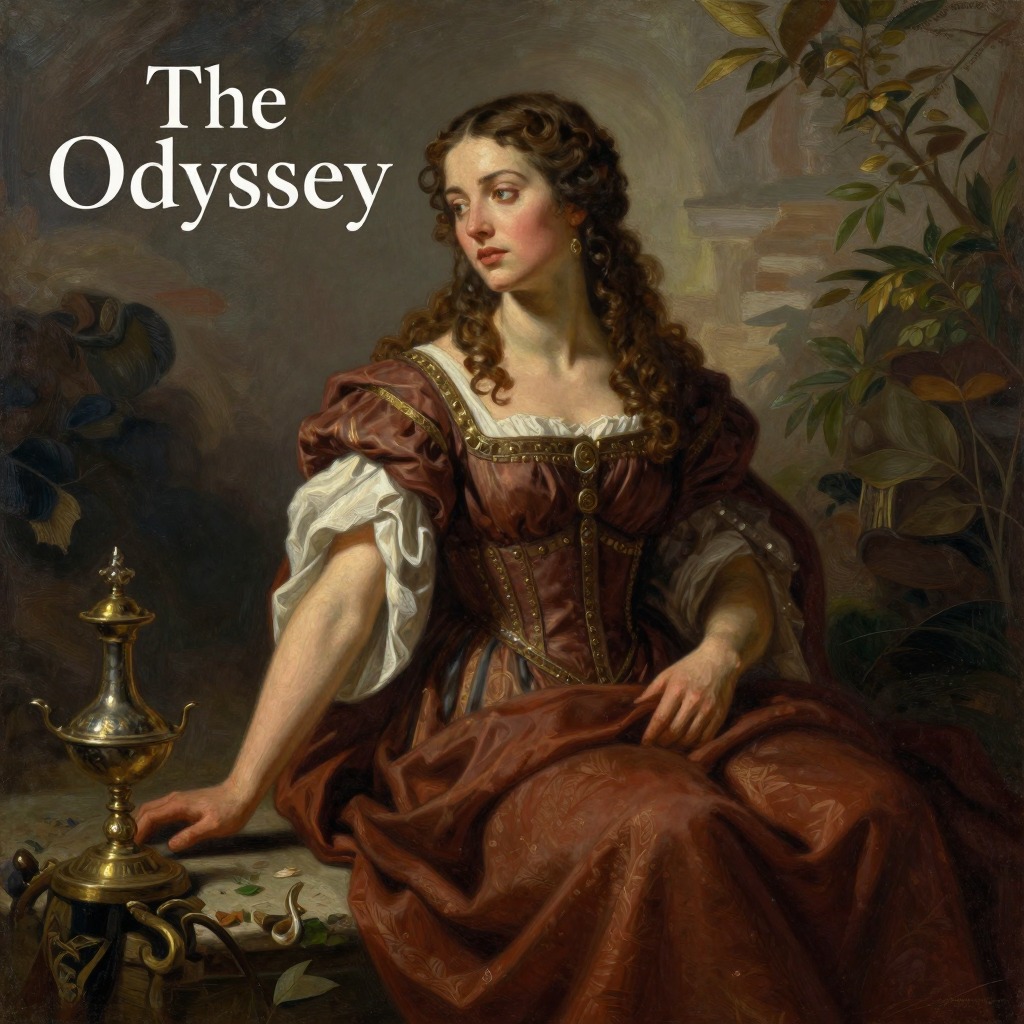
The OdysseyPenelope, daughter of Icarius and wife of Odysseus, is the queen of Ithaca who for twenty years holds her household together against the predatory suitors while her husband is lost at sea. Her role is not passive lamentation but active, strategic resistance: she deploys cunning, emotional manipulation, and a profound understanding of social performance to delay a marriage she does not want, preserving both her own integrity and her son Telemachus's inheritance. The poem makes her the moral counterweight to the faithless Clytemnestra and the ultimate test of Odysseus's homecoming—a recognition that requires not force but shared, intimate knowledge.
Identity and Background
Penelope is the daughter of Icarius, a Spartan prince, and the cousin of Helen. She married Odysseus as a young woman and bore him a son, Telemachus, whom Odysseus left as an infant when he sailed for Troy. When the poem opens, she has been separated from her husband for nearly twenty years—ten years of war and ten of wandering—and is besieged in her own home by 108 suitors from Ithaca and the surrounding islands of Dulichium, Same, and Zacynthus. These men have taken over her house, consuming her livestock and wine, and pressuring her to choose a new husband on the assumption that Odysseus is dead.
The Weaving Trick and the Management of the Suitors
Penelope's most famous stratagem is the weaving trick. For three years she tells the suitors she will choose a husband only after she has finished weaving a funeral shroud for Laertes, Odysseus's aged father. Each day she weaves the great web; each night, by torchlight, she unravels what she has woven. The ruse succeeds until the fourth year, when a maidservant betrays her to the suitors, who catch her in the act of unpicking her work and force her to complete it. The episode reveals her as a master of deferred decision, using the suitors' own greed and patience against them. Even after the trick is exposed, she continues to send encouraging messages to each suitor while meaning the opposite of what she says—a policy that Athena herself describes as giving "hope and sending encouraging messages to every one of them, but meaning the very opposite of all she says."
Emotional Life and Grief
Beneath her public composure, Penelope is consumed by grief. She spends her days weeping and her nights lying awake, tormented by uncertainty. When she hears the bard Phemius singing of the Achaeans' return from Troy, she comes downstairs in tears, holding a veil before her face, and begs him to stop because the song "breaks my sorrowful heart, and reminds me of my lost husband." Her son Telemachus rebukes her for this display, telling her to go back to her loom and leave speech—"man's matter"—to him. She obeys, but her grief does not abate. She prays to Artemis for death, wishing to be spirited away like the daughters of Pandareus rather than be forced into a second marriage. Even in sleep she is haunted: she dreams that an eagle kills her twenty pet geese—an omen that the seer Theoclymenus interprets as the coming destruction of the suitors.
Relationship with Telemachus
Penelope's relationship with her son is strained by his growing independence and by her own necessary secrecy. She does not know of his voyage to Pylos and Sparta until after he has left, and when she learns of it she collapses in despair, flinging herself on the floor of her room and crying out that her "darling son is at the mercy of the winds and waves." She is kept in the dark about Odysseus's return even after he is in the house; Telemachus and Odysseus agree that she must not be told. This exclusion is part of Odysseus's strategy of disguise, but it also reflects the poem's broader pattern of keeping Penelope at the margins of the violent action that restores her husband's rule.
The Contest of the Bow and the Test of the Bed
Penelope herself initiates the climactic contest of the bow. Acting on what the poem presents as a divine impulse from Athena, she brings out Odysseus's great bow and the twelve axes, and announces that she will marry the man who can string the bow and shoot an arrow through all twelve axe-heads. This is her final, public act of delay—a contest she knows no suitor can win—but it also becomes the trap that enables Odysseus's slaughter of the suitors. After the killing, however, she does not immediately accept the blood-spattered stranger as her husband. She tests him with a secret known only to the two of them: she tells Euryclea to move the bed out of the bedchamber. Odysseus reacts with fury, describing in precise detail how he built the bed himself from a living olive tree, making it immovable. This proof—the shared knowledge of the bed's construction—finally breaks her resistance. She weeps, throws her arms around him, and explains that she has been "shuddering all the time through fear that someone might come here and deceive me with a lying story."
Thematic Significance
Penelope is the poem's central figure of fidelity and cunning intelligence—a female counterpart to Odysseus's own metis. Her weaving trick mirrors his verbal deceptions; her patient endurance matches his physical suffering; her final, cautious recognition of him is the anagnorisis that completes the nostos. She is also the standard against which other women in the poem are judged: the ghost of Agamemnon praises her as the opposite of Clytemnestra, declaring that "the fame of her virtue shall never die, and the immortals shall compose a song that shall be welcome to all mankind in honour of the constancy of Penelope." Her role ends with the reunion; after the recognition scene she withdraws from the narrative, having fulfilled her function as the keeper of the house and the guarantor of Odysseus's identity.