Scylla
The OdysseyScylla is one of the two terrors that flank the narrow sea passage Odysseus must navigate after leaving Circe's island, and her attack constitutes the most sickening single loss of life he suffers on his entire voyage. She is not a mortal enemy who can be fought or reasoned with, but an immortal, invincible, and mindlessly predatory force of nature—a monster whose function in the poem is to test whether a hero can accept unavoidable loss and press forward without futile resistance.
Identity and Habitat
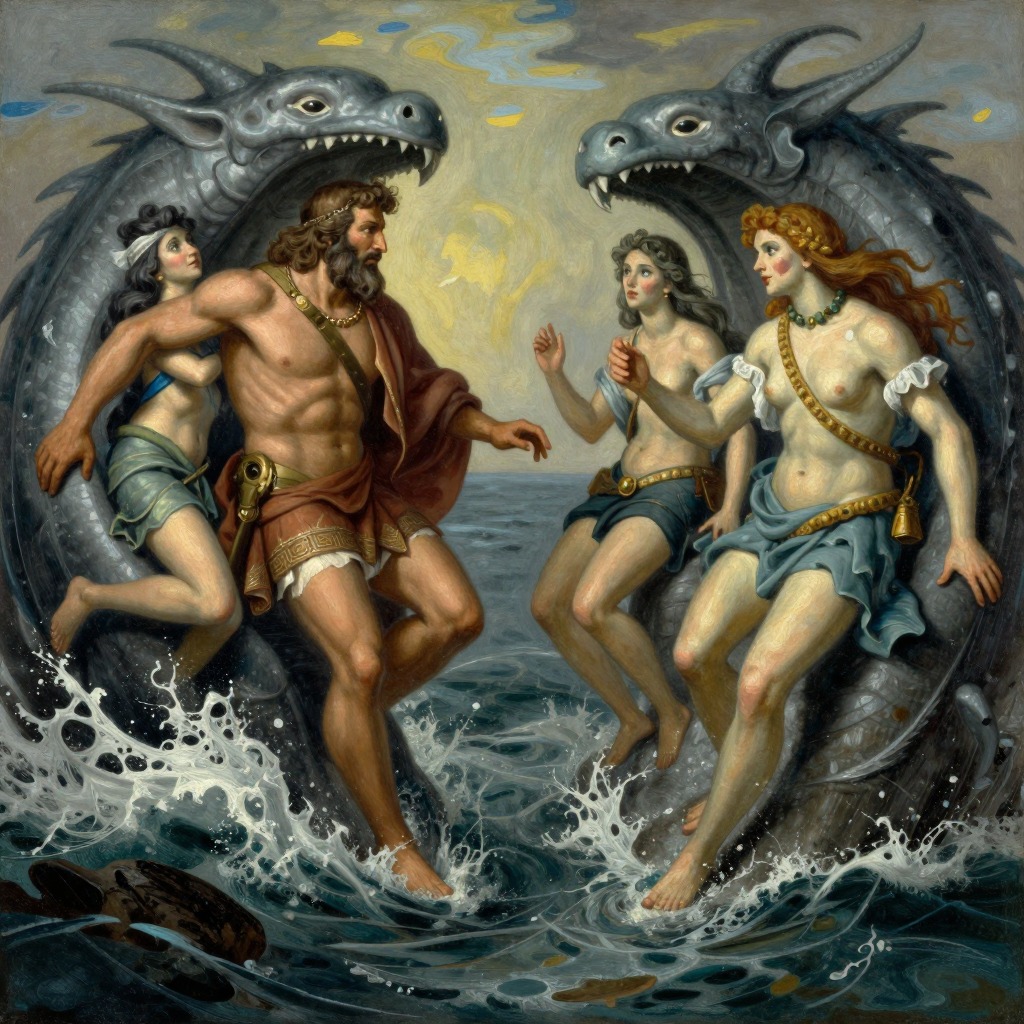
Scylla is a creature of mixed and monstrous form. She has twelve misshapen feet and six extremely long necks, each ending in a frightful head with three rows of teeth set close together, capable of crunching anyone to death in an instant. She sits deep within a shadowy cavern high up on a rock face so sheer and smooth that no man, even with twenty hands and twenty feet, could climb it. The cave looks west, toward Erebus, and is so elevated that not even the stoutest archer could shoot an arrow into it. From this lair she thrusts out all six heads at once, fishing for dolphins, dogfish, or any larger sea monster she can catch among the thousands with which Amphitrite teems. Her voice is like the yelp of a young hound, a detail that makes her seem almost deceptively ordinary before the scale of her horror is revealed.
The Attack on Odysseus's Crew
Circe warns Odysseus that no ship has ever passed Scylla without losing men, and that the only strategy is to drive the ship past her rock at full speed, because losing six men is better than losing the entire crew to Charybdis. Odysseus, however, disobeys Circe's strict instruction not to arm himself: he puts on his armour, seizes two spears, and takes a stand on the ship's bows, hoping to see the monster and strike her. But he cannot make her out anywhere, no matter how hard he strains his eyes over the gloomy rock. As the crew is transfixed by the sight of Charybdis sucking down the sea—the water boiling like a cauldron, the whirlpool's bottom black with sand and mud—Scylla pounces. She snatches up six of Odysseus's best men, and in a moment he sees their hands and feet struggling high above him as she carries them off. They call out his name in one last despairing cry. The simile the poet uses is that of a fisherman seated on a jutting rock, who throws bait to deceive small fish and spears them with an ox-horn-tipped spear, landing them gasping one by one. Scylla lands these panting creatures on her rock and munches them up at the mouth of her den, while they scream and stretch out their hands to Odysseus in their mortal agony. Odysseus himself calls this "the most sickening sight that I saw throughout all my voyages."
Narrative Role and Thematic Significance
Scylla functions as a threshold guardian of the most absolute kind: she cannot be defeated, evaded, or bargained with. The only choice Odysseus has is whether to accept the loss of six men or to risk the whole ship. His instinct to fight—to arm himself and try to kill the monster—is precisely the wrong response, and it achieves nothing. The episode thus dramatizes a central lesson of Odysseus's wanderings: that heroic prowess is useless against certain kinds of cosmic danger, and that wisdom sometimes consists in enduring unavoidable loss rather than resisting it. Scylla also serves as a structural counterpart to Charybdis; the two monsters together represent a double bind in which the only safe passage requires the hero to choose which form of destruction he will accept. The fact that Scylla is immortal and invincible—"savage, extreme, rude, cruel and invincible," as Circe says—underscores the poem's recognition that the world contains evils that cannot be overcome, only survived.