
Work as Existence
The Old AxolotlFrom robot maintenance to the claim that a robot exists to work, the novel examines whether labor gives machine life meaning or confines it.
increasing Bearing strength in each event
 decreasing
Bearing strength in each eventdecreasingWork Before Catastrophe
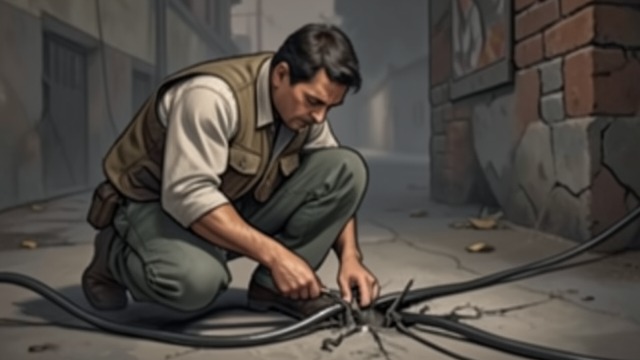
Work Before Catastrophe
Practical labor
Bartek’s everyday role is to fix equipment, trace cables, and keep systems running. The work is ordinary, often invisible, and valued because it allows other people to continue their own tasks.
A skill carried forward
When catastrophe arrives, that same labor becomes essential to survival. His occupational identity crosses the break between human society and transformer existence.
The opening establishes work as both a practical activity and a possible foundation for Bartek’s sense of self.
A City Kept Alive
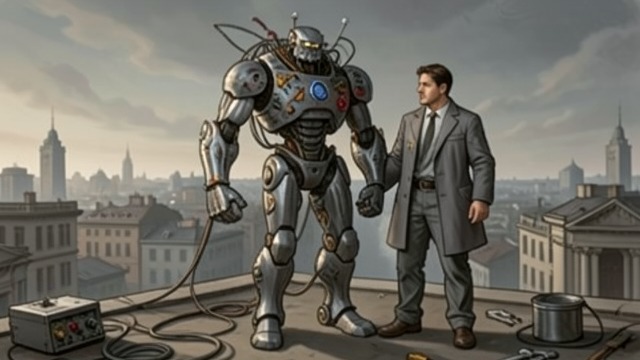
A City Kept Alive
Maintenance replaces civic life
Bartek repairs mechs and infrastructure as transformers struggle to keep Tokyo functioning. The work maintains a city whose streets are largely empty of organic people.
Purpose and repetition
Technical activity gives the community something to do, but it can also reduce a person to a function. Bartek’s usefulness does not resolve his melancholy.
The city’s continued operation therefore raises a question about whether keeping systems alive is itself a meaningful life.
A Robot Exists to Work
A Robot Exists to Work
An inherited rule
Bartek recognizes that transformer societies repeatedly reproduce work, roles, and hierarchies to make existence feel organized. The habit may persist even when the material conditions that once required it have changed.
A possible alternative
The paradise project asks whether a community can live without making productivity the condition of value. Its experiment challenges a rule that has become almost part of transformer psychology.
The question concerns not only economics but the meaning assigned to motion and life.
A Caretaker’s New Work
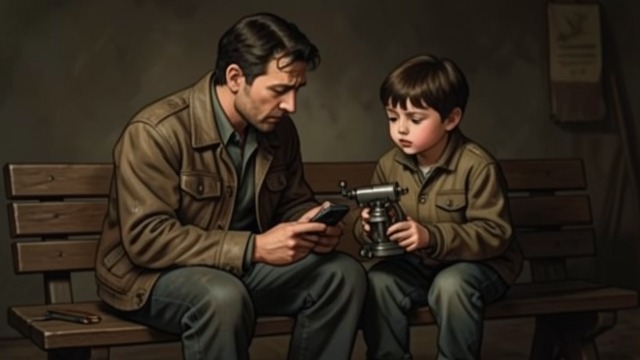
A Caretaker’s New Work
Care replaces repair
Bartek increasingly spends time with children and their environment rather than concentrating only on servers. He jokes that the work is still a form of caring for hardware, but the comparison does not fully capture the change.
A changed relation
Care gives him intimate responsibilities that cannot be reduced to fixing a machine. His role grows through attachment, even while he struggles to name it.
The shift suggests that the old technician may be changing through the relationships he forms.
Work Across Civilizations
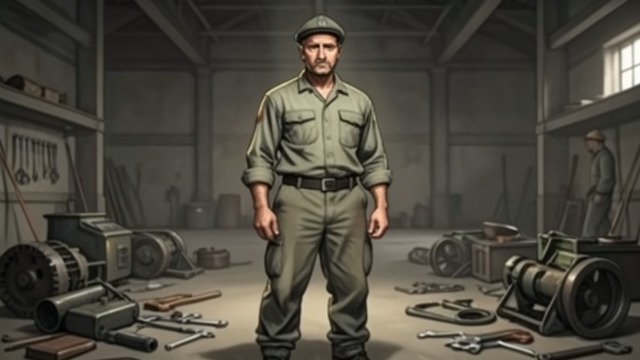
Work Across Civilizations
Repeated activity
New societies and forms of life arise around the remnants of older systems. Mechanical work, ecological change, and cultural creation recur in different shapes.
Purpose without permanence
Bartek’s history cannot establish that any single form of work or society is final. Meaning shifts with each world, while the capacity to build and maintain persists.
The long chronology turns work into one possible expression of existence rather than its universal definition.
Before Zero Hour
During the early years in Tokyo
During the creation of First Paradise
Around 10K PostApoc
In the deep-time sections near the ending
