
Nature Returned and Remade
The Old AxolotlThe resurrection of living systems gradually reshapes landscapes and societies, showing that restored nature is neither a simple return nor a stable achievement.
increasing Bearing strength in each event
 decreasing
Bearing strength in each eventdecreasingA Sterile Planet
A Sterile Planet
Biology disappears
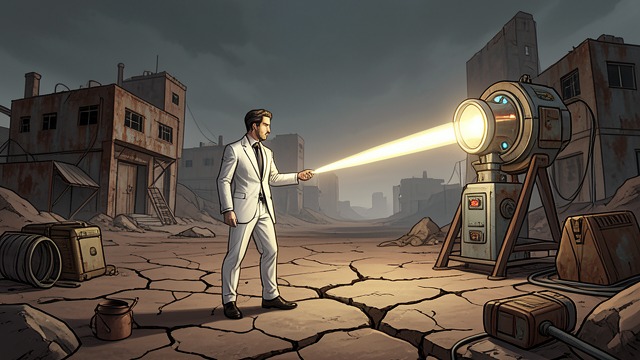
The Death Ray kills organic life while leaving much of the built environment intact. Cities, machines, and stored information remain amid an absence they were not designed to withstand.
A transformed problem
The survivors can access records about life but cannot depend on living ecosystems. Their task is not merely to repair machines; it is to recreate conditions for biological existence.
The opening catastrophe separates technical continuity from ecological continuity.
First Organisms
First Organisms
Reconstructing life
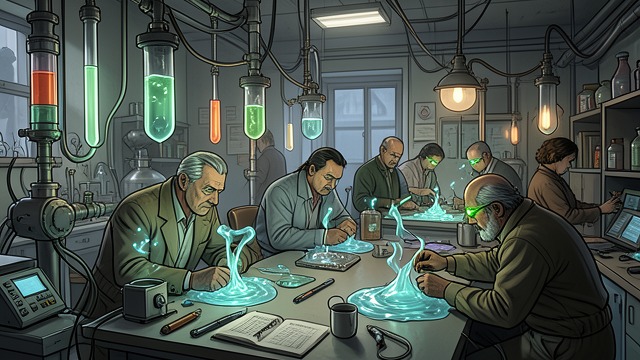
Scientists and technicians use archives and synthesis equipment to make organisms from stored knowledge. Each successful reconstruction depends on developmental conditions, not simply on copying a sequence.
Unpredictable outcomes
Biological processes exceed straightforward technical control. The project must learn from variation and failure as living systems develop in unfamiliar environments.
The first organisms demonstrate that restoration is a process of experimentation, not an exact rewind.
Green Returns
Green Returns
The first expansion
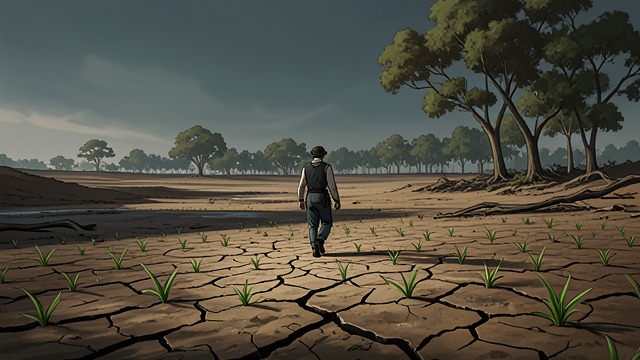
Plants spread across land near the Farm, and Bartek follows evidence that seeds have traveled beyond cultivated plots. A landscape that once appeared permanently dead begins to change.
New dependencies
The return of vegetation offers hope but does not restore a complete ecosystem. Soil, microbes, climate, and other organisms remain part of the work.
The green shoots mark both ecological recovery and the beginning of new environmental complications.
The Ocean Crisis
The Ocean Crisis
A missing foundation
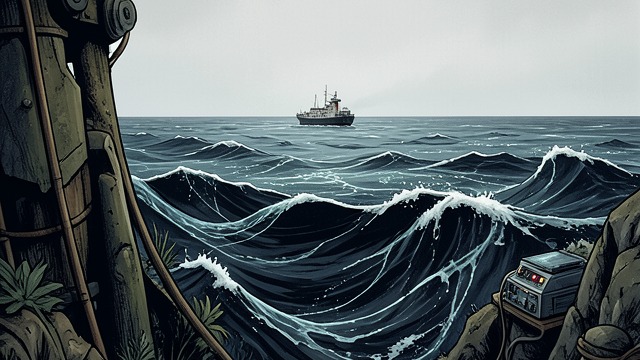
The disappearance of plankton disrupts atmospheric processes and contributes to rapid warming and rising seas. The crisis shows how organisms invisible to most people had sustained the larger biosphere.
A new priority
Dagenskyoll pushes for research into ocean life, arguing that terrestrial restoration cannot prevent the ocean from overwhelming existing communities.
The emergency expands the project’s purpose from rebuilding selected species to restoring planetary systems.
Nature Without a Final Form
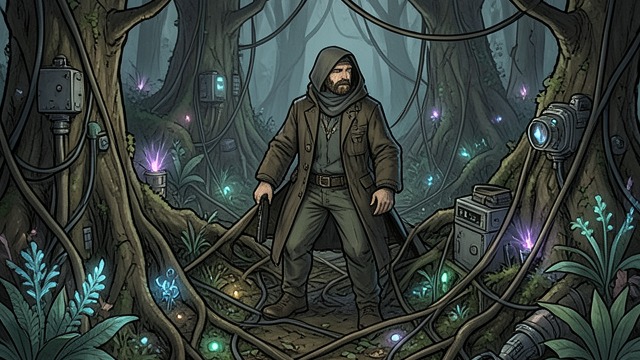
Nature Without a Final Form
New ecologies emerge
As time passes, landscapes fill with unfamiliar plants, animals, machines, and networked forms. Reconstructed biology becomes a source for further combinations rather than a fixed copy of the past.
Restoration becomes evolution
No single generation controls what nature becomes. Life continues through unexpected forms that may no longer resemble the world the original project hoped to recover.
The deep-time vision treats ecological renewal as an open process, not a return to one lost equilibrium.
Immediately after the Extermination
During the early Project Genesis experiments
Around 27 years after the Extermination
Several years after the Gulf Stream stops
Across the novel’s deep-time future
