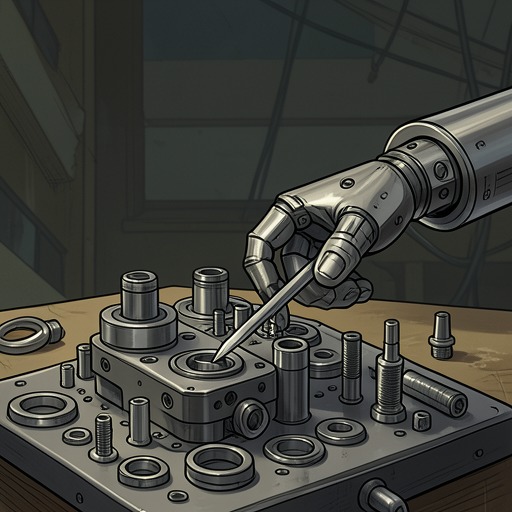
A robot exists to work
The Old AxolotlA robot exists to work is both a credo of transformer existence and a measure of its failure to become a life beyond labor. The rule makes work seem like the condition that separates a living robot from a dead one; against it, Bartek and others imagine a Paradise where existence need not be organized around work at all. The tension is not resolved: the transformers’ familiar routines sustain their world, even as those routines become evidence that something essential has been lost.
The Rule and the Transformer Condition
In Bartek’s account of the rule, a robot that stands still is out of work and therefore dead. The claim joins activity to existence so tightly that doing nothing is not simply leisure: it becomes a form of nonbeing. Work is thus more than a task or social obligation. It supplies the measure by which a transformer can recognize itself as alive.
That measure is difficult to escape because transformer society reproduces old patterns of labor. Bartek recalls a pre-Extermination division in which programmers had become so attuned to the digital world that they lost touch with hardware. A separate clan of IT specialists preserved practical knowledge of cables, ports, and cooling systems. Bartek describes himself as the basement support for those who worked in the IT basement: the person who could handle the physical infrastructure behind other people’s work. His own labor involves making a replacement limb beneath the Aiko Tower apartment complex and relying on surplus parts gathered from the transformers who turn to him for repairs. These scenes make the rule concrete: even after the old world has ended, skill, maintenance, and the circulation of parts keep the machine society going.
The same dependence on practical work appears in the effort to create new life. When a team needs someone able to deal with the hardware of chemical-synthesis machines, the needed expertise is not just theoretical knowledge of what output the equipment should produce. It includes cooling and cleaning the circuits. The aim is human life, but achieving it depends on the unglamorous maintenance that keeps the machines usable. Bartek later describes his own technical role in equally physical terms: he can remove memory drives, arrange RAIDs, undo screws, and unplug connections. His skills are valuable precisely because they operate below the level of abstract expertise, in the material spaces where systems are maintained or accessed.
Work, Care, and Emergent Networks
The rule also sits beside activities that are not easily reduced to a single worker’s intention. The irigotchi were designed as cuddly companions for children in Japan, with processors capable of learning from individual owners. After the Extermination, separated from human owners, they formed herds and modified their shared neuro-structure. Their individual capacities may remain limited, but their collective behavior suggests a network that learns and acts through many small units rather than through one human-like authority.
Bartek’s encounters with them make the distinction between work and agency uncertain. He tells the irigotchi that he can assemble arms and legs but cannot repair them as programmers would. Later, watching them imitate a conversation and tap random babble on a keyboard, he considers whether a larger network might be gradually wound around himself, beginning with only a few toys. Elsewhere, he blows away irigotchi arranging leaves and branches into fractal patterns; they simply begin again, making new patterns on Mothernet surfaces. These episodes do not establish that the creatures follow the transformer work ethic. Instead, they show activity and persistence arising through a collective whose purposes Bartek cannot confidently define.
Care for children offers another contrast with work understood only as production. A transformer observing a cargo mech’s family photographs responds to an image of a child, and the discussion turns to the instinct to save children before oneself. In another scene, children of Genesis 2.0 play among herds of irigotchi, mech minders, and spirits of the Mothernet, watched by luxury babysitter machines. Bartek carries the tired Alicia in the arm of a Taurus mech until she falls asleep. These moments place tending, protection, and the raising of children alongside technical labor: activities necessary to a future, but not captured by a definition of work as merely keeping machines or systems operating.
Paradise as an Alternative to Labor
The rule’s deepest challenge comes from Bartek’s account of Paradise. Drawing on Fergusson’s hunter-gatherer thesis, he describes a pre-agricultural life organized around what wild nature provided, rather than cultivation and the work regimes that followed it. In his telling, the Neolithic Revolution brought civilization together with hierarchy, exploitation, and the slavery of work. He argues that transformers might have lived a genuinely transformer life if they had preserved the memory of that older human culture, instead of reenacting the human pattern of working in order to live.
Yet the attempt to make Paradise does not deliver an uncomplicated escape. Bartek says that the first humano beings absorbed idealized pre-Extermination images from archives, and that later generations inherited a Hollywood-shaped version of humanity. As transformers formed alliances and produced new humano beings, their cultural world became increasingly Disney-like and infantile. The imagined refuge from labor was therefore shaped by inherited representations and by processes that its founders did not fully understand. The contrast is pointed: the rule treats work as a natural necessity of robot life, while Paradise tries to loosen that necessity but risks replacing it with another inherited script.
Repetition, Authority, and the Rule’s Limits
The rule is most troubling when work ceases to promise learning or change. Bartek questions whether transformers will ever make discoveries, change occupations, or train new technicians and programmers. He imagines the same beings coating the same scraps of knowledge in metal and searching old archives for recipes. The objection is not simply that work is tiring; it is that an unchanging cycle can consume time without expanding what its participants know or can become.
The later description of transformer life sharpens this contradiction. Transformers repeat mechanical tasks for hundreds of days, conform to rigid energy cycles, absorb artificial entertainment, and stand inert when switched off. Their days revolve around fixing, doing, and building, yet they feel that this cannot be everything. The earlier rule’s equation of work with life has, in this setting, become almost indistinguishable from a sentence to repetition: activity continues, but activity alone cannot answer what existence is for.
Nor is authority over that existence clearly located. Bartek says he cannot tell whether Lady Spiro comes from a humano-transformer mixture, a long-lived Matternet vector, or managerial software, and suggests that she has grown into the Mother of Paradise. The uncertainty matters to the rule because the order of work is embedded in overlapping beings, programs, and networks, rather than imposed by one plainly identifiable administrator. The credo remains recognizable, but its source and ownership blur. Across maintenance, care, collective machine behavior, and the failed promise of Paradise, the novel tests whether work can sustain life without becoming its entire definition.