Aiko Tower
The Old AxolotlAiko Tower is a forty-storey apartment complex in Tokyo, but its importance lies as much below and above its apartments as in the building itself: an underground-garage workshop shelters Bartek’s repair work, while a satellite antenna on the roof connects him to information about the surrounding city. The tower becomes a compact portrait of post-apocalyptic infrastructure—not a self-sufficient refuge, but a place where machines are repaired, parts accumulate, and distant systems remain visible through improvised links.
Setting and Physical Structure
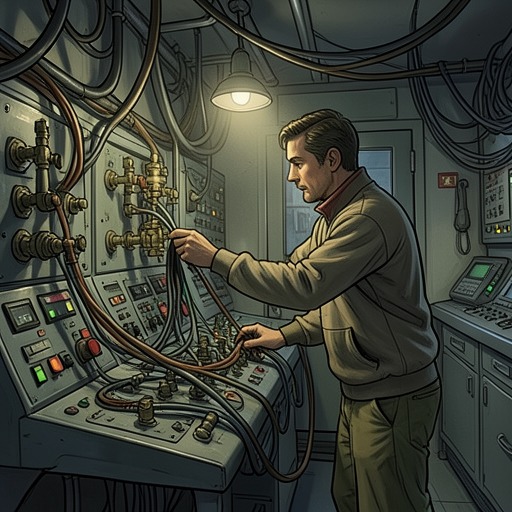
The workshop sits beneath the Aiko apartment complex, in an underground garage where Bartek works on a replacement limb. The scene is situated at night in Tokyo on day 847 PostApoc, with the city’s fading lights providing the only response to the irigotchi’s signals. The setting joins bodily repair to urban repair: Bartek’s own need for a new limb is addressed in the same space where he handles components and equipment for other machines.
The garage is organized around material abundance without easy access to expertise. Hundreds of robot parts, obtained as surplus payment from Tokyo transformers of the Royal Alliance whom Bartek has helped, are stacked against the workshop walls and on overhead racks. Their range of sizes suggests a broad reserve, but the parts are not interchangeable solutions; the boutique Miharayasuhiro Star Trooper components are rare, and using them requires uncommon skill. Bartek’s shelves therefore record both his usefulness to the local community and the limits imposed by scarcity.
Workshop, Repair, and Technical Knowledge
Bartek’s work depends on a practical library assembled from construction plans, manuals, and urban hardware catalogs. The catalogs divide machines into domestic, street, industrial, medical, municipal, military, recreational, air, and underwater lines. Their sequence also gives the workshop a larger technological horizon: mechs lead to drones, then to stationary hardware and the Matternet, a server-less network of microprocessors using RFID, infrared, and NFC. The materials offer a map of a technological development interrupted by the Extermination just as service robots might have become widespread.
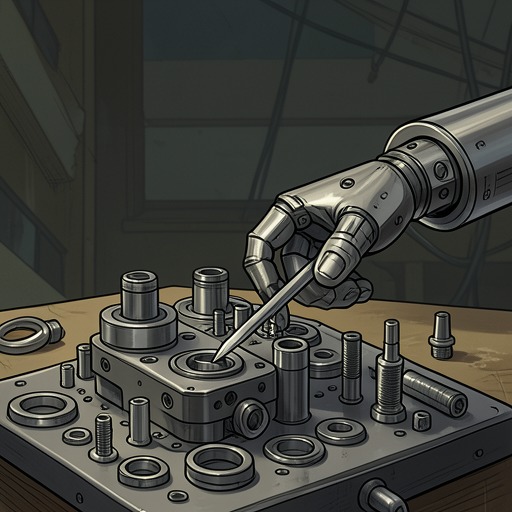
That archive does not make Bartek an all-purpose engineer. The Japanese handbooks that interest him most remain unreadable to him, and he wishes he could call a mech service center. He distinguishes his ability to assemble arms and legs from programming, which he cannot do. His importance instead rests on hardware knowledge: years before the Extermination, programmers had become so oriented toward the digital world that a separate group of technical specialists maintained the practical knowledge of cables, ports, cards, and cooling. Bartek describes himself as the basement support beneath even those basement specialists. His competence is specific, accumulated, and indispensable precisely because it concerns the physical systems that software-oriented workers overlook.
A Faraday cage at the rear of the workshop holds three sexbots, a medico, and a Beetle. The irigotchi keep away from the cage, clustering together to watch Bartek from a distance. The contrast places vulnerable, dependent machines beside equipment that they fear, while Bartek insists he is not going to repair the irigotchi themselves. The garage is thus not a seamless repair facility: it contains machines he can work on, machines he cannot, and others whose response to the equipment shapes how they move through the space.
Connections to the City
A satellite antenna perched on the roof links the basement workshop to a wider Royal Alliance information network. Through a double-filtered USB connection, Bartek uses a laptop to inspect updated zones of influence in Greater Tokyo and alert colors for power lines from plants in Tokyo and Hamaoka. The display makes the tower more than a place of isolated labor: from its roof, information about the city’s power and political geography reaches the worker below.
The network view includes specific places and activity indicators. The JPX server room at Nihonbashi Kabutocho, where most Royal Alliance transformers in Tokyo are processed, is marked green; the attendance meter at Chūō Akachōchin in Kyōbashi registers seven transformers. These details make the tower’s connection to the city operational rather than abstract. Bartek can track the status of infrastructure and the presence of transformers, even as his daily work remains the repair of particular bodies and machines in a garage.
People and Narrative Significance
The workshop serves a community beyond Bartek. Royal Alliance transformers turn to him for hardware help, and surplus parts returned as payment have filled the space. Frances Rory later arrives at his basement workshop in a mass-produced Honda Geisha IV and kneels near the irigotchi’s playpen. SoulEater39 appears briefly as a four-armed Sony medico to vouch for Frances symbolically. The scene makes the garage a meeting place as well as a repair site: relationships and recognition occur amid its practical equipment and dependent machines.
Aiko Tower’s significance comes from this layering of local and networked work. Bartek’s underground labor repairs what a damaged technological world still uses, while the roof antenna brings updates from a much larger system down to his laptop. The contrast is pointed: the city’s networks can mark power lines, influence zones, and server activity, but they do not replace the person who knows how to fit parts, clean hardware, and make a machine usable again. The tower concentrates that dependence in one building, where the future of automated infrastructure is preserved through repair work that remains stubbornly physical.