Al-Asr
The Old AxolotlAl-Asr is Bartek’s mech, a vermilion machine whose changing form gives physical shape to the novel’s reflections on companionship, vulnerability, and mechanical survival. It is at once a body that can meet another mech in exuberant combat, a recognizable figure whose head becomes an axolotl’s snout, and a damaged machine whose failing batteries gradually narrow the possibilities of movement and thought.
Identity and Physical Form
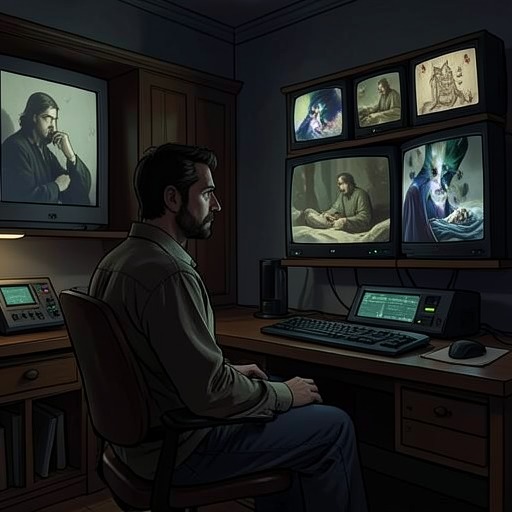
The narrative refers to Bartek’s machine as Al-Asr and also calls it an iguarte. Its material appearance is vivid and mutable: during the fight with Dagenskyoll’s Schmitt 4, something jangling on the vermilion mech sounds as the opposing machine strikes its back plate. Later, the cinnabar egg of Al-Asr’s head turns into the oval snout of an axolotl. The transformation makes the machine’s amphibian likeness unmistakable, its bulging eyes scanning the bright expanse below the cliff.
This image connects the mech to the axolotl motif without erasing its mechanical body. After its fall, the snout still shines from among twisted scrap metal, and the dull eyes of the ambystoma continue to search the horizon. Al-Asr’s machine form is therefore not merely a shell that disappears when damaged: its recognizable face remains present even when the rest of the body has lost its shape and function.
Combat, Contact, and Companionship
Al-Asr’s most physical encounter with another machine is its fight with Dagenskyoll’s Schmitt 4. After Dagenskyoll describes how exhausting a week of negotiation with the Castlings has been, he says that seeing Bartek feels like returning to his senses and nudges Al-Asr again. Beneath the cliff, an upside-down Venice seems to float by, followed by Las Vegas, El Dorado, and Metropolis, as Al-Asr nudges the Schmitt back. The setting’s shifting spectacle accompanies the machines’ contact rather than interrupting it.
The exchange quickly becomes a brawl. The Schmitt strikes the metal plate on Al-Asr’s back, making something jangle on its vermilion frame; Al-Asr answers with a lightning uppercut from a squatting position. The machines repeatedly pound each other, rising to their feet and staggering toward the tower. Around them, joyful emotes burst into fountains while images of Alhambras and Teotihuacans parade across the sandy plain. The collision of battered metal is both sound and spectacle, shared with the Castlings, who run around the fighters clapping and singing about the transformers’ fight.
The combat escalates into deliberate destruction. Dagenskyoll plays roars from his archive, including Godzilla, King Kong, and the Alien; Bartek answers with the primal howl of Bruce Lee and the wail of a ship’s fog siren. Their exchange gives the fight an improvised, performative quality: each machine replies not only with a blow but with an archived or reproduced sound. Yet the contest has physical consequences. Bartek drives Al-Asr’s head like a torpedo into Dagenskyoll’s hip joints, and Dagenskyoll catches Bartek around the middle and hurls the robot onto the stone beneath the tower. The tower tilts and the sun jolts askew. The machines’ play is forceful enough to unsettle the landscape around them.
The Cliff and the Axolotl Face
Later, Al-Asr approaches the cliff edge and looks down into the abyss. At this point its head changes from a cinnabar egg into an axolotl’s oval snout. The amphibian face, fixed in development, surveys a continent described as both death and dreaming. The transformation concentrates the contrast between the machine’s engineered body and the vulnerable, searching expression imposed upon it: Al-Asr is presented as a mech, but also as a face looking out over an immense and uncertain world.
Bartek’s response to Lady Spiro’s appeal brings that image into a conflict over attachment. He remembers Mika, Floki, Sloki, Dedek, and Philomenka, who let themselves be vectored at once without saying goodbye, and questions whether they could care for him rather than treat him as furniture, an old computer, or a blow-up doll. As the dispute continues, Al-Asr stands at the cliff edge; Bartek then leaps backward and falls into the abyss. The recording cuts out when the machine hits the first shelf of rock, separating the fall from the moment when Bartek next returns to awareness in the machine.
Damage and Diminishing Power
At the bottom of the cliff, Al-Asr can repair itself internally, but its recovery is not immediate: several hours must pass before the iguarte can get back on its feet. It is smashed and twisted out of shape, no longer resembling the distinctive handiwork associated with the transformers of Allah. The cinnabar snout remains visible in what is now only a colorful heap of scrap metal. Above it, Lady Spiro and the humano appear as dark figures on the cliff; because the Mother does not extend beyond Paradise’s borders, Lady Spiro must lean out, strain, and bleed out of herself to reach the fallen machine.
The damage persists into Al-Asr’s later journey. It has lost its back plate, its eyes search the horizon, and something is wrong with its batteries. It must wait for dawn and drink in sunlight before it can raise itself to a higher energy curve and move again. The need for sunlight makes recovery contingent on the machine’s surroundings: movement is possible, but only after a pause dictated by its damaged power system.
Al-Asr limps onward through deserted Grenadas, Gothams, and Nessuses, then past Florences and Shanghais and across the dried-up Sargasso Sea, where millions of ships of water, air, earth, and vacuum lie. Its pedometers register absurd distances, suggesting that the machine has already crossed a vast continent. It reaches ramshackle wind and solar power stations and collapses beneath a white pole. The repair systems cannot solve the serious battery malfunction: the batteries neither store energy through the night nor charge fully, leaving just enough power to keep the processor running.
The Mech as a Limit
The failure of Al-Asr’s batteries turns movement into a direct cost. Every movement of metal means one thought less, so the machine eventually stops moving and rests against the polished, crystalline bone of an ancient beast. Its efficiency continues to decline as entropy reduces the output of its subassemblies; it drops to lower energy profiles, slows, and cools. Days pass without registering clearly, and Al-Asr sometimes misses whole periods of light and darkness while exposed to scorching heat, monsoonal rain, and sand that rises to its breastplate before flowing back down its inert limbs.
Even as the machine becomes nearly motionless, the world around it continues to change. Constellations turn faster; new Rosettes and non-Rosettes, radio telescopes, habitats, solar mirrors, orbital elevators, and particle accelerators appear in space. Al-Asr does not pursue the question of what is being built there, because even wondering would cost a year in lethargy. Its enduring presence is therefore not a triumphant return to function but a narrowing into passive observation: the mech that once answered blows with an uppercut and crossed the continent is reduced to a processor kept alive by its remaining power, exposed to the currents of time, technology, nature, and dreaming.