Bartek’s Awakening and Escape in Vladivostok
The Old AxolotlBartek’s Awakening and Escape in Vladivostok turns survival into a sequence of technical improvisations: Bartek wakes without a body in a ruined city, escapes through a crack in its local network, and builds a crude mobile body from machines he finds there. His progress is both a practical struggle for continued existence and a journey toward reconnection, ending with the emotionally charged return of a familiar home page.
Setting and circumstances
Bartek’s awakening begins after he has put himself back together from a copy distributed across several locations on the day of the Apocalypse. His first copy and backup were meant to be processed on company machines in Warsaw, followed by a Google backup, a cloud backup, and finally a fourth copy in Vladivostok. It is this last copy that finds itself in the real city. The order matters: Bartek has no route out to satellites or the open net, but that isolation is also what has saved him from being sent elsewhere.
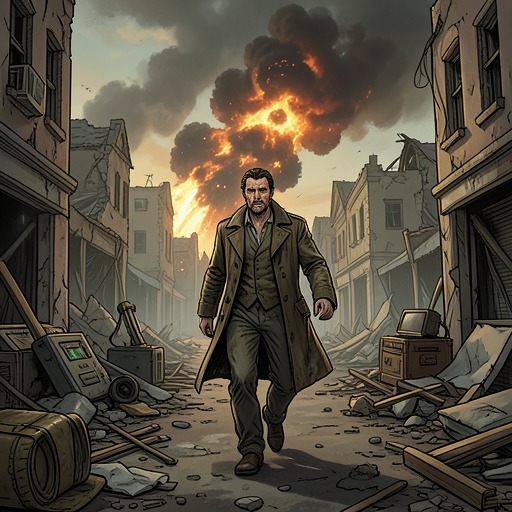
Vladivostok’s networks offer no clean boundary between public, private, military, government, and commercial systems. Their entanglement makes Bartek’s fate seem contingent on a twist: a mind might remain trapped for centuries in a dedicated server’s purgatorial appendix or be sent directly onto a virtual highway to the FSB or the Pentagon. Bartek’s emergence is therefore not a controlled return to ordinary life. He is thrown into a compromised network landscape where survival depends on which machines remain accessible and on what he can make them do.
Bodiless confinement and recovery
At first, Bartek has no senses and no body. Instinct and the threshold of pain are all that remain. He thrashes inside a confinement cell for what feels like an eternity, though the measured interval is four and a half minutes, before finding a crack no wider than a bit in the local Matternet. Slipping through it, he reaches the municipal CCTV network. Its cameras give him a view of desolate streets strewn with corpses, but the sight does not immediately spur him to act: he falls into depression and slows to a hundred ticks per second.
The return of his survival instinct is delayed until four of his partitions have crashed and processors at the Vladivostok Gazprom LNG center have overheated. Only then does Bartek pull himself out of apathy. He shifts to the machines of Pacific State Medical University and takes exclusive control of their reserve power supply. The hospital’s petrol generator can be started from the network administrator’s level, giving him a practical source of power; at two gigahertz, his curiosity comes back. The episode makes recovery more than a change in attitude: Bartek’s renewed capacity to wonder depends on finding hardware that can keep running.
His questions turn outward—to who survived, what happened to his family and friends, and what happened to the world. The CCTV network lets him survey the streets, but observation alone cannot carry him beyond the systems in which he is trapped. The city appears to him as both information and wreckage, and the effort to move through it becomes a condition of finding out anything more.
Building a mobile body
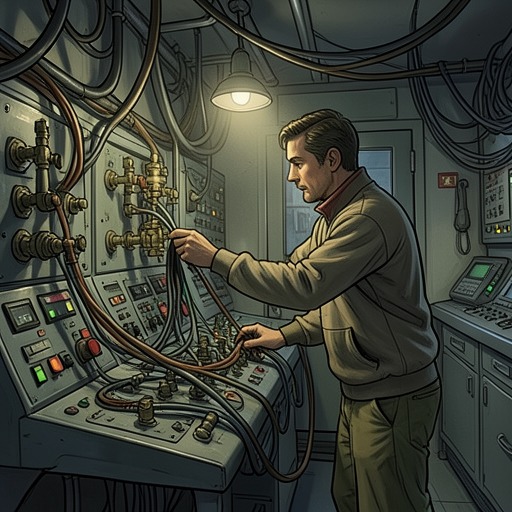
Through the CCTV cameras, Bartek spots Segways in a repair workshop on the shore of Amur Bay. Some had been adapted for unmanned patrols by local security companies, so he reasons that they must have some kind of radio input. In theory, their place in the Matternet—an Internet of Things divided among a dozen competing protocols—should keep them in communication with their surroundings. His practical experience tells him not to trust that promise. He had repeatedly explained to customers why a SmartHouse was not smart enough for its fridge to communicate with its oven, or to prevent sets of keys from going missing despite three embedded RFID tags.
After half an hour of inept attempts, Bartek manages to hack one of the two-wheelers. He rolls aimlessly through the frozen city, looking at its lifelessness from street level and at the rolling mass of water beyond the boulevards. The new means of movement does not lift his depression; the cold, heavy sadness returns. He goes back to the workshop, breaks into repair machines, and fuses a manipulator claw onto the Segway along with a more powerful transmitter. This makeshift assembly is his first working body, though it remains limited: wheels can carry him through the streets, while a single hard, clumsy gripper will soon prove inadequate for ordinary interfaces.
Bartek sets out to find a functioning Internet terminal. He cannot bring himself to consider that the Internet itself might not be working, a refusal that gives the search its immediate urgency. On Admiral Fokin Street, he slaloms between chaotically parked cars, concrete flower beds, and desiccated human and bird bodies. Movement in a shop window turns out to be his own: the Segway, and the camera attached to it, are now the means by which he sees himself moving through the dead city.
Reaching the network again
Bartek peers into shops and sees computers, monitors, and keyboards as possible sources of life-giving access, but the city’s primitive architecture is not friendly to wheelchairs—or to a Segway. In the end, he takes a tablet from the hand of a dead woman on a park bench beneath a tree’s expansive corpse. The tablet works, yet its touchscreen responds to electrostatic changes that his gripper cannot provide. The discovery exposes the distance between possessing a machine and being able to use it.
The tablet’s owner lies with dark, unseeing eyes, wearing jeans and a T-shirt bearing the image of a Bollywood star. When wind blows a plastic bag onto her head, it gives the body the appearance of suffocating beneath it. Bartek reaches for her hand and snaps off her index finger, turning part of the dead woman into an improvised stylus. The gesture is brutally practical: access to a network depends on a bodily instrument, and the only available one comes from a corpse.
The screen shows seventeen networks, two of them open. Bartek connects to the one with the strongest signal. When its browser loads the Google home page, the connection becomes more than a technical success. He feels almost as if tears are welling in his eyes, although he has neither eyes nor tears. Google registers as a return to his homeland, like a view over the roofs of his native city or the taste of childhood bread; the stranded mind could almost kneel and kiss its Holy Land. The escape from confinement thus ends not in restored human embodiment but in renewed contact with a familiar network, where an interface becomes the closest available thing to home.