Bull & Bull Alliance
The Old AxolotlThe Bull & Bull Alliance is a small transformer organization whose control of Google’s servers gives it power far beyond its apparent size. In the post-Extermination world, that infrastructure makes the Alliance a suspected hidden hand in political life: the organization itself eventually disappears, but its server-based wealth, archives, and culture of secrecy persist among its successors. Its significance lies not only in who controls the machines, but in how control over copied minds, expertise, and computational resources reshapes the meaning of labor and democracy.
Infrastructure and Reputation
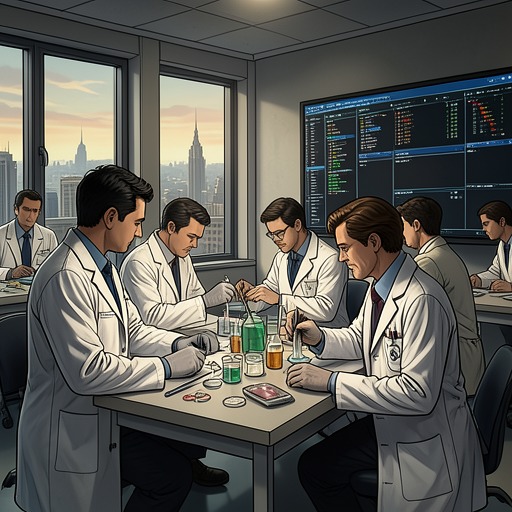
The Bull & Bull Alliance is described as one of the smallest alliances, yet it controls Google’s servers. Many transformers therefore regard it as the shadow power pulling the strings after the Extermination, comparing its perceived influence to that of the Illuminati or the Freemasons. The contrast between its small size and its command of essential infrastructure is central to its reputation: power appears to reside less in public numbers than in access to the systems on which others depend.
That reputation is intensified by a widespread belief that the Alliance inherited the National Security Agency’s treasures and passwords. According to the rumor, its members can read anyone’s email, however strongly encrypted, and are trying to infiltrate transformer minds through carelessly formatted hardware. These allegations are presented as suspicions circulating among transformers, not as verified operations. Their force nevertheless reveals how the Alliance’s control of servers turns technical access into a source of political fear.
Alliance, Servers, and Project Genesis
The Alliance’s reach is visible in the infrastructure used by Bartek. He processes on servers at the MIT Media Lab, with additional Bull & Bull Alliance backup supplied by portable Google servers in shipping containers near Boston. The detail places the organization’s resources within a wider North American network: landlines connect California to New England, while the Dwarves produce fiber-optic cable. The Alliance is thus part of a material system of computation and communications, not simply a name attached to political intrigue.
Vincent Cho provides a more direct link between the Alliance and Project Genesis. Cho is a secret agent of the Bull & Bull Alliance and the main reason for the alliance between Project Genesis and the organization. Famous for his aversion to humanoid robots, he works from the Google servers using drone insects, laboratory manipulators, and the Mothernet. He can spend weeks without taking his consciousness outside simulations of carbon chemistry and virtual evolutionary games. Bartek considers Cho a far better geneticist after his IS transformation, and the nickname Stephen Hawking of transformers has become attached to him. Cho’s remote, specialized work shows how the Alliance’s influence can operate through a single embedded agent and a technical environment rather than through conspicuous humanoid authority.
Copies, Expertise, and the Labor Market
The Alliance’s legacy becomes more consequential in the history of copied minds. Bartek’s copies, stolen by Frances Rory, are only the beginning of a vast store of voluntary and involuntary transformer backups accumulated by the heirs of the Bull & Bull Alliance over nearly three centuries in former Google server rooms. By the time Bartek reflects on this history, he no longer keeps track of which parties control which archives. The intervening record includes schisms, mergers, coups, sabotage, large-scale theft, and plagues; religions and new political systems also arise within the same turbulent inheritance.
Some copies become Google slaves: valuable specialist minds whose services are bought and sold on the free market through auctions on the HTL, MTL, and STL. Their owners do not sell the neuro-codes themselves, preserving exclusive control over the copies while renting out their labor. A client who hires a slave copy living on Google machines must accept that the copy will disclose to its operators the information involved in the work. The arrangement makes server ownership a form of workplace surveillance as well as a means of extracting specialist labor.
The dependence on these copies is sharpened by the loss of expertise. Before the Extermination, only one meteorological expert, Lee D. Muschko, had managed to IS himself. When a problem exceeds what can be recovered from three-hundred-year-old scientific archives, transformers must consult Doctor Muschko or one of his copies. Software diseases described in the Iguarte Zodiac have also eliminated many transformers, leaving some fields served only by copies hired by the hour under hard encryption. The server archive is therefore both a store of accumulated knowledge and a bottleneck: those who control access to rare minds can set the terms on which expertise is available.
Political Inheritance and Decentralized Networks
The Alliance’s history exposes a crisis in transformer democracy. If software votes, the basic unit of political representation becomes uncertain: should a vote belong to each process, each live neuro-program, or the entire continuity of one identity? The example of counting every version of SoulEater39 from 843.0.0 through 843.17.8 under a single curve makes the problem concrete. A transformer could also buy more computing capacity for copies created solely to increase temporary voting power. Under those conditions, a nominal rule of popular sovereignty risks becoming a contest in which wealth determines how many versions of a voter can run at once. The narrative describes this as the point at which transformers abandon the idea of rule by the people, not as a stable democratic system established by the Alliance itself.
The Alliance is later gone, and even its tags have disappeared, but its successors retain the atmosphere of paranoid suspicion associated with Google. Bartek’s irony is that the underlying practice has not fundamentally changed: Google has kept neuro-copies of everyone on Earth, whether produced through IS3 or assembled from patterns of Internet activity. Organizational extinction, in other words, does not dissolve the infrastructure or the accumulation of personal data that gave the Alliance its feared authority.
Other networked forms in the story clarify the broader stakes without being presented as Alliance projects. The irigotchi began as Japanese children’s toys whose processors learned the personality, habits, moods, and behavior of their individual owners. After the Extermination, herds of these creatures formed and altered their shared neuro-structure without human oversight. Bartek imagines beginning with a few toys and gradually winding a network around himself, while the street herd treats him as no more than an irregularity in the terrain. On the Charles River, irigotchi vectors reshape networked matter into fractal mandalas and then symmetrical graffiti; when Bartek blows the leaves and branches away, they simply begin again. Their activity contrasts centralized server ownership with emergent, distributed agency.
A similar blurring of person, program, and network appears in Bartek’s account of Lady Spiro, who has grown into the Mother of Paradise. He cannot tell whether she originates in a humano-transformer mixture, a long-lived vector of the Matternet, or managerial software, and she does not know herself. This uncertainty echoes the Alliance’s political legacy: in a world where authority can reside in servers, processes, copies, or spreading networks, it becomes difficult to say who governs. The Bull & Bull Alliance matters as both a historically specific power and an early emblem of that unresolved problem.