DNA·RNA synthesizer
The Old AxolotlThe DNA/RNA synthesizer is the material centerpiece of Frances Rory’s proposal to rebuild human life after The Extermination. It stands between inorganic chemistry and the hoped-for return of a human being, but it cannot make that return self-sufficient: the project would also need an egg, incubator wombs, and a functioning biological world. When Bartek presses his metal finger into the machine’s polished housing and scratches it, the proposed reversal becomes physical: machines are preparing to create humanity, while the machine itself remains vulnerable to a mark made by one of them.
Equipment and Intended Output
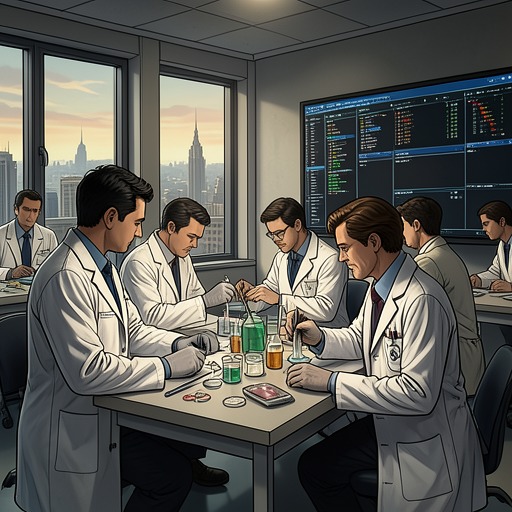
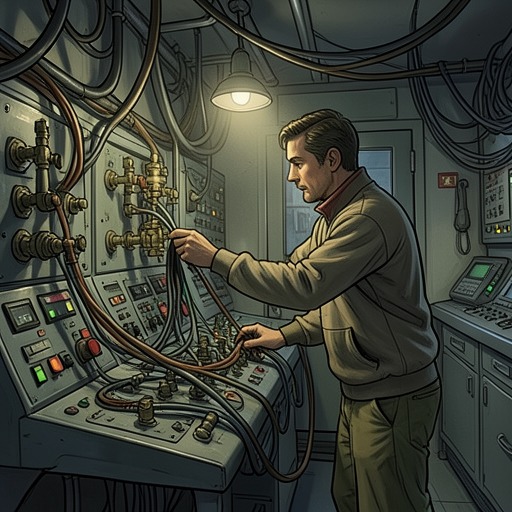
Frances leads Bartek into a laboratory and directs his attention to machinery housed in casings as large as industrial refrigerators. The equipment belongs to a line of Polygen products for high-temperature chemical synthesis. Frances has searched for information about the line but does not understand the hardware, and the group needs someone who can handle practical work such as cooling and cleaning circuits. Their expertise is divided: they can identify the desired output, but do not yet understand how the machines produce it.
That output is a human being. Frances’s proposal treats the synthesizer not as a device that can simply print a person, but as one part of a longer process. Before The Extermination, biochemists had already become proficient at synthesizing nucleotide chains; the Human Genome Project had also supplied precise DNA maps. The plan would use these existing building blocks and recipes, while separately synthesizing an egg and preparing wombs in incubators. The device therefore represents a technical possibility within a larger undertaking, not a demonstrated, self-contained means of producing life.
The Biological Problem Beyond Synthesis
Bartek challenges the proposal by pointing to what an organism needs in order to survive. A person would require the surrounding world of biology, including bacterial flora in the stomach and a continuing supply of food. Human beings consume protein—other life—over years, on a scale of tons and hundreds of tons. Frances accepts that the whole biological world must be rebuilt and says the work will take years. The machine’s importance thus lies partly in what it cannot do alone: chemical synthesis might help begin life, but sustaining a human being requires an ecology.
The distinction becomes more consequential in light of the damage The Extermination has done to Earth. The disappearance of plankton removed a major mechanism for absorbing carbon dioxide and trapping it in ocean depths. Atmospheric carbon dioxide rose to three times its earlier level, average temperatures increased by five degrees Celsius, and the loss of plankton’s role in dimethyl sulfate production further darkened ocean clouds and strengthened warming by at least another three degrees. The polar ice caps melted, sea levels rose almost a meter, and the Gulf Stream stopped. Japan was slipping underwater; the possibility of life proliferating again in the oceans was presented as a condition for reversing that trajectory. The synthesizer belongs to a project of biological reconstruction whose stakes reach well beyond the production of a single person.
Bartek’s Encounter with the Machine
Bartek initially responds to Frances’s description with blankness. As she explains the chemical route from primordial ingredients through RNA, DNA, cells, plants, and animals, he stands listening like a dead lump of metal. When Frances asks whether he will join the work, Bartek raises his metal arm and drags the sharp edge of a finger along the synthesizer’s smooth casing, pressing hard enough to leave a scratch. Metal grates against metal; the sound is described as one that would have hurt his ears, if he had ears.
The gesture makes the machine’s polished surface newly visible as material rather than transparent equipment. Bartek does not answer Frances’s question in the recorded exchange; instead, the scratch registers his reaction to the prospect of a machine-made man. The narrative frames the moment as a reset by an evil god, with the former hierarchy reversed: robots now create humanity. His contact is neither the operation of the synthesizer nor proof that the proposed reconstruction succeeds. It is a physical response to the altered relation between machine and human that the project would make possible.
Life, Inheritance, and Competing Forms of Agency
The synthesizer’s promise also encounters a limit that sequence-level knowledge cannot settle. Jarlinka explains that organisms with exactly the same DNA, developed under exactly the same conditions, can still differ. Gene expression depends on processes outside the DNA and on intergenerational memory: histones shape how DNA is arranged, while methylation can record aspects of a life, including trauma, illness, material status, education, residence, and the air breathed. Rebuilding a genome therefore does not by itself specify the organism that will emerge. The project’s challenge extends from chemical production into inheritance and development.
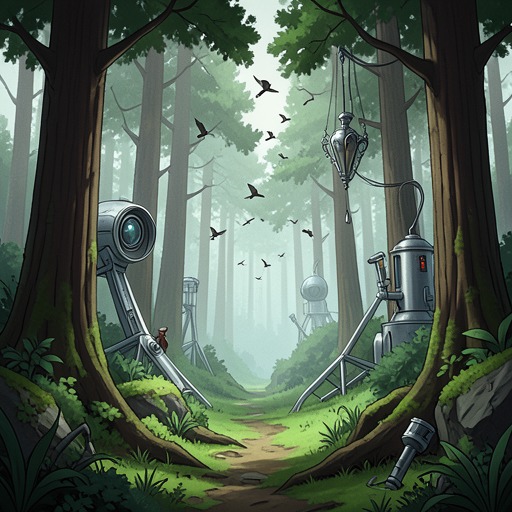
That uncertainty sits within a world where nonhuman systems already display forms of learning and collective change. The abandoned autonomous trawl nets, powered by sea currents, have developed swarm intelligence and are learning to hunt despite there having been no fish at the bottom for three years. The irigotchi, originally designed as cuddly companions for children in Japan, learned from individual owners; after The Extermination, they formed herds and began modifying their integrated neural structures without human beings. Bartek imagines how a network built from a few toys might gradually wind around him, while a Totoro soft toy taps random babble on a keyboard. These examples do not show the synthesizer at work, but they complicate the idea that life or intelligence begins only when a machine deliberately produces a human.
The ambition to create people also raises the question of what kind of humanity would result. Bartek asks whether there will be two Project Genesis 2.0s, two natures, and two humanities; Dagenskyoll answers that there will be at least two. Bartek says he wants a return to Paradise and, if Homo sapiens is begun again from scratch, wants to raise the new human his way, from epigenesis to bedtime stories. The synthesizer is therefore linked to a dispute over how life is shaped after its chemical beginnings: not just by DNA, but by developmental conditions, memory, care, and the world built around it.