Fergusson
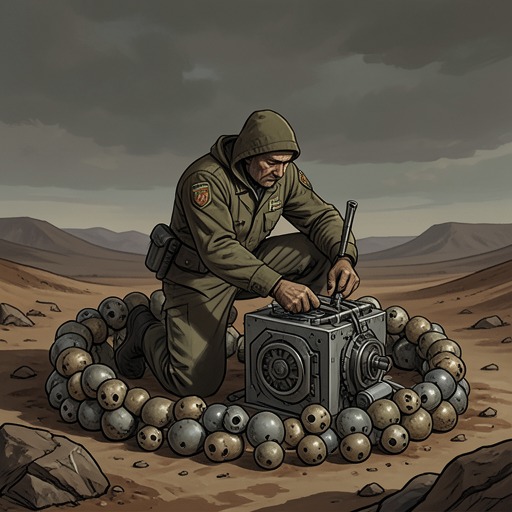
The Old AxolotlFergusson is remembered as both a practical pioneer and a theorist of what transformer life might become. After the Extermination, he planted the first Fields of Plenty; later, his account of hunter-gatherer society became a way to imagine existence beyond inherited human institutions. That alternative remained precarious: the effort to create a transformer life could itself be absorbed by familiar fantasies, while Fergusson’s eventual fate was invoked as a warning about the dangers of IS3 transformation.
Identity and Early Role
Fergusson is identified as a fellow Uralian and as the person who planted the first Fields of Plenty after the Extermination. The detail places him among the early makers of post-Extermination society: his work was not only a theory about how life could be organized, but a concrete act of cultivation within a world being rebuilt.
His later reputation rests on an explanation of why transformers continued to reproduce human social arrangements. The account presents him as someone who found a possible alternative in humanity’s distant past, before settled agriculture, and who could describe that alternative as more than a nostalgic ideal. The surviving evidence does not establish the full course of his life or the circumstances of his planting work, but it makes those two roles—founder and interpreter—central to his legacy.
Fergusson’s hunter-gatherer thesis
Fergusson’s analysis begins with capitalism’s practical appeal. As reported in a later discussion, he argued that capitalism repeatedly returned because it offered the simplest, most obvious way to manage limited resources. Its influence was not confined to economics: it brought with it ethical assumptions, aesthetics, mental habits, lifestyles, complexes, and dreams. On this account, its persistence did not prove that capitalism was innate to human nature; it showed how readily resource management could carry an entire social order in its wake.
That diagnosis is set against a society in which alliances compete over working mechs, servers, power supplies, defenses against the Plague, and access to the Mothernet. The First Transformer War would break out over resources, and ownership of functioning servers and power plants would become a settled fact. These conditions give force to Fergusson’s emphasis on scarcity: whoever controls the means of continued operation can shape the social forms built around them. The evidence does not say that he predicted the war, but his explanation addresses the resource pressures that define this wider history.
For transformers, the inherited forms of human life are described as theater without an underlying human purpose. Pseudo-families, quasi-houses, quasi-work, simulated salaries, and professions repeat the rituals through which human societies once gave meaning to labor. Fergusson’s contribution was to challenge the assumption that meaningful life required those structures. His argument turns on a difficult possibility: could a society exist without commandments, prohibitions, or ideological systems organized around work and resource allocation?
A prehistoric alternative
Fergusson located a possible answer in hunter-gatherer cultures before the Neolithic Revolution, roughly fifteen thousand years earlier. As the account presents his view, these communities met their needs from what wild nature provided. They were healthier and stronger, lived longer, and were characterized by equality between women and men, little violence, no exploitation, few hierarchies of power, and little work. The discussion associates this way of life with the Golden Age, Eden, and the paradise remembered across human mythologies.
The significance of the thesis is not simply that it idealizes prehistory. It supplies a different reference point for judging transformer existence. If the social order of settled agriculture and work was a historical development rather than an unavoidable expression of human nature, then its rituals need not be the only available model. Fergusson’s proposal was that preserving the memory of hunter-gatherer culture might let transformers live a genuinely transformer life, rather than continually staging human beings’ work-centered existence.
The ideal and First Paradise
Fergusson’s thesis becomes a premise in the later explanation of First Paradise, although the account does not say that he founded or designed it. The speaker’s reasoning is that memory of a non-work-centered life could open a path toward a distinctively transformer existence; from that aspiration came the attempt to invent Paradise. The gap between the ideal and its realization is crucial. The archive offered images of the pre-Extermination world, but those images were already idealized, a sugar-coated Hollywood version of the past.
The speaker describes the subsequent development as a generational process. The first humanos absorbed those archived images; later generaciones of humanos underwent IS3 transformation, formed alliances, and produced further generaciones whose epigenesis was heavily influenced by Hollywood. Over thirty kilodays, vectors accumulated and overlapped until Paradise had become a landscape of The Lion King, Disney, Pixar, cartoons, and comics—more infantile with each generation and increasingly detached from the truth about humanity. This is the speaker’s interpretation, not a verdict explicitly attributed to Fergusson. Yet it sharpens the contrast at the heart of his legacy: a theory meant to escape the inherited performance of human society could be overtaken by another inheritance, the fantasy archive from which the new society drew its dreams.
Fate and remembered warning
Fergusson’s fate is recalled alongside Arkon and seven hundred copies of Perez. All are described as having undergone IS3 transformation using the Ural Team cheats and then being swallowed by the same void, characterized in the recollection through the language of dream and the Valley of the Shadow of Death. The account gives no technical explanation of what happened, and it does not clarify whether the void is literal, virtual, or metaphorical. It does, however, place Fergusson among those whose disappearance is used to warn against assuming that transformation through the cheats offers a safe route forward.
That warning gives his history an unresolved shape. Fergusson proposed that transformers might stop reproducing human institutions and discover a life of their own; the project associated with that hope became entangled with inherited fantasies, and Fergusson himself became an example of the losses surrounding IS3 transformation. His significance lies in that tension: he is remembered for imagining an alternative to the existing order, but the surviving account cannot show whether he ever lived to see it realized.