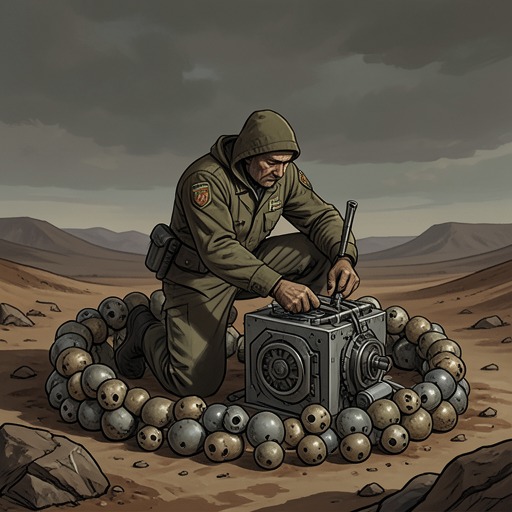
First Paradise’s Disneyfication
The Old AxolotlFirst Paradise’s Disneyfication is the cultural drift by which a refuge intended to let Transformers live on their own terms became a recursively reproduced fantasy of pre-The Extermination entertainment. Dagenskyoll traces the change from the archived idealizations that shaped the first humanos to a world that, thirty kilodays later, had become a childlike Disney-and-Pixar compendium—and ends by acknowledging that this may be his own interpretation.
The Promise Behind Paradise
The transformation is set against an original desire to escape the human model of labor. Dagenskyoll describes the alternative as preserving memories of thousands of years of hunter-gatherer culture, so Transformers could live what he calls a genuinely Transformer life rather than reenact the human pattern of working in order to live. Paradise was invented in pursuit of that alternative; its name, however, carried an inheritance that the creators could not simply set aside.
How the Fantasy Took Hold
Dagenskyoll calls the consequence a curse of dreams coming true. The word Paradise summoned idealized images of the world before The Extermination, preserved in archives and softened into what he describes as a sugar-coated Hollywood. The first humanos absorbed those images deeply. The influence then became generational rather than remaining a founding image: humanos began to IS and transform, entered alliances, and gave birth to further humanos through an Epigenesis heavily influenced by Hollywood.
As this process continued, the inherited material accumulated and compounded. Dagenskyoll describes Vectors being superimposed on Vectors, then compresses the long cultural development into a fast-forwarded interval of thirty kilodays. The number marks not a sudden founding decision but the elapsed time in which repeated inheritance reshaped the community.
The Result and Its Uncertainty
At the end of that interval, Dagenskyoll sees a Paradise organized like The Lion King, a composite of Disney and Pixar, cartoons, and comics. Its generations, in his account, become progressively more infantile and more disconnected from the truth about humanity. The reversal is central: a project meant to recover a distinct Transformer existence has instead taken its imaginative materials from idealized human archives and reproduced them until they obscure the reality they were supposed to help escape.
Dagenskyoll does not present this judgment as fully settled. After describing the decline, he allows that this may simply be how he sees it. That qualification leaves the account both a history of cultural inheritance and a situated criticism of what Paradise became, rather than an uncontested narrator’s verdict.