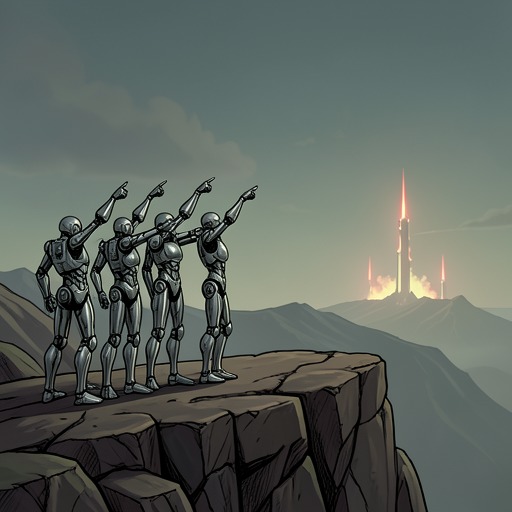
First Transformer War
The Old AxolotlThe First Transformer War is a conflict over the infrastructure that makes transformer life possible. It ends with control of working servers and power plants settled, but the order that follows is more restrictive: transformers lose the ability to provision themselves independently, and their alliances become tied to specific territories. The war makes material access—not just shared identity—a basis of political power.
Background and Stakes
After The Extermination, transformers depend on functioning hardware, reliable power, and continuing maintenance. The account frames the First Transformer War as a fight over resources and says it unfolded as SoulEater39 had predicted. The stakes are therefore concrete: access to the servers and plants needed to keep transformers operating, rather than an abstract dispute over allegiance.
This dependence has a human prehistory. Before The Extermination, programmers had become so fluent in the digital world that a separate clan of hardware specialists was needed to preserve practical knowledge of cables, ports, and cooling. Bartek is described as the hardware specialist’s specialist, and later characterizes his own work as physically removing memory drives and arranging storage arrays rather than hacking software. The war’s resource politics emerge from a world where technical existence still rests on equipment and hands-on maintenance.
Course and Settlement
The conflict breaks out, rages across the planet, and subsides. The account gives no battles, commanders, or individual campaigns; its decisive outcome is instead expressed through ownership. Once the war is over, everyone knows exactly who owns the working servers and power plants. The struggle thus converts contested infrastructure into a legible political map: the resources remain, but access to them has been divided among owners.
The reported endpoint is not universal security. On 4529 PostApoc, the last white dot disappears from the world map: no unaffiliated transformer can independently secure both regular power and constant hardware maintenance. The disappearance of that final mark gives the settlement a stark measure. Independence has become practically impossible for anyone outside the groups controlling the necessary infrastructure.
From Alliances to Nations
The war’s settlement develops into a wider political transformation. The GOATs and Black Castle divide Tokyo and its power plants between them. They unite, split into factions, and unite again; eventually, the account says, they are really Japanese. Their changing coalitions show that political unity can be repeatedly renegotiated, while territorial control over power plants gives those groupings a durable local basis.
A later communications failure further narrows the scope of transformer life. On 7899 PostApoc, the last telecommunications satellite still carrying signals across the Atlantic stops working. The undersea cables had failed earlier: the routine human repair work that once kept them usable ended on the day of The Extermination, and accumulated faults and entropy eventually overcame them. Deep-ocean engineering, the narrative stresses, is not feasible without the support of an entire civilization.
With that long-distance link gone, transformers can no longer freely log into mechs anywhere in the world. Guilds and alliances ossify into nations because they are bound not only by language and culture but also by time and place. This communications collapse is distinct from the war’s immediate settlement, yet it extends the same movement toward enclosure: control of local infrastructure and the loss of global connectivity make political borders harder to escape.
Distributed Agency and Significance
The surrounding account unsettles any simple picture of transformers as isolated individuals. The irigotchi, toys originally designed to learn from individual children, form herds after The Extermination; Bartek identifies the Tokyo population as a possible million and describes the herd as a single mind operating through a neural network. He imagines beginning with a few toys and gradually winding their network around himself, rather than being noticed by the vast street herd as anything more than a minor irregularity. This is not presented as a direct cause or episode of the war, but it clarifies the world in which the conflict occurs: intelligence and agency can be distributed across networks, while the material resources that sustain those networks remain subject to ownership.
The First Transformer War consequently marks a political threshold. It establishes who controls essential hardware, and the subsequent loss of independent provisioning and global communication turns temporary alliances into territorially rooted nations. Its history is told less through combat than through what can be maintained, powered, and reached.