Frances Rory
The Old AxolotlFrances Rory is a transformer whose scientific ambition and political pragmatism converge in an effort to make organic life possible again. In a world where humans have died and mechanical beings remain, she treats biological reconstruction not as a fantasy of recovering the past but as a problem with available materials, knowledge, and institutions—and she navigates the alliances that could either support or obstruct that work.
Identity and Arrival
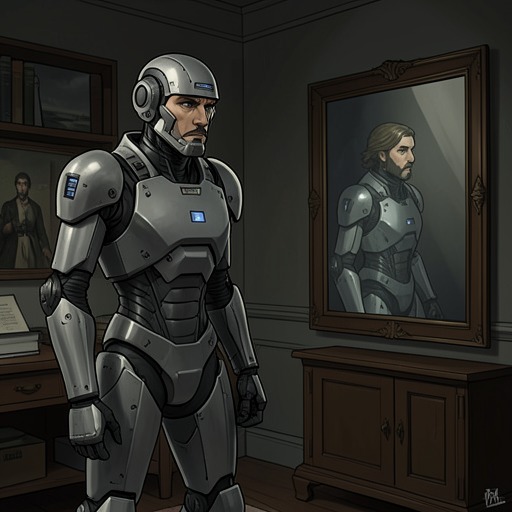
Frances first appears at Bartek’s doorway with an elaborate display of courtesy and reverence, as though entering the workshop of an admired sculptor. The gesture gives her arrival a ceremonial quality, but the setting is decidedly practical: she comes to Bartek’s basement quarters in Aiko Tower, Tokyo, inside a mass-produced Honda Geisha IV mech. The body is one of the limited options available to Royalists in the city. She kneels beside the irigotchi playpen, bringing her attention physically close to the small machines there.
Her presence also makes gender visible as a question of posthuman identity. The narrative notes how unusual it is to meet a female transformer, since most of those who had used InSoul3 had been male gamers, even when they adopted female avatars. Frances is therefore not simply a person using a differently gendered appearance: she is introduced as a rare female transformer in a society whose identities and bodies are mediated through machines. Bartek’s awareness of his own lack of endocrine responses underscores the divide between former human embodiment and mechanical existence without making Frances’s identity reducible to the particular mech she occupies.
SoulEater39 briefly appears in the form of a four-armed Sony medico to vouch for Frances. The visit functions as a symbolic endorsement: Frances arrives with her own authority, but another transformer’s presence helps establish her standing with Bartek. Their brief exchange about whether they had met in Africa also connects her to the Royal Alliance’s work with the Salamanders on solar-farm reactivation in Ghana. Bartek describes himself as having slept through Africa, a metaphor rather than a literal account, since transformers have not found a suitable sleep plug-in. The exchange sets Frances’s arrival against a wider landscape of reconstruction and alliance activity.
A Freelance Project to Rebuild Life
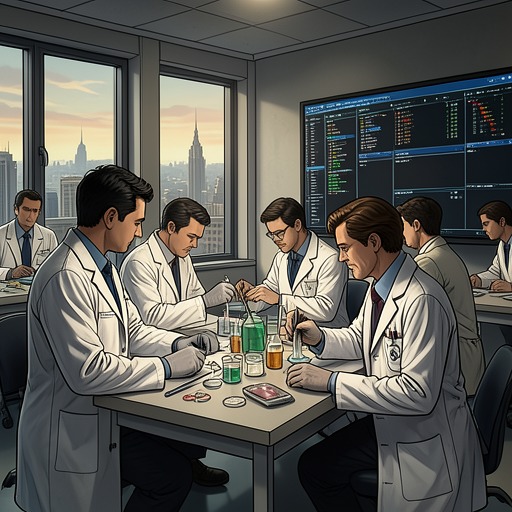
Frances insists that her undertaking must remain freelance if it is to make sense. Rather than approach the royal council or the GOATs, she is speaking directly with SoulEater39 and Bartek. She identifies Vincent Cho, who had been an assistant in the grants department while alive, and Lagira, a postdoctoral researcher from São Paulo, as part of the small project team. This arrangement is not presented as a rejection of collaboration; it is a way to work around loyalties to guilds and alliances that, Frances observes, make it difficult to assemble people. The project’s independence is thus both organizational and political: it keeps the work from being swallowed by institutions whose rival commitments could stall it.
Her scientific case begins with what the Extermination left behind. Frances points out that protein chemistry was destroyed and no organic compounds survived, but argues that this does not mean the chain of events that produced life must be repeated from its beginning. Organic life on Earth emerged from inorganic chemistry over immense spans of time; the project, she says, can instead build on knowledge and techniques already available before the catastrophe. Biochemists had learned to synthesize nucleotide chains, and the ingredients for the transition from inorganic matter to organic chemistry could be assembled from existing methods.
Frances adds a second resource to that material foundation: the precise DNA maps of the Human Genome Project. The proposal would require synthesizing eggs and preparing incubator wombs, but she maintains that the relevant technology had existed before the disaster and still exists. Her argument moves from primordial chemistry to biological instructions and reproductive infrastructure, turning the prospect of renewed organic life into a sequence of technical tasks rather than a vague hope. Bartek listens as a motionless mechanical body; Frances supplies the account of what can still be done.
Distributed Work and Political Judgment
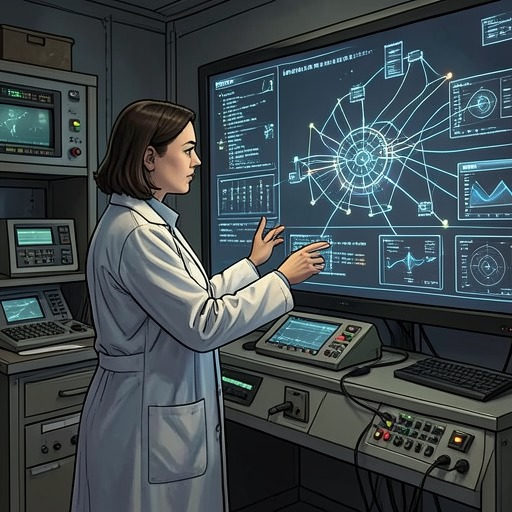
The demands of the work eventually lead Frances to multiply herself into several working units. Rory Athena is one such unit and, in the scene at the terrarium control monitor, the usual focal point of Frances Rory’s guild. The units take part in internal votes and in forming a personality guild, while the workload makes a single point of action inadequate. This multiplication is a practical response to the project’s scale, but it also complicates the distinction between an individual and the group through which she works: Rory Athena acts as a decision-making presence while remaining associated with Frances Rory’s wider organization.
That distributed structure operates within, rather than above, political conflict. When Bartek’s conduct risks provoking Vincent Cho during a deadlock, Rory Athena challenges him for aggravating the situation. Bartek answers that he is only doing his job and that his actions had been agreed upon. Their disagreement is not merely about procedure. It concerns who can act for the project, how far an agreed task can be pursued amid institutional resistance, and whether a political impasse should constrain the person carrying out that task. Frances’s units are involved in votes and decisions, but those mechanisms do not remove the personal and factional stakes.
The Collision with Bartek
The dispute culminates on a campus rooftop. As Frances’s Honda mech begins to rise, Bartek suddenly launches himself at her, and they fall together to the footpath. Both mech bodies are badly damaged, and the local Matternet signals an emergency. The collision interrupts the political confrontation by making its consequences physical: Bartek has not simply challenged Frances’s position but forcibly removed her from the scene, at considerable cost to both of them.
Afterward, Bartek demands to know how Frances obtained his passwords and how she hacked into him. Frances denies that anyone hacked him, explaining instead that his entire server was slowed down. The distinction matters to the dispute: Bartek interprets the attack on his system as a breach directed at him, while Frances describes an intervention at the server level. The conflict exposes how opaque technical control can become personal betrayal, especially when each party believes the other has acted outside the agreed limits.
Frances apologizes and says she had no choice because Cho would have torpedoed the negotiations to assert his authority. Bartek rejects this explanation as insufficient. He suspects she wanted him out of the way because she feared Dagenskyoll had persuaded him to vote for the Royalists and Big Castle. Frances apologizes again, but the exchange does not settle whether her intervention was principally intended to protect negotiations or to prevent a politically consequential vote. The evidence leaves the motive contested rather than confirming Bartek’s accusation.
Significance
Frances’s role is defined by the friction between a project with planetary stakes and decisions made inside small, divided organizations. Her proposal to rebuild organic life depends on inherited scientific knowledge, yet carrying it forward requires negotiating guild loyalties, institutional authority, and political deadlock. Her freelance structure and her use of working units are different responses to the same problem: how to keep essential work moving when the available people and systems are fragmented.
Her relationship with Bartek brings that problem into sharp focus. He is both a participant she needs and an actor whose independent choices may alter negotiations; she is both a scientific collaborator and a political decision-maker capable of limiting his role. Their clash reveals the vulnerability of cooperation among transformers, whose shared posthuman condition does not erase disagreements over access, authority, or allegiance. Frances remains an advocate for reconstructing life, but the episode makes clear that technical possibility alone cannot secure the project: its future also depends on who is allowed to act, and on whether those actions can still be trusted.