Fredek · Indy
The Old AxolotlFredek / Indy is a nearly fourteen-year-old child of the First Litter whose upbringing joins transformer guardianship, digital human culture, and machine care. His chosen name and his appetite for Indiana Jones adventures shape his appearances: first as a boy barely able to manage an oversized motorcycle, then as a determined player who tries to reach a forbidden form of virtual reality. When the attempt stalls at an eight-hundred-page manual, Bartek chooses to help him, making the episode a small but telling crossing of the boundary between prohibition and participation.
Identity and Upbringing
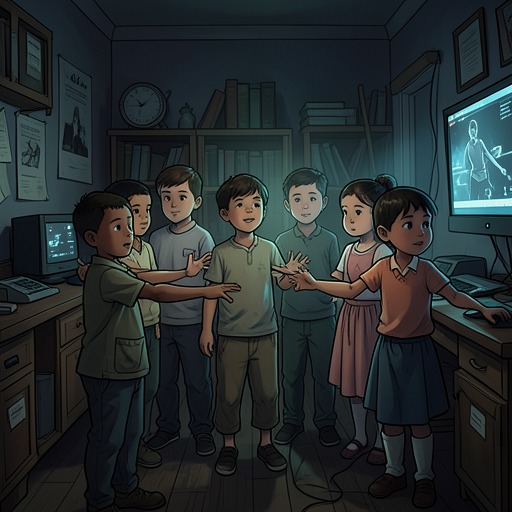
Fredek / Indy had exited the laboratory womb on 4882 PostApoc and was almost fourteen when Bartek encountered him. He belonged to the First Litter, alongside Margo, Diablo, Sierra, and Nurmi. The children had been raised by transformers of the Bull & Bull Alliance and by the digital archives of human culture; the Mothernet and hospital nurse robots supplied the bodily care, feeding them and rocking them to sleep. His formation therefore depended on human cultural records and several kinds of nonhuman caretaker, rather than on an ordinary human family.
That history sits within Bartek’s unresolved doubt about what the children are. He does not believe that the Homo sapiens synthesized and incubated in the First and Second Litters are really human, just as he does not regard transformers as human. The narration immediately qualifies the force of that judgment: there is no way to prove or disprove his theory. Fredek / Indy’s identity is thus presented inside a question the story leaves open, not as evidence that Bartek’s suspicion is correct.
The Name and the First Encounter
His introduction is physical and comic before it is explanatory. A motorcycle fishtails to a halt, and the boy leaps from its saddle. The bike is far too large for him: even with it tipped almost entirely on its side, his feet only just reach the ground. He parks it that way, leaving its tires spinning. The mismatch between the machine and its young rider gives the scene its immediate outline of a child testing the limits of equipment built for someone else.
Bartek introduces him to Dagenskyoll as Fredek. Fredek corrects the introduction: he is Indy, not Fredek. The correction makes the name a small act of self-definition, though the evidence does not explain why he prefers it or whether he has formally changed it. Bartek then displays a caricature of Dr. Jones staring intently at a little television screen. The image connects the boy’s chosen name with the films: he has access to all of them and has just reached Indiana Jones. The scene does not describe him imitating the character’s conduct; it establishes the film series as the source and focus of his enthusiasm.
From Films to Forbidden Games
Later, Fredek / Indy has discovered old game-playing equipment. The Big Nest already offers the children an abundance of entertainment: six huge playrooms filled with Sony and Microsoft consoles, including the latest models from before The Extermination. But that collection no longer satisfies the eldest among them. Indy tells Bartek that he has made a bet with Charlie and asks him not to reveal it, introducing secrecy and peer competition into what might otherwise look like a solitary hobby.
Once hooked on Indiana Jones, Fredek / Indy wants to play every version of Paradise Indy’s archaeological adventures, including the stories made for full VR. The distinction matters: he is not simply seeking more access to games, but a particular kind of immersive experience that the existing consoles cannot provide. The Project Council still prohibits humans from playing VR, so the children organize the experience on their own initiative. His plan is therefore both a continuation of his interest in the films and a response to a rule that places a boundary around human participation in virtual reality.
Bartek approaches amid the evidence of the attempt: dozens of boxes have been torn open, and installation disks are scattered around Indy. He reacts with good-natured skepticism. Indy, meanwhile, is trying to make sense of the apparatus rather than merely collecting it. He turns a rubber skullcap in his fingers, squints at its pictorial instructions, and puts it on askew. Bartek impulsively straightens it. That small adjustment precedes the more consequential help he will give, while the askew cap and the scattered packaging show how far the children’s improvised project has progressed without a capable guide.
The InSoul3 Setup
The obstacle is the instruction manual: Indy pulls the InSoul3 instructions from their packaging and struggles with a volume eight hundred pages long. His frustration leads him to ask Bartek for help. The request changes the scene from a child’s private experiment into a choice for Bartek, who hesitates for a thousand processor ticks. He still has time before his departure, but he reflects that it is no longer his humanity and considers leaving the matter to Frances Rory and Vincent Cho.
Bartek decides to help instead. He tells Indy to sit, installs the neurosoft, calibrates InSoul3, and straightens the cortex reader on the boy’s head before pressing ENTER. The account gives these exact preparations but does not state what the scan or experience produces for Indy; the episode should not be mistaken for proof that he successfully enters VR or completes the game. What it does establish is that Bartek actively enables the setup despite the restriction and his initial hesitation.
Narrative Significance
Fredek / Indy’s scenes connect the book’s questions about constructed humanity to ordinary acts of play. His upbringing combines synthesized human bodies, transformer guardians, machine nursing, and digital cultural inheritance; Bartek’s uncertainty about whether such children count as human hangs over that background without being settled. At the same time, Indy appears not as an abstract test case but as a boy with a chosen name, a secret bet, a towering motorcycle, and a specific desire to inhabit archaeological adventures.
The movement from film to game to InSoul3 hardware gives that desire a concrete progression. First he watches Indiana Jones; later the standard gaming rooms are not enough, and he seeks full VR despite the Project Council’s prohibition. The equipment does not yield a documented outcome in the supplied account, but Bartek’s decision to install and calibrate it marks a clear change in their immediate relation: skepticism gives way to practical assistance. Indy’s episode remains unresolved at the level of consequence, while making visible the pressure between institutional rules, children’s self-directed experimentation, and the adults who can either leave them to struggle or help them cross a technical threshold.