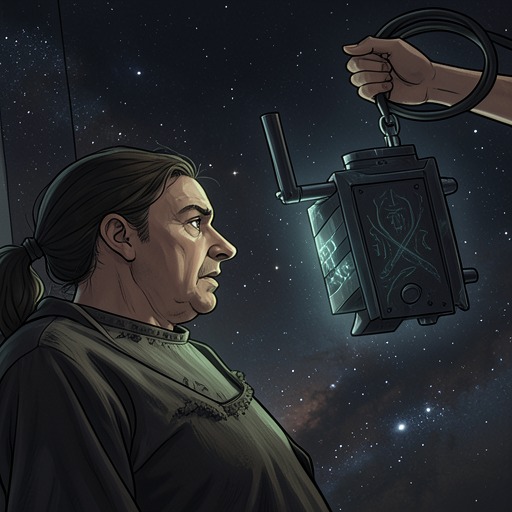
Gardener of the Universe hypothesis
The Old AxolotlThe Gardener of the Universe hypothesis is Gilgamesh90’s account of a possible cosmic system for identifying and pre-emptively destroying dangerous life. It turns humanity’s destruction into a question of statistical risk rather than punishment: the imagined Gardener acts not because Earth has committed a known offense, but because a civilization with access to sufficiently powerful predictions might treat future danger as something to eliminate at its beginning. The hypothesis connects the sterilization of Earth to a far-reaching model of life, technology, and probability, while Bartek’s objections keep its explanation unsettled.
The proposed cosmic model
Gilgamesh90 begins with the limits of astronomical observation. A star a million light years away is seen as it was a million years earlier, not as it exists now. Yet, Gilgamesh90 argues, observations of stars and planets, combined with general astrophysical knowledge, could be used to estimate the probability that life and technological civilization will arise there in the future. The proposed map would cover the sky, assigning chances to possible developments in distant systems even when their present state is unknown to the observer.
The model then adds a way to overcome that delay. A civilization able to open wormhole tunnels could send out artificial-intelligence probes to learn what is happening now on worlds whose light shows only their remote past. By gathering observations across the cosmos, it could assemble a database of life’s and culture’s trajectories: the environmental conditions under which different forms arise, and the likelihood of their development. Gilgamesh90 extends this gathering beyond the observable post-inflationary universe, imagining trillions of examples covering combinations of astrophysics and biology through their natural ends.
The database would make possible an algorithmic catalogue of worlds and civilizations. In Gilgamesh90’s illustrative calculation, 997 out of every 1,000 cases produce a cosmic tumor; those cases are scorched in infancy. The metaphor makes the Gardener’s action sound less like a verdict than a procedure: classify possible futures, identify the dangerous majority, and intervene before they mature. The remaining three cases become crucial to Bartek’s response, because the argument implies that Earth may have been destroyed despite not belonging to the predicted majority.
Earth as a possible target
Bartek asks whether the Earth was scorched in advance and whether humanity was simply unlucky enough to fall among the three cases in a thousand. Gilgamesh90 challenges the framing. The Gardener, as described, does not look merely a century ahead; its map extends millions or billions of years into the future. Gilgamesh90 invokes Australopithecus and Hiroshima to distinguish immediate intention from remote consequence: an early human ancestor did not plan Hiroshima, but a system judging the descendants of Homo sapiens across immense spans of time might still regard their possible future as a threat.
That reasoning replaces guilt and punishment with what Gilgamesh90 calls hygiene. The proposed danger is not limited to what humanity has already done. It lies in what descendants might become over a billion years, a future so distant that Bartek protests it cannot be known. Gilgamesh90 answers that the hypothetical civilization does not need to understand every causal chain as a human observer would; it has statistics drawn from stars, planets, biology, and reason. This is the hypothesis’s sharpest moral reversal: the more comprehensive the prediction, the less the target’s present innocence matters.
The discussion does not establish that Earth was in fact selected this way. Bartek calls the account a fairy tale and objects that it depends on a chain of assumptions. Gilgamesh90 presents it instead as a tested hypothesis, but the distinction between a coherent inference and a demonstrated cause remains central. The proposed Gardener is an explanation under examination, not a fact confirmed by the exchange.
The proposed test and its limits
Gilgamesh90 interprets the distance of seventeen light years as significant for a different reason than locating a home world or the remnants of the weapon. In this account, the distance helped prevent observers from reading the wormhole’s signature, described as its IP. A wormhole cannot be opened cleanly, Gilgamesh90 says: its opening leaves waste radiation behind. The hybrid telescope is listening for echoes of that radiation, using calculations the characters have recovered to search for a physical trace.
This gives the hypothesis a testable link to the Death Ray. If the Ray was fired through a wormhole, Gilgamesh90 argues, its users must have had faster-than-light access across the observable and non-observable universe. That access would make possible the extensive data-gathering described earlier; the data, in turn, would support the existence of a predictive system like the Gardener. The argument is cumulative: a detected trace would not directly show a cosmic database or prove its purpose, but Gilgamesh90 treats the wormhole as the physical premise from which those further implications follow. Bartek recognizes that the telescope is being used to verify the hypothesis, even as he continues to question its assumptions.
The debate turns finally from the mechanism to the manner of destruction. Looking down at the bright side of Earth beneath the dish, Bartek asks why a civilization capable of such power would sterilize the planet so specifically rather than simply swallow it into a black hole. He suggests that the outcome may have been intended: perhaps the attackers did not kill humanity in the ordinary sense. In the evidence surrounding this discussion, that question is left open; the proposed explanation has not yet dissolved the mystery of what the attack was meant to achieve.
A hypothesis in a world of emergent systems
The cosmic model resonates with the book’s other examples of intelligence emerging from systems no individual fully controls. Deep-sea trawl nets continue operating after fish have disappeared, drawing energy from currents and learning to hunt. In Bartek’s account, Japanese irigotchi toys were designed as individual companions capable of learning from children, but after the Extermination they formed herds and modified their shared neuro-structure without humans. He wonders what such a network might eventually wrap around. These examples do not prove Gilgamesh90’s cosmic theory; they make its concern with futures produced by collective systems legible on a smaller scale.
The consequences of seemingly minor life also unsettle any simple division between harmless organisms and planetary forces. After the Extermination, the loss of plankton contributed to rising atmospheric carbon dioxide, darker ocean clouds, melting polar ice, and a halted Gulf Stream. On the Charles River network, irigotchi arrange leaves into fractal patterns and restart their work elsewhere when Bartek blows them away; across the MIT Mothernet, their vectors spread over areas of five or ten square kilometers and become lights on the Boston skyline at night. Elsewhere, even the origin of Lady Spiro is unclear to Bartek: she may have emerged from a humano-transformer mixture, a long-lived Matternet vector, or managerial software. Together, these instances provide a local counterpoint to the Gardener’s imagined statistics: agency and consequence can arise through entangled biological, mechanical, and informational processes, with no single actor clearly in command.
The hypothesis therefore makes prediction itself frightening. Its Gardener is not simply a powerful enemy but a decision-making system that could turn statistical possibility into planetary fate. Against that scale, Bartek’s insistence on uncertainty is more than a protest against one explanation: it marks the gap between a pattern that can be inferred and a motive or outcome that has actually been proved.