Genesis Farm
The Old AxolotlGenesis Farm is a post-Extermination agricultural site where machinery and living systems work side by side, and where ecological recovery can be measured in a first flush of grass, scattered flowers, and trees not yet mature. Its fields and garden give the long work of rebuilding a tangible setting: the Farm is at once a place of cultivation and a landscape still marked by what has failed to grow.
Agricultural machinery and the Farm
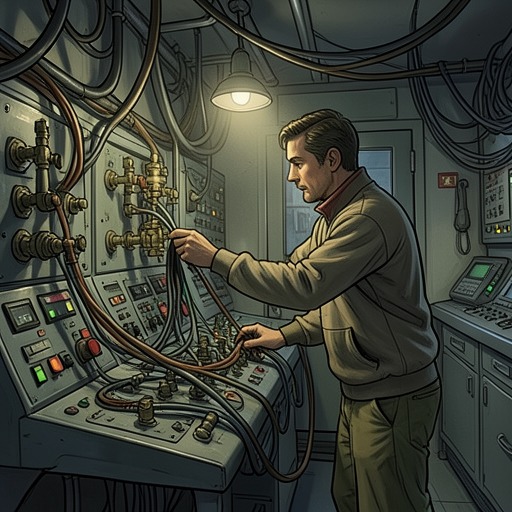
Before The Extermination, corporations invested enormous sums in agronomical mechs intended to replace farmers. At Genesis Farm, that industrial ambition survives in altered circumstances. Bartek works in a specialized Mandrake II-A, a six-legged machine with a praying-mantis profile and batteries of agricultural tools projecting from beneath its casing. He stands upright from the machine and unplugs a USB mustache from its condenser lines, a small, specific image of how the Farm’s labor joins bodily gesture to technical equipment.
The machinery is not presented as a clean break from the past. The mechs were developed by corporations just before the catastrophe, but at the Farm their agricultural capacity serves a landscape undergoing recovery. Bartek also uses an old Miharayasuhiro Star Trooper, parking the Mandrake in a long garage beneath a maintenance hood before emerging in the older machine. The change of equipment places the Farm’s work within a layered mechanical environment rather than a single, uniform system.
Garden, building, and inhabitants
The Farm’s spaces shape who can meet and move through them. Bartek and Dagenskyoll face one another in the garden, using emoted gestures to stage an imagined handshake, beer, table, and chairs. Their exchange takes place in a cultivated outdoor space, but the gestures supply the social furniture: the men stand while emoting themselves into a seated conversation.
When Bartek wants to speak beyond the irigotchi’s hearing, he leads Dagenskyoll through the long garage and up external stairs to the roof of the Farm’s main building. Triangular solar panels mark the rooftop, and the steep steps prevent the irigotchi from following. The constraint is both physical and revealing: the creatures are assembled from many mechanical toys, yet their vector has an instinct for self-preservation and will not willingly disassemble itself to manage the climb. The Farm is therefore not just a backdrop for conversation; its architecture sets the terms of access, privacy, and movement.
The irigotchi also belong to the Farm’s garden in a more unsettled way. Bartek points out a group stealing up from the north side: filthy, mud-caked stuffed-animal figures patched together from dozens of mechanical toys drawn from many pre-Extermination cultures and age categories. Their visible disorder contrasts with the agricultural tools and planned cultivation around them. The garden holds both the deliberate work of growing food and a composite, mobile presence that cannot be reduced to a single toy or identity.
A landscape beginning to recover
From the rooftop, the Star Trooper looks south across tall green grass moving in dark waves. It is the first grass to grow so luxuriantly in twenty-seven years. The account marks recovery not as a completed transformation but as a change that can finally be seen across the fields: after a long interval, the landscape has produced vigorous growth.
Flowers and weeds had succeeded the previous spring. Images downloaded by Bartek from remote cameras showed that wind had carried their seeds across a large part of New England. He still zooms in on each bright fleck amid the monochrome blades of grass. That repeated attention gives small patches of color a distinct place in the Farm’s history: they are evidence that seeds have traveled and taken hold, not merely decoration in a green landscape.
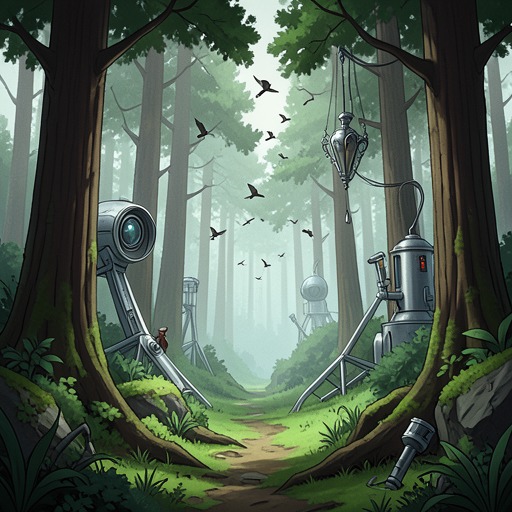
The view also reaches beyond the fields to woods that have stood mummified for a quarter of a century. Bartek identifies their renewal as the Farm’s goal for the current year and the next. First, Vincent Cho is to release fungi and bacteria to decompose the dead trees; then a new forest is to grow on the resulting compost, using digital DNA. The proposed sequence makes the Farm’s environmental work depend on decomposition as well as growth. The dead woods are not bypassed: their remains are the material from which another forest is meant to emerge.
Cultivation, fruit, and human life
The garden’s tree and shrub growth shows how far this recovery remains from its intended result. From the roof, Dagenskyoll surveys adolescent, misshapen trunks of apple, plum, and mulberry, alongside chestnuts, pines, and maples. His judgment that things do not yet seem to be going well sits against the more expansive view of grasses and returning flowers. The contrast distinguishes signs of ecological movement from successful cultivation: new growth is real, but the planted or recovering trees remain puny and irregular.
The fruit house and compost vats extend that contrast into a scene of human embodiment. Bartek leads Dagenskyoll behind the fruit house, beneath the vats, after Fredek / Indy eats an apple. The eating is rendered through the body’s ordinary mechanics—juice on chin and neck, chewing and swallowing, moving jaw and throat, a grimace, and a wiped mouth. Dagenskyoll watches the act at maximum camera zoom, visibly transfixed by an organic Human 2.0 eating living fruit. At Genesis Farm, the apple is not only a crop: it makes bodily life palpable to a mech whose attention fixes on the human act of consuming it.
Significance
Genesis Farm brings technological labor, nonhuman assemblages, and damaged ecology into one bounded landscape. Its machines inherit the corporate project of replacing farmers, but the Farm’s immediate task is not simply mechanized production: it includes decomposition, seed dispersal, soil-making, and waiting for trees to grow. The setting’s strongest evidence of change remains modest and uneven, from flowers caught on remote cameras to fruit eaten by a newly organic human. Its rooftop views place those signs alongside mummified woods and misshapen young trunks, preserving the tension between a promised future forest and the unfinished work visible on the ground.