Horus I
The Old AxolotlHorus I is the mech Bartek pilots through a perilous orbital maneuver after its maneuvering tanks have run dry. Its broad wings collect solar energy, but its survival depends on precise movement: an attempted anchor capture sends it spinning into a radio dish, damaging the machine and awakening mechs stored inside. The damaged Horus I then becomes both Bartek’s means of approach and the vulnerable body through which the dish’s machines assess him.
Identity and Design
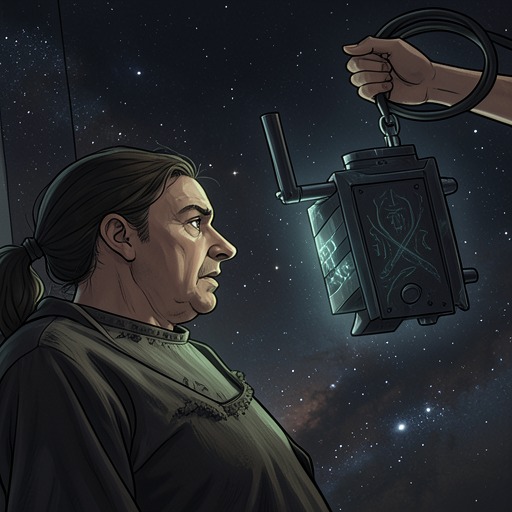
Horus I is presented as a mech with deployable wings, maneuvering tanks, magnets, diagnostic systems, a thermostat, and an arm-mounted launcher capable of firing an anchor line. Its structure includes shins, nozzles, a shoulder, and an arm, all of which become consequential when the machine collides with the dish. Bartek is inside the cooled mech, concentrating and operating its systems; the scene makes the boundary between pilot and machine practical as well as intimate, since survival depends on the mech’s bodily orientation, temperature, and remaining power.
The mech’s black wings give it a distinctive silhouette against the African sunrise. Bartek reflexively tenses his spine to spread them wider, while the wings collect sunlight. The imagery of the wings as both a bodily extension and a solar surface ties Horus I’s motion to the light it can harvest. Its name also recurs among the machines later activated inside the dish: Horus I and Ia mechs are among the models that rise from storage, placing Bartek’s own machine within a larger population of dormant hardware without making the two Horus models identical.
Orbital Maneuver and Collision
At this point Horus I has circled Earth 315 times. It is a lonely, orbiting sphere in a changing orbital field, and Bartek has used the last of its gas for maneuvering. The immediate problem is therefore not simply to move toward the dish, but to find a way for the machine’s trajectory to meet the construct’s without ordinary propellant. If the equations align, one orbit can flow into another; if they do not, Horus I will fall out of its course.
Bartek switches on the diagnostic systems and thermostat, adjusts the solar profile angle, and lets the wings absorb the Sun’s light. Through the zoom, the dish expands into a rough crescent of solar reflections. He starts a countdown and aims Horus I’s right arm. As the graph curves converge, the mech launches into motion, disengages its wing sails, fires an anchor line, and curls into an embryonic ball. The anchor catches the passing construct, but the difference between their orbital vectors sends Horus I into a tight spiral. Before the line has been reeled in a quarter of its length, the mech slams into the dish.
The collision leaves visible, consequential damage: both shins are dented, the right nozzles are crushed, and the right shoulder is crumpled. The right arm can no longer move. Bartek nevertheless maintains his connection, and the narrative notes that several Black Castle satellites and recycled Iridium satellites remain within range. Horus I is thus impaired but not simply discarded; the continuing connection and nearby satellites remain important as he proceeds through the scene.
Inside the Dish
Bartek unhooks the anchor and switches on the mech’s magnets, using them to sling Horus I over the dish’s edge. From there the interior opens around a receiver at the geometric focal point, with multilevel galleries extending along the rim. The shift from exposed orbit to the dish’s shadowed interior changes the maneuver’s stakes: Bartek has reached the structure, but still has to cross its interior to approach the focal point.
His attention is initially fixed on the route. Only when he follows the line with his zoom does he notice movement among the machines packed into the galleries. The stored robots activate together, stretching their limbs and emerging into open space. The impact of Horus I against the construct appears to have sent a shock through its aluminum and titanium skeleton, waking machines that had been switched off and connected to power and conservation sockets. The mech’s collision has therefore altered the scene beyond its own damage: it has disturbed the entire dormant assembly.
Encounter and Halt
Horus I stands on twisted legs and limps along a metal rib toward the focal point. Before it can cross from dazzling light into deep shadow, newly awakened mechs surround it. The group includes Horus I and Ia models, Schmitt 202s, 203s, and 223s, Honda Xs, and an Usaburo Rex whose fuel tanks give it an exaggerated, double-humped profile. The assembly ranges from familiar mech types to a machine described as capable of flying to the Moon and back or destroying an orbital bunker; the dish’s stored population is not a single uniform kind of hardware.
Bartek tries to push off and catch the radio dish at its focal point, soaring over and between the surrounding machines. A Schmitt 203 intercepts him at speed, collides with Horus I, and deflects it back into the dish’s internal shadow, away from the spidery hardware suspended at the hemisphere’s center. Space is silent, so Bartek switches on a slow techno beat after remagnetizing the mech. The music marks his response to the encounter, but does not undo the physical separation from the focal point.
The Google mechs scan Horus I with beams, and Bartek sends honest tags. Their answer is a single short emote: WAIT. The machines then freeze like statues. After fifteen minutes, Bartek lowers Horus I to its lowest energy level, a half-bar above complete deactivation, while sunlight and shadow move across the dish in regular waves. The scene ends with the damaged mech conserving what little energy remains and the newly awakened machines holding their pause; it does not establish what the Google mechs intend or what happens after the wait.
Narrative Significance
Horus I’s predicament turns a technical constraint into the scene’s central tension. With no maneuvering gas left, Bartek must use sunlight, orbital calculations, an anchor, and the dish itself to change course. The resulting collision both injures the machine and triggers the encounter that makes arrival at the focal point impossible for the moment. Its capabilities are real but limited: the wings gather power, the magnets secure it to metal, and the launcher provides reach, yet a small difference in orbital motion becomes an uncontrolled spiral, and damage disables the right arm.
The mech also makes the encounter legible as an exchange between beings through machinery. Bartek remains connected, offers tags, and receives WAIT in response; the machines first surround and deflect him, then stop moving. Horus I’s depleted, damaged body is the immediate medium of that uncertain contact. Its final reduction to near-shutdown leaves the scene suspended between renewed communication and renewed danger, without supplying a resolution the evidence does not show.