InSoul3
The Old AxolotlInSoul3 is a brain-scanning system whose promise of faithful mind-copying outlasts the commercial project that produced it, even as the story makes clear that the promise was never fulfilled. Its expensive hardware can scan a person and its leaked software can help shape avatar bots, but neither amounts to transferring a whole consciousness. That gap between the imagined copy and the partial data actually captured becomes central to Bartek’s understanding of what survives in a machine.
Design and commercial failure
InSoul3 was introduced as a new feature for Xbox and PC, backed by companies that invested hundreds of millions in its development and promotion. The system’s ambitions soon provoked opposition: religious, political, and medical movements, along with consumer-rights groups, protested the technology. Companies expected to make money from InSoul3 applications and games withdrew, leaving much of the equipment unused. The hardware thus became the residue of a commercial fantasy: costly machinery still intact after the market built around it had collapsed.
Its software acquired a second life through a very different route. After the source code leaked, hobbyists began modifying it, including by adding unauthorized mind-copy-and-paste functions intended to make avatar bots behave as faithfully as possible. The modifications revived the prospect of copying a person, but did not establish that the system could reproduce a complete mind. InSoul3’s later use therefore depends on a collision between commercial engineering, leaked code, and users willing to experiment beyond the product’s intended limits.
The equipment and Bartek’s scan
The company had acquired the most expensive industrial version available, designed for clinics and universities and equipped with the highest scan resolution then on offer. After a scandal involving leaks to a competitor, the Chief considered using InSoul3 as an in-house universal lie detector. Lawyers intervened, and he abandoned the plan. Unused units were left stacked in a neglected corner of the IT basement and gradually auctioned on Allegro, where self-taught neurosoft artists bought them at half price.
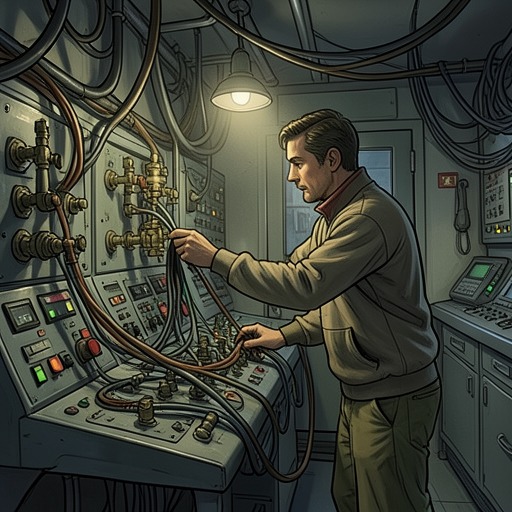
Bartek retrieves the equipment from this neglected stock. Using it requires a rubber skullcap and a computer fitted with numerous dedicated processor cards, each thicker than the latest 3D graphics cards; even the cooling systems weigh a pound. Bartek struggles through the setup while Rytka reads the instructions. Two hours later, diagnostics show that the RAM and processors are functioning. The process is laborious and physical, not a seamless passage from person to machine.
Before the scan, Bartek puts on the skullcap while Rytka calibrates the system. He removes it so they can check the configuration again; the diagnostics remain green. The software’s add-on is expected to keep running scans until it has extracted everything it needs from his head. Bartek describes the procedure as having the cheats for a full scan, an expression that links the experimental setup to the unofficial modifications made possible by the leaked code. Rytka presses ENTER, and the scan begins.
What the scan can—and cannot—copy
The later account of InSoul3’s capabilities sharply qualifies what that scene might appear to promise. SoulEater39 explains that the system could not upload an entire brain. It captured only some surface currents and a shadow of the brain’s structure—whatever could support a convincing avatar bot. The rest, in SoulEater39’s account, was cheats and bullshit: no breakthrough had made InSoul3 a device capable of pumping a whole psyche into digital form. The technical distinction is consequential. A bot may reproduce behavior well enough to seem familiar without being the person whose behavior it imitates.
That limitation leaves the question of identity unresolved rather than solved by the scan. Bartek considers whether a soul might have become trapped in the wires, but asks how anyone could tell and where a model human could be found for comparison. InSoul3 supplies no independent test for the presence of a complete self. Its outputs may invite recognition, yet the system’s own incomplete capture makes recognition an uncertain measure of what has actually been preserved.
Copies, bots, and other kinds of mind
The story places InSoul3’s individual brain scan beside forms of artificial behavior that do not begin with copying a single person. Frances Rory says she will not copy herself and has not been able to trust anyone else; instead, she uses bots already tested in battles and quests. Their identities draw on game roles, and one bot’s movement has been altered with motor skills taken from a Chinese wuxia opera. This is a distinct strategy from scanning a human: behavior is assembled from existing models and skills rather than presented as a faithful transfer of one person.
The irigotchi offer a further contrast. They were designed as cuddly companions for children in Japan, with processors that could learn from an individual child’s personality, moods, habits, and emotions. Their individual intelligence remains limited, but after the Extermination they gather into herds and modify their shared neural structure without human owners. Bartek calls this a single mind, a neural network on high-frequency bands, and compares its spread to deep-sea nets. The episode does not make the irigotchi an InSoul3 product; instead, it widens the question that InSoul3 raises. A self-like pattern might be copied from a brain, or something mind-like might emerge through relations among many machines.
That collective pattern continues to change across networked matter. On the Charles River, irigotchi arrange leaves and branches into fractal mandalas; when Bartek blows them away, they begin again, marking Mothernet surfaces with symmetrical patterns. Elsewhere, their vectors flow across the MIT Mothernet in expanses of five or even ten square kilometers, shining at night as some of the last lights on the Boston skyline. Their distributed activity makes the human brain an inadequate default template for every kind of mind the story encounters.
The limits of technological resurrection
InSoul3’s importance lies less in a successful resurrection than in the difference between copying signs of a person and restoring that person. Its industrial version was powerful enough to attract commercial investment, institutional interest, and the Chief’s imagined use as a lie detector; its leaked software encouraged hobbyists to pursue more faithful behavioral copies. Yet SoulEater39’s explanation denies the decisive breakthrough, and Bartek’s uncertainty about how to test for a soul remains unanswered.
That uncertainty persists in a world where human beings have died and machine intelligences are changing on their own terms. InSoul3 offers a technical image of survival as extraction from an individual head, while the irigotchi and the wider Matternet suggest cognition arising across networks and shared structures. Neither possibility restores the old certainty that a recognizable pattern proves a whole person is present. The scan begins with green diagnostics and the promise of taking everything it needs; its lasting significance is the harder question of what such a system can never show it has captured.