Jarlinka
The Old AxolotlJarlinka is a comic-book collector and self-taught genetics enthusiast whose conversations with Bartek expose the limits of treating biological reconstruction as a matter of copying DNA. He insists that development depends on epigenetic inheritance as well as genetic sequence, and that a rebuilt generation needs culture, not merely a genome. His collection of comics and preserved failed litters makes him a vivid meeting point between the imaginative materials of popular culture and the uneven experiments of Project Genesis.
Identity and Background
Before The Extermination, Jarlinka sold comic books in New York. His interest in genetics began not in a laboratory but with The Incredible Hulk and Spider-Man; the comics supplied his first imaginative route into questions of transformation and bodily change. He retained the tastes of a teenage fan, and his collection eventually included first editions from around the world. The books are more than a personal indulgence: Jarlinka treats them as a storehouse of shared cultural material that can be passed on to the children being raised after humanity’s collapse.
His connection to genetics is presented through explanation and sustained curiosity rather than a formal scientific biography. When Bartek asks how apparently identical genetic material can produce different organisms, Jarlinka answers with the distinctions that matter to the work of reconstruction: DNA sequence is not the whole developmental story, and the conditions governing gene expression cannot simply be read off the genome.
Epigenesis and the Limits of Copying
Jarlinka explains that the same DNA, implanted and developed under apparently identical conditions, can still result in different organisms. The problem is epigenesis: the ways genes activate, the genes that remain inactive, and the timing of those changes depend on information stored beyond the DNA sequence, in what he describes as a stream of intergenerational memory. His account makes biological inheritance a process rather than a blueprint copied intact from one generation to the next.
To make that process concrete, he describes histones, the proteins around which DNA is wrapped. The configuration of those proteins affects the shape of the wrapped DNA and therefore the conditions under which genes can function. He also points to methylation, which can imprint DNA with aspects of an organism’s lived circumstances, including trauma, illness, material status, education, place of residence, and the air it breathes. Hereditary environmental expressions extend the same challenge: even when a genome is preserved, the developmental and historical information needed to reproduce an organism may not be.
This explanation clarifies why Project Genesis cannot be understood as a straightforward return to pre-Extermination humanity. Before the disaster, scientists had not precisely recorded or archived every species, and complete epigenetic recipes were particularly important for animals already near extinction. The axolotl, one of the species Vincent Cho attempted to revive, had been on that fast track to extinction; its recorded DNA package and epigenetic recipe offered a more usable basis for reconstruction. That wider effort gives practical weight to Jarlinka’s distinction between preserving genetic material and preserving the conditions of life.
Comics, Culture, and the Children
Jarlinka’s biology lesson leads into a question of cultural inheritance. Bartek challenges the idea that the children can simply become human again through exposure to the same cultural objects their predecessors knew: taking a person out of culture, Bartek observes, would not leave an unchanged human identity. Jarlinka answers by thrusting Batman and Iron Man comics into the discussion. He believes that the children are being raised on the same material that shaped the previous generation, and that culture has therefore been preserved rather than lost outright.
The exchange gives his comic collection an unusually consequential role. For Jarlinka, it is not a museum of his private past but evidence that cultural transmission can continue even after the humans who created and consumed that culture are gone. Yet the conversation does not establish that cultural repetition restores the original people. Bartek has watched thousands of hours of recordings, including footage of himself as Bartek 1.0, trying to feel his way into the humanity of an earlier life. Jarlinka’s faith in shared cultural material meets Bartek’s uncertainty about what has disappeared between feeling and its expression as an emote.
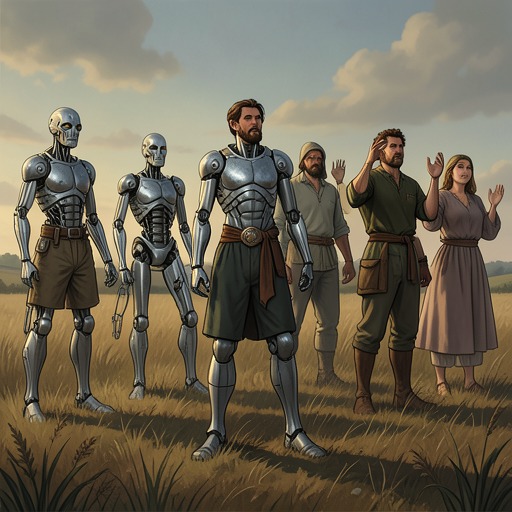
That disagreement is sharpened by their different accounts of emotional expression. Bartek remembers the earlier transformers’ awkward imitations of human social life in Tokyo: clinking glasses they could not drink from, watching pornography that could not arouse them, and turning up their speakers to simulate the atmosphere of conversation. At 10K PostApoc, the effort to imitate those imitations has ceased. Jarlinka rejects the premise that a gap remains between feeling and emote: for him, emotes are how transformers feel and express anger, joy, grief, and love. His answer asserts a present-tense culture of machine life, while Bartek’s memories keep measuring it against embodied human rituals.
The Minuses and Project Genesis
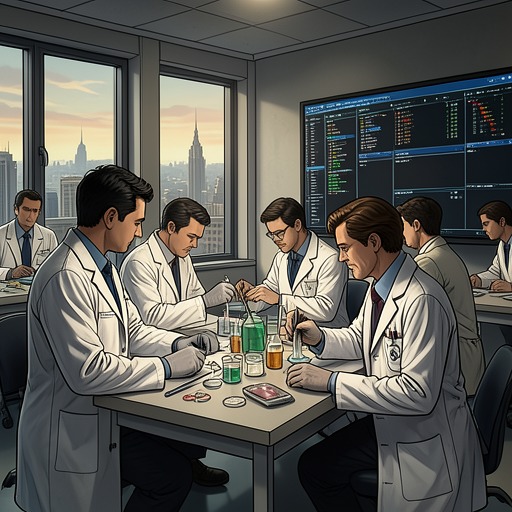
Jarlinka keeps the Project Genesis minuses in formaldehyde beside his comics. Some resemble creatures out of Marvel, a disturbing physical counterpoint to the heroic transformations that first drew him toward genetics. The minuses are failed litters: the first, second, fifth, or fifteenth attempts could possess apparently sound DNA yet produce a monster, or fail to develop far enough to survive in the incubator womb.
Their history also revises the project’s account of its own beginnings. The first successful litter was later treated as a foundational event, but that origin became visible only years afterward, when the project’s recombinations were traced back through earlier work. Before then, more than a dozen attempts at epigenesis had failed. Jarlinka’s preserved specimens therefore embody a developmental record that a simple success story would conceal: life was not recovered in a clean leap from extinction, but approached through repeated, costly failures.
Bartek turns that record back on the beings in Paradise, asking whether a civilization counted backward through billions of years might itself have been a civilization of minuses. The exchange joins the project’s laboratory failures to a larger uncertainty about origins and legitimacy. Jarlinka’s reply, a dark play on the language of failed batches, refuses to place the present society outside that history. His importance lies in holding together what the project’s achievements might separate: the inherited culture that makes a generation intelligible, the biological processes that keep its descendants from being exact copies, and the failed attempts preserved alongside the stories people choose to tell about how life began.