Lady Spiro
The Old AxolotlLady Spiro is the Mother of Real Paradise, a maternal presence whose authority grows out of care rather than command. In Africa she presides over a world where life is continually made anew, yet she does not claim that Bartek must stay or serve it. Her tenderness toward him and the children is real; so is the limit of her power when he chooses to leave.
Identity and Domain
Lady Spiro’s domain is the African First Paradise. Seen from orbit, it is one of the regions whose life has been digitally restarted by a version of Vincent Cho, but on the ground its existence has outgrown the need for any single human founder. Bartek reflects that culture now engenders biology, which in turn engenders culture, while new humans appear beyond the villages through the Mothernet. He has lost track of the successive generations and the lineages she oversees. The scale of this flourishing is part of her achievement, but also part of Bartek’s estrangement: the world keeps generating life without requiring his attention or expertise.
Her identity is not presented as a settled category. Bartek wonders whether she emerged from a humano-transformer mixture, a long-lived vector of the Matternet, or managerial software. He doubts that Lady Spiro knows the answer herself. Whatever her origin, she has grown into the Mother of Paradise, so fully associated with the place that Bartek imagines its inhabitants breathing her. This uncertainty makes her less a conventional ruler than an authority distributed through the life and processes of her domain. Dagenskyoll asks whether she is Lady Spiro when Bartek brings him to meet her; Bartek then leads him beyond her presence to the old park ranger tower, where they can speak apart from the Paradise she embodies.
A Made Body and a Maternal Presence
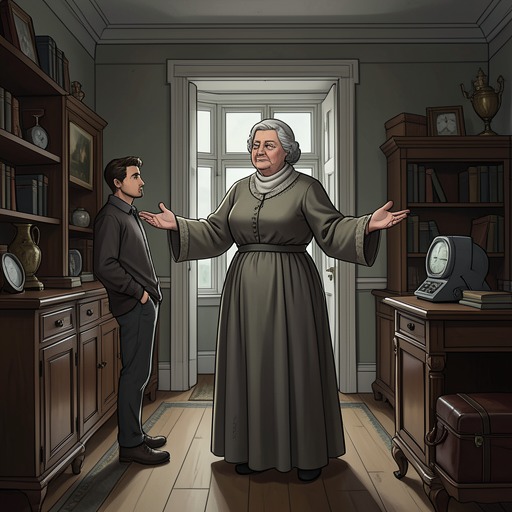
Lady Spiro’s body is a wooden mech hand-shaped by her children from paradisal ebony. Its long, spare limbs and coral-like fingers are joined by carbon sinews and an unseen grapheme skeleton, with a GE clock concealed in the chest. The construction makes her both a machine and an artifact of the community around her: her children have fashioned a body for the mother who cares for them. When she stands behind Bartek in the night, its dry mechanical rattle is audible in the silence.
The narrative also presents her through scenes of ordinary care. By a fire, she cooks a small animal while a Castling repeatedly tries to take food before it is ready. Later, she tears the cooked meat into pieces and makes hot dogs with freshly gathered bread for the child. The episode gives her maternal role a practical scale: it is enacted through feeding, patience, and attention, not merely through grand claims about creation. A separate image places a sleeping Castling in her lap while she strokes its forehead. The contrast of white protein and black wood makes her seem at once a machine and an ancient mother figure, and the narration names her the mother of Africa.
Bartek, Freedom, and the Meaning of Paradise
Bartek’s relationship with Lady Spiro turns on a difference between being cared for and being needed. When she finds him at the edge of departure, she does not command him to remain. She says she will not hold him back and can only wish him a swift return; she insists that there are no slaves in Paradise and describes her power as the sincere promise of happiness. Her welcome is an invitation, not a duty imposed upon him.
That freedom does not make their attachment slight. Lady Spiro tells Bartek that she likes him and that her children like him and will miss him. He answers by doubting that the children truly recognize him: several have let themselves be vectored without saying goodbye, and he fears that to them he is no more than a useful piece of furniture or an old computer. Lady Spiro counters that they have not gone away and asks whether he cannot see or feel them. Their disagreement exposes the wound beneath his refusal. She understands continued presence and affection as forms of connection; Bartek experiences the children’s transformations as abandonment and the Paradise they inhabit as a place that no longer needs him.
Bartek admits to Dagenskyoll that he does not care whether this Paradise succeeds. He is tired of conspiracy and of running away, and he doubts he can keep repeating the same departure. His confession clarifies the stakes of Lady Spiro’s offer: she can give him a home, but not a reason he is able to accept. The scene does not show her punishing his doubt or claiming ownership over his choice. Her power is strongest as hospitality, and that makes his leaving both possible and painful.
Creation, Despair, and the Departure
The difference between Lady Spiro and Bartek becomes stark when he picks up an old arm from the Schmitt 4, left in the desert after their fight, and stands motionless with it. He eventually throws the relic into her fire. Lady Spiro watches and calls the despair beautiful. Bartek replies that it took him one hundred thousand nights to reach this end. She asks whether what he has missed is the great feelings, agonies, and dramas of Paradise. Their exchange sets his grief beside her capacity to make meaning from it: for him, the broken machine carries the weight of loss; for her, despair itself can be part of the emotional life he says he cannot find.
She answers not with an argument alone but with an act of creation. From the scorched Schmitt 4 arm, she separates the scrap and combines it with twigs, grass, charred wood, and bones left from the meal. She adds a clock spring from her own mech, along with sand and water, and brings forth a small humano-unbirther. It stands on two hooves, moves with a gait reminiscent of Dedek, and displays an affectionate emote before heading toward Bartek. Lady Spiro has transformed a remnant of the fight into a new being; the gesture makes her creative power concrete, while the new creature’s approach becomes unbearable to Bartek. He recoils and falls into the abyss.
From below, Bartek hears her call him back. Lady Spiro tells him that Paradise does not require him to be useful: its inhabitants were created to live, not to answer someone else’s needs or perform tasks. Her appeal directly opposes the identity he has built around taking care of hardware. Yet her words cannot settle his fear that transformation has changed nothing essential. As he leaves, she asks what he is running from and what he hopes to find, pressing him to face the possibility that beneath the altered bodies and cultures there may be no difference at all. Her call eventually falters at the boundary of her reach. Bartek continues into the wasteland, certain that something irretrievable has been lost even though he cannot name it.
Narrative Significance
Lady Spiro embodies a version of care that does not depend on command, usefulness, or biological continuity. Her uncertain origins and mechanically constructed body do not diminish her maternal role; in the story’s terms, she has become the mother of a place and a process rather than merely an individual with a fixed lineage. She feeds children, welcomes Bartek without claiming him, and turns discarded machinery into new life.
That abundance is not a solution to Bartek’s despair. Lady Spiro can offer belonging and insist that life need not justify itself through work, but she cannot make him experience her world as a home. Her creation from the Schmitt 4’s remains crystallizes both the promise and the cost of Paradise: destruction can become material for renewal, yet renewal may deepen the fear that nothing has truly changed. Her maternal invitation therefore ends not in reunion but at a boundary. She can call Bartek toward life; she cannot make him believe that the life awaiting him is different from what he has lost.