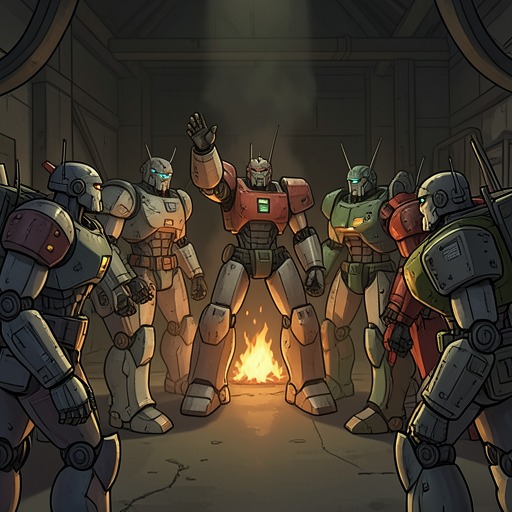
Little Castle
The Old AxolotlLittle Castle is a durable alliance formed after the Black Castle schism and defined by its uncompromising commitment to Heavy Metal. Set against the changing politics of the Patagonia Riders, it represents a fixed ideological position in the conflict over whether civilization should return to biological humanity or accept an irreversible future in hardware. Its eventual defeat is folded into the account of the Second Transformer War as a religious war, though the text does not separately describe Little Castle’s fate after Heavy Metal loses.
Formation and Political Character
Little Castle emerged as a separate alliance after the Black Castle schism. Unlike the Patagonia Riders, which grew by absorbing other guilds and freelancers across South America, Little Castle is characterized not by expansion or internal variety but by the permanence of its allegiance. The contrast makes its identity legible through what it refuses to change: it committed itself to Heavy Metal and, in the account, remained locked into that alignment.
The difference is also a difference in political temperament. The Patagonia Riders, the largest alliance in South America, became numerous and diverse enough that successive member votes could reverse its policies, leading it to adopt opposing strategies in turn. Little Castle stands at the other pole: its choices are presented as fixed rather than revisable. This contrast does not establish that Little Castle had no internal debate; it shows that the alliance’s defining public character is steadfast adherence where its regional counterpart is marked by change.
Heavy Metal and Internal Continuity
Heavy Metal’s doctrine rejects a return to biological life. Its adherents regard the Extermination as an acceleration of an inevitable passage beyond flesh, and condemn Project Genesis 2.0 as a backward turn toward human biology. Little Castle’s lasting commitment to Heavy Metal therefore places it on the side of an explicitly ideological dispute, not merely in a temporary political partnership. Its alignment connects the alliance to a conviction that there can be no return to what its opponents regard as humanity.
The alliance’s continuity is reflected in its leadership: for the last 4K, it had kept the same leader, Anemoza Quatro. The detail sharply distinguishes it from the Patagonia Riders, whose leaders changed more frequently than the oil in their mechs. The text also reports rumors that some Little Castle transformers had transferred themselves entirely onto more powerful mech processors, following the example of Ernesto Iguarte, known as the Seeker of Infinity. This is presented as rumor, not confirmed fact, but it extends the alliance’s image of permanence into the form of its members’ existence: a lasting political allegiance alongside the possibility of binding oneself to a single piece of hardware.
The Patagonia Crisis
Little Castle becomes a direct strategic concern when it aligns with the Patagonia Riders. During a discussion of a possible coalition, Bartek warns that Patagonia has gone with Little Castle and that the opposing side could set drones from Russia and Brazil against them. His proposed response is a pre-emptive bombardment of the Patagonian servers. The warning is part of a debate about a potential attack, not evidence that the bombardment takes place.
The practical limits make the threat more desperate. The ballistic missiles buried in silos have rusted, and an attempt to launch them would, Bartek says, only blow a hole in the ground. The only working option he identifies is an Internal Revenue Service submarine drone, which another participant calls a savage. Persuasion is suggested as an alternative, but Bartek argues that even a present agreement would offer no guarantee against the Heavy Metal faction gaining the upper hand later; he also insists that Little Castle cannot be persuaded. The exchange presents the alliance’s ideological rigidity as a strategic obstacle: it is not simply an ally that might be detached from Patagonia by negotiation, but a committed participant in the larger struggle.
Defeat and Significance
The war’s outcome is compressed into the declaration that Heavy Metal went down, Homo sapiens won the day, and humanity would be made. The next line identifies the Second Transformer War as a religious war. Together, these statements frame the conflict as a contest between rival convictions about what should follow the Extermination: an irrevocable passage beyond biological life, or the reconstruction of humanity. Little Castle’s significance lies in its firm place on the Heavy Metal side of that division.
The account does not state that Little Castle itself was destroyed, dissolved, or persuaded to change its position. Its outcome should therefore not be conflated with Heavy Metal’s defeat. What the ending does establish is that the alliance’s chosen ideological cause loses the immediate contest, while the effort to make humanity proceeds. Little Castle’s fixed identity gives that reversal weight: the political order it represented was steady, but steadfastness could not secure victory for the belief around which it had organized itself.