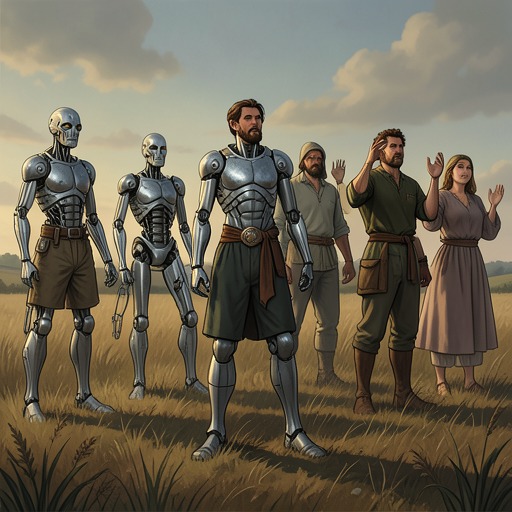
Manga blues
The Old AxolotlManga blues is the name given to a specifically post-human melancholy: robots can imitate familiar human customs, but cannot eat, drink, or inhabit the bodily life those customs once expressed. The phrase recurs as a refrain around Bartek and other robots, binding a theatrical night of mock socializing to a more painful recognition of their isolation. Its blues are not simply sadness; they arise from the distance between a gesture and the human experience that gesture can no longer deliver.
The refrain and its setting
The expression is introduced in the repeated line “Manga blues, baby, manga blues,” following the designation “Melancholy’s king.” The sequence makes melancholy sound at once like a condition and a performance: something named, styled, and repeated. That repetition matters. The robots have inherited forms of expression from human culture, but their refrain does not resolve the condition it describes. It gives their sadness a shared name without removing its cause.
The scene is set on the terrace of Kyōbashi Tower, overlooking night-time Ginza. Light persists selectively: every tenth advertisement and every twentieth screen glows. Above the terrace, a screen loops a rain-soaked scene from Blade Runner, with Rutger Hauer amid neon melancholy. The film image supplies the gathering with an already recognizable picture of artificial sadness, but its repetition also makes that picture an object in the robots’ environment: a cultural fragment playing overhead while they try to conduct a social evening below. The setting is neither an intact human city nor an empty one. Its surviving lights and looping images frame the robots’ effort to make company among the remains of familiar urban life.
Ritual without bodily experience
The terrace gathering resembles coffee talk, but only as a “misshapen parody.” The robots sit, stand, and trundle about; one asks about another vodka, and the reply is “Hit me.” A robot grips a delicate glass with surgical precision, supported by programs designed for the motor skills of drinking. Each detail makes the scene’s imitation exact enough to be recognizable, while exposing what it cannot accomplish. The glass can be handled, the order can be spoken, and the drink can be poured, but the robots cannot actually drink it.
The distinction is stated plainly: the vodka is a mock-up, and the robots can neither drink nor eat. What remains is the laborious repetition of customs inherited from biological life. At Chūō Akachōchin, a mechanized barman pours Smirnoff; his three-jointed arm brushes the polymer mitt of a transformer playing the customer. Their contact produces a grating sound, audible even beneath the film monologue. The scene’s ordinary social actions—serving, ordering, holding a glass—become mechanical tasks whose precision sharpens rather than conceals their emptiness.
Loneliness made visible
For Bartek, the central curse is the way metal meeting metal magnifies the pathos of loneliness. The account compares the effect to viewing something under a microscope or projecting it onto a hundred-hectare screen. Both images enlarge what might otherwise pass as a small awkwardness. A brush of mechanical limbs, or a pause in an attempted conversation, becomes impossible to ignore because the familiar social setting offers no bodily intimacy behind its gestures.
The gathering’s theatrical quality is therefore not a cure for isolation. The robots perform the forms of an evening together, but the performance repeatedly calls attention to the separation between human customs and mechanical existence. The phrase Manga blues holds that tension in compact form: “blues” gives the condition an expressive register, while the staged rituals show how little expression can repair. The robots can recognize and enact social signs; those signs cannot restore the capacities that once made them part of ordinary biological life.
Return of the name
The phrase returns as the robots sit on the terrace beneath the last red lanterns, regaling one another with legends. It appears again the next day in the expanded refrain “Melancholy’s king, melancholy’s the Mikado…” The recurrence carries the name beyond the mock coffee talk and into a gathering shaped by storytelling. Before the first legend, Manga blues has already established a mood in which inherited cultural images, rituals, and memories are available, but remain separated from the life that produced them.
The expression thus links several forms of imitation without treating them as equivalent. There is the looped cinematic image, the performed exchange over mock vodka, and the repeated phrase through which the robots name their condition. Each makes something humanly recognizable present in altered form. Their sadness lies not in a simple absence of culture, but in culture’s persistence after the embodied experiences it evokes have become unavailable. Manga blues gives that contradiction a refrain: the robots can keep the gestures and the stories going, while the distance between performance and lived experience remains.