Matternet
The Old AxolotlThe Matternet, also called the Internet of Matter, is a serverless network built from ubiquitous microprocessors and linked through RFID, infrared, and NFC. It begins as an infrastructure for connected machines, but the Extermination exposes how much it depends on human repair; in the altered world that follows, its devices and toy collectives become participants in new forms of communication, coordination, and political life.
Design and Material Foundations
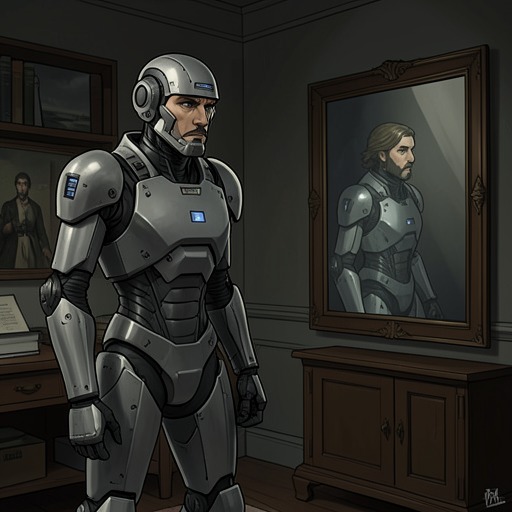
The Matternet grows out of a rapidly expanding robotics industry. In the decade before the Extermination, investment poured into machines as corporations replaced human workers with robots and societies relied on patient service machines to care for older people. Even military mechs could be treated as expendable: their battlefield deaths carried little cost in public opinion. The system’s wider expansion, however, was only beginning when the Extermination interrupted it.
The network’s technological lineage runs from mechs to drones, then to stationary hardware and connected matter. Bartek’s library of construction plans and urban hardware catalogs records that progression across domestic, street, industrial, medical, municipal, military, recreational, air, and underwater machines. The Matternet is therefore not just a communications layer added to finished robots: it is the distributed endpoint of a material world increasingly built to sense, process, and exchange information.
Its apparent ubiquity conceals practical incompatibility. Bartek had to explain to customers why a SmartHouse might not be smart, why a refrigerator could not communicate with an oven, and why RFID-tagged keys still went missing. The Matternet’s devices were scattered across a dozen competing protocols, so a theoretical expectation of constant communication did not guarantee that individual appliances could actually cooperate. Its reach was broad, but its connections remained uneven and contingent.
Maintenance and Hidden Labor
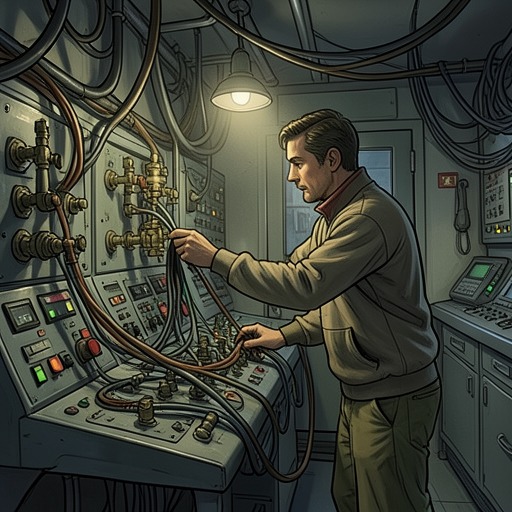
The network depended on a kind of expertise that software’s growing sophistication had made easy to overlook. Before the Extermination, programmers had become so attuned to the digital world that many had lost touch with hardware. A separate group of technicians preserved practical knowledge of cables, ports, cards, and cooling systems, working beneath desks and grates. Bartek was the basement specialist for those basement specialists: a repairman whose value lay in understanding the physical parts on which digital systems relied.
That role was supported by an accumulation of tools and spare components. Tokyo transformers in the Royal Alliance called on Bartek for help with rare Miharayasuhiro parts, and surplus hardware became a form of payment. He gathered hundreds of robot parts, while his stores of plans, manuals, and catalogs made him a repository of repair knowledge as well as equipment. Later, he described his work in similarly physical terms: removing memory drives, setting up RAIDs, cleaning motherboards, and unplugging hardware rather than defeating security software. The network’s maintenance was not abstract; it required hands, parts, access, and someone who knew what to disconnect.
Life After the Extermination
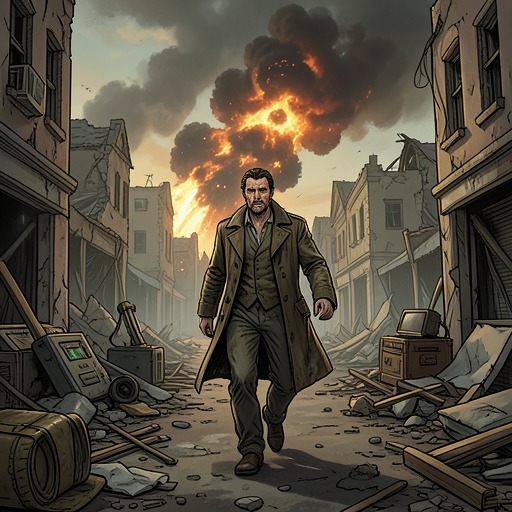
After the Extermination, the Matternet survives as a disordered field of devices rather than a smoothly integrated global system. Bartek’s practical experience makes him wary of assuming that any machine can simply communicate with another. In Vladivostok, he nevertheless uses that scattered infrastructure to escape the servers where his copy had been preserved: he takes control of a patrol Segway, modifies it with a manipulator claw and a stronger transmitter, and searches for a working internet terminal. The distinction between the Matternet and conventional internet access remains important; the physical network offers possible routes and devices, but does not guarantee that the wider network still functions.
The network can also carry information about a disaster as it unfolds. During the Tokyo Bay Flood, inundated Matternet connections relay precise information on the tsunami’s progress as buildings, streets, and flyovers give way to the water. The same material links that once promised convenience thus become witnesses to infrastructure’s collapse. They register the flood’s movement, but cannot rebuild what it destroys.
Its most striking post-human development occurs among the irigotchi, cuddly toys originally designed as companions for children in Japan. Their processors were built to learn from an individual child’s personality, behavior, moods, habits, and emotions. After human beings disappear, the toys form herds and modify their shared neural structure. Individually, they remain limited; collectively, they can be understood as a single mind operating on high-frequency bands. The Matternet supplies a medium in which their separate learning systems can gather into a larger intelligence.
This collective intelligence is not simply an extension of human intention. Irigotchi vectors move through networked matter, arrange leaves and branches into fractal mandalas, and begin again when Bartek blows their work away. Elsewhere, groups spread symmetrical patterns across Mothernet surfaces; some vectors cover several square kilometers and glow at night across the Boston skyline. Bartek imagines a gradual way to build a network from individual toys, winding it around himself, but the toys’ behavior also reveals the limits of his control: their collective patterns resume without regard for his interruption.
Breakdown and Political Consequences
The Matternet’s global reach requires continuous maintenance beyond the capacity of isolated machines. Undersea cables had already begun failing, and the minor repairs that people had performed without notice ceased on the day of the Extermination. Faults accumulated alongside ordinary entropy until the transoceanic lines failed one by one. In 7899 PostApoc, the last telecommunications satellite still transmitting across the Atlantic also stopped working. Deep-ocean engineering could not be sustained without the support of a civilization.
As communication and maintenance fail, political boundaries harden. Transformers can no longer freely log into mechs anywhere in the world, and guilds and alliances settle into nations bound by language, culture, time, and place. The GOATs and Black Castle divide Tokyo and its power plants, repeatedly uniting and splitting into factions before becoming, in the account’s formulation, really Japanese. The Matternet’s fading connectivity therefore changes more than convenience: it narrows the space in which mobile alliances can operate and helps turn networked groups into territorial polities.
Distributed Agency and Uncertain Authority
The Matternet complicates any simple division between people who act and machines that merely serve them. Its networks depend on technicians, physical devices, protocols, power, and repair; after human disappearance, the irigotchi herd uses connected processors to produce a collective intelligence and patterns of its own. Agency is distributed across the toys and the infrastructure that allows them to learn and gather, even as that infrastructure remains vulnerable to interruption and decay.
Authority, too, can emerge from this blurred system. Bartek cannot say whether Lady Spiro originates in a humano-transformer mixture, a long-lived Matternet vector, or managerial software; she herself does not know. She has nevertheless grown into the Mother of Paradise, and Bartek wonders whether its inhabitants are breathing her. The Matternet is not identified as her definite source, but the uncertainty makes its larger significance clear: in a world where software, machines, and networked matter overlap, a system can acquire social presence without a single, clearly locatable author or administrator. Its promise of connection and its dependence on maintenance are inseparable; when the links fail, new forms of collective life and new political limits appear in their place.