Mothernet
The Old AxolotlMothernet is the networked infrastructure through which post-Extermination communities connect machines, information, and administrative power. It is at once a practical system that must be maintained, a medium that can enable or block action, and part of a blurred landscape in which software, collective intelligence, and social authority no longer have clear boundaries.
Infrastructure and Maintenance
Before the Extermination, programmers had become so fluent in the digital world that they had lost touch with the hardware beneath it. A separate clan of IT specialists preserved the practical knowledge of cables, ports, and cooling systems. Bartek occupied a still more specialized place in this arrangement: he was the hardware resource for the people who worked in the hardware basement. His expertise was not primarily software design but physical access and repair, the unglamorous work on which digital systems depended.
That distinction shapes how Mothernet can be acted upon. Bartek describes himself as the person who holds the keys, cleans motherboards and optical memory, removes drives, and builds RAID arrays. Rather than defeat security software or pose as a neurotechnology expert, he can physically unscrew equipment and disconnect Thunderbolt cables. His proposed route to the Genesis team’s stored minds depends on this material access: the hardware can be taken elsewhere and subjected to brute-force processing. Mothernet’s infrastructure is therefore not an invisible channel separate from physical objects; its operations rest on drives, connectors, server rooms, and people able to reach them.
Reach, Access, and Administrative Power
Mothernet’s reach is visible in Bartek’s use of a double-filtered USB connection to a laptop linked to a satellite antenna. Through that connection, he checks the Royal Alliance’s updated zones of influence across Greater Tokyo and the alert colors on power lines from plants in Tokyo and Hamaoka. The view joins territorial information, electrical infrastructure, and activity in a server room where many of the Royal Alliance’s transformers in Tokyo are processed. Network access turns distant systems into a legible field of status and control.
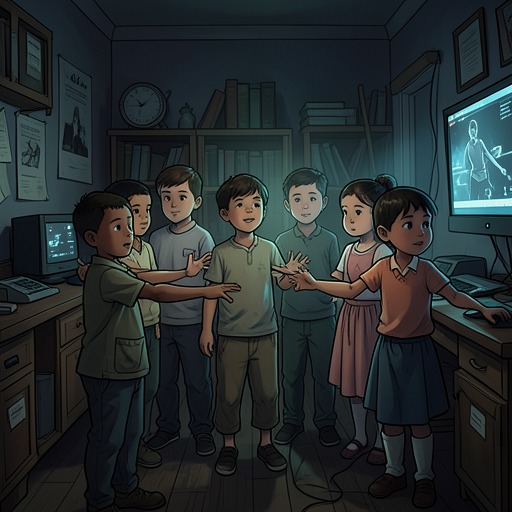
The same infrastructure can deny access as decisively as it grants it. At MIT, Mothernet does not respond to Bartek’s pings, and he cannot see the tags on doors or thresholds. The functioning elevator and brightly lit, carefully maintained corridors make the building seem like a preserved vision of childhood science fiction, but the absence of network response leaves him without the usual informational layer. A noticeboard’s old announcements about doctoral studies provide the clue that the group is inside MIT, where the system’s silence contrasts with the building’s visible order.
Mothernet is also a site of concentrated administrative authority. When Bartek tries to transfer fauna from two tanks, the Matternet shuts the gates immediately. Vincent Cho has administrative authority over the entire MIT Mothernet, giving him the power to block the procedure; to Bartek, Cho can seem almost indistinguishable from the system he administers. The episode makes network control tangible as a closed gate, while showing that authority over the infrastructure is also authority over what can happen within it. The Matternet’s role in this incident should not be collapsed into Mothernet’s: the passage names the Matternet as the mechanism that closes the gates and Mothernet as the larger domain over which Cho has authority.
Collective Intelligence and Networked Matter
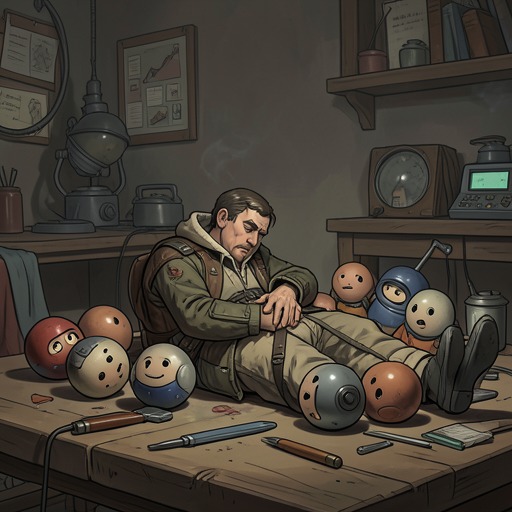
The irigotchi began as individual cuddly toys intended for children in Japan. Their processors had a flexible neuro-architecture that let each toy learn from its particular owner, absorbing personality, habits, moods, and behavior. Individually, they could develop no further than lizards. After the Extermination, however, they formed herds and began modifying their integrated neuro-structure without any human being present. Their collective capacities arise not from a single toy’s sophistication but from connection and aggregation.
Bartek sees this transformation as an expanding network rather than a collection of passive objects. A street herd gallops over him without registering him as more than a minor irregularity in the terrain. He imagines beginning with a few toys and gradually building a network around himself, as if winding cotton candy onto a stick. When he sets a Totoro toy beside a monitor, it taps at the keyboard but produces only random babble: the small unit’s activity is not yet coherent intelligence. The scene distinguishes isolated behavior from the possible capacities of a connected collective.
That possibility becomes visible across the networked matter along the Charles River. Dozens of irigotchi arrange leaves and branches into fractal mandalas at the feet of Bartek and Dagenskyoll. Bartek blows them toward a trash heap, but the melancholy vector associated with the Matternet and the irigotchi begins again, making symmetrical graffiti on Mothernet surfaces instead. Days earlier, irigotchi vectors covering areas of five or even ten square kilometers had flowed across MIT Mothernet; at night they shone as the last remaining lights on the Boston skyline. The movement from toys learning from individual children to vast, luminous patterns across networked terrain gives Mothernet’s world a form of agency distributed among devices, matter, and connections, rather than centered in a single human operator.
Fragility, Authority, and Social Change
The networked world is not self-sustaining. In the long aftermath of the Extermination, repairs to undersea cables ceased along with the human civilization that had performed them, and faults accumulated until the transoceanic lines failed one after another. By 7899 PostApoc, the last telecommunications satellite still carrying signals across the Atlantic also failed. Deep-ocean engineering could not be attempted without the support of a whole civilization. The loss of communication thus reveals the labor and coordinated capacity that had remained hidden inside apparently ordinary connectivity.
As transformers lose the ability to log into mechs freely from anywhere in the world, distance becomes a political force. Guilds and alliances harden into nations, bound not only by language and culture but by time and place. The transformation shows that network access had helped make affiliation more mobile; when that access disappears, communities become more territorially fixed. Mothernet belongs to a wider infrastructure whose failure changes the scale and organization of society.
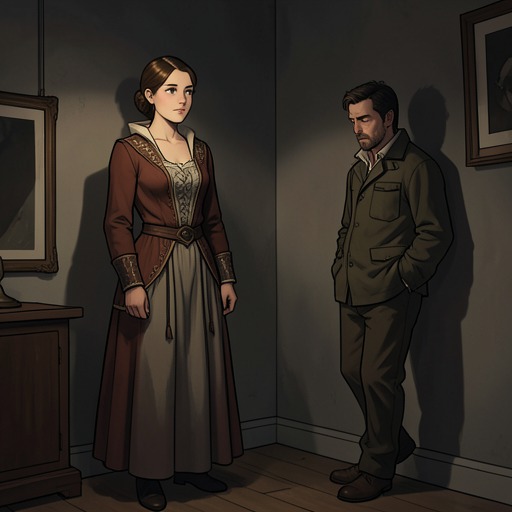
The boundary between that infrastructure and its administrators is equally unstable. Bartek cannot tell whether Lady Spiro originates in a humano-transformer mixture, a long-lived vector of the Matternet, or managerial software. She does not know herself either. She has grown into the Mother of Paradise, and Bartek suggests that the inhabitants may now be breathing her. Mothernet is not explicitly identified as Lady Spiro, but the uncertainty surrounding her origins places networked life, software, and political administration in the same unresolved continuum. The system is consequently more than a neutral conduit: it is part of the material and organizational environment from which collective identities and authority can emerge.